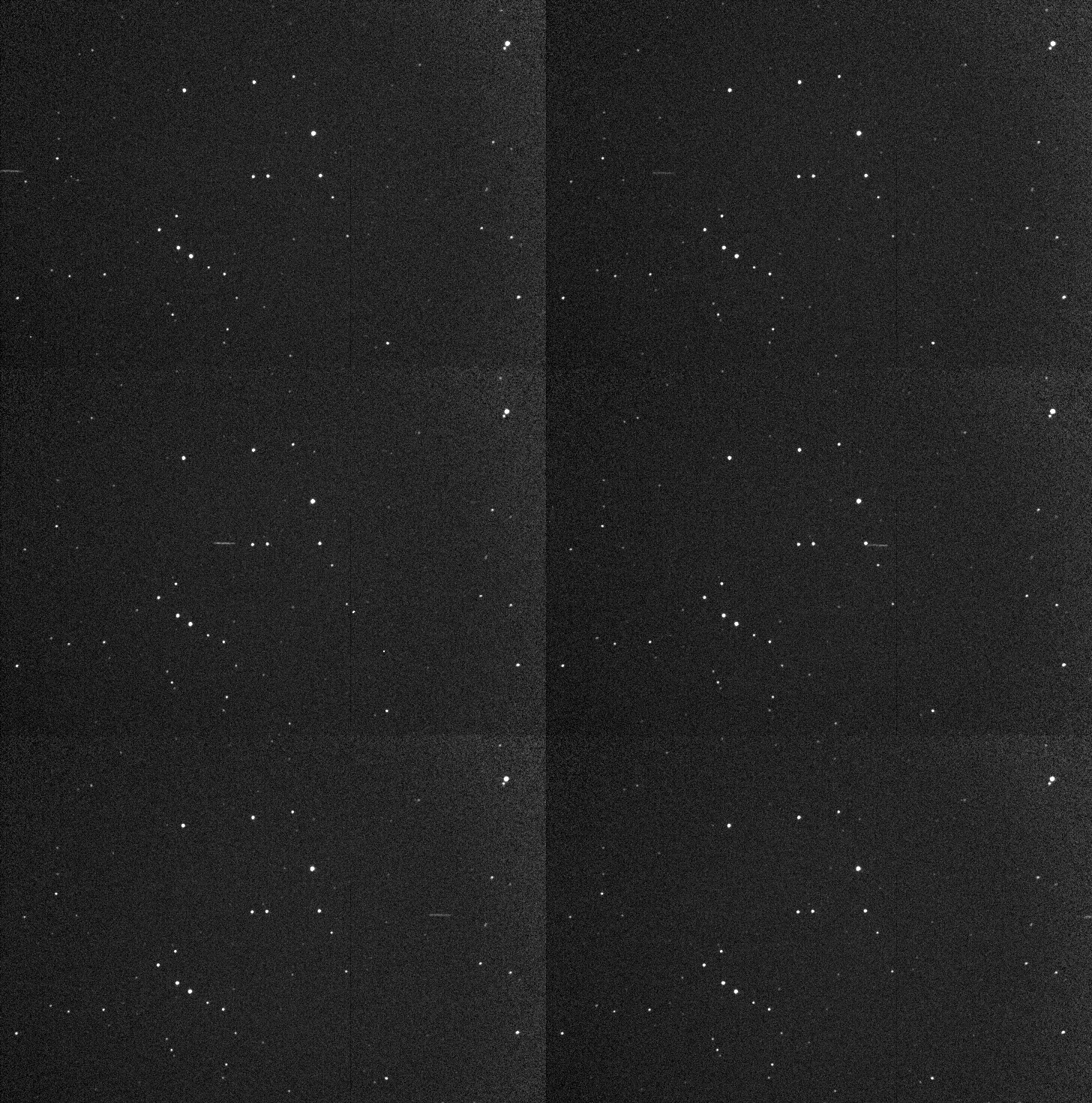
What's 7 billion light years away, equivalent in weight to 800,000,000,000,000 of our Suns and holds hundreds of galaxies? It's the most galaxy cluster ever discovered, that's what.
Astronomers using the South Pole Telescope discovered the behemoth and designated it the rather unspectacular SPT-CL J0546-5345.
Redshift measures how light from a distant object has been stretched by the universe's expansion. Located in the southern constellation Pictor (the Painter), the cluster has a redshift of z=1.07. This puts it at a distance of about 7 billion light-years, meaning we see it as it appeared 7 billion years ago, when the universe was half as old as now and our solar system didn't exist yet.
Well! The last day of the squid fertilization workshop was just as exciting, in its own way, as Sunday's fishing excusion.
The workshop's dozen participants hail from Mexico, Peru, Brazil, USA, Germany, Russia, and Spain. But our passion for cephalopod reproduction is as pure as our backgrounds are diverse. That's right, we are all obsessed with squid sex. So obsessed that we will make ourselves late for lunch with concerns about the chemistry of egg masses, and debate ommastrephid paralarval nutrition well into the night.
Yesterday morning we showed each other videos of egg masses and baby squid. We cooed over Susana's paralarvae and applauded Sakurai's shockingly spherical egg masses.
The smallest entity of life is the single cell, which exists not only as single cell organisms, but as evolution proceeds, as members of a bigger and more complex living organism. During the progression of life, an organism encounters many experiences, and encodes these experiences as memories or knowledge.
A 32-foot asteroid flew between the Earth and the Moon this morning. It was spotted in advance. It did not hit the Earth, but passed about 28,000 miles up. If it had hit the Earth, it would not have done damage. One of this size tends to hit the Earth's atmosphere every 2 years, on average. And, as NASA notes, we get a flyby of this size in the 'tween-Earth-Moon space about once every day.
This particular one passed much closer to Earth than the Moon's distance, and in fact almost to the spacing of our Earth-launched geosynchronos satellites. While the Moon is a hefty 236,000 miles away, geosync is only 26,000 miles away.
A few months ago,
an undercover investigation by the GAO found patients were getting blatantly ridiculous advice from personal genetic profiling services. One representative claimed they could repair DNA damage, one said their supplements could cure all kinds of diseases. The luster is off personalized medicine once companies allow claims to exceed reality.
Mental health clinicians need a new way classify personality disorders. A more scientific and practical method of categorizing disorders could improve treatment, says a new analysis.
The fifth edition of the Diagnostic and Statistical Manual of Mental Disorders (DSM-5) scheduled to come out in 2013, could be a complete train wreck due to inclusion of virtually every personality type as some spectrum of disorder. What is needed is some sanity because the DSM is considered "The Bible" of the U.S. mental health industry and is used by insurance companies as the basis for treatment approval and payment.
In the wake of blackouts across Italy in 2003 and that same year in the US northeast, two recent studies caused
a Congress that has usually been preoccupied with important things like a law that will limit TV commercial volume to berate the energy industry because a military analyst worried that an attack on a small, unimportant part of the U.S. power grid might, like dominoes, bring the whole grid down.
Astronomers are certainly not strangers to manipulating public relations through mass media - they write reasonable papers and then encourage the press to go nuts with it. Witness
the recent arXiv paper by Vogt, Butler, et al on Gliese 581g, should it even exist, which reads
Will Los Angeles go the way of Paris? The City of Angels can learn a lot about public health from the capital of croissants.
Not long ago, I came across a book about the trials and tribulations of a giant city. This city was reeling from a seemingly endless migration of rural peoples from its south. Its traditional family structure was strained - papa and mama both had to work. Most of them had to live in housing close to sources of polluted air. Infectious disease was rampant but largely untreated. Most had known hunger in their lifetimes. Their mothers likely experienced some kind of trauma while pregnant, thus predisposing their children to chronic disease.
What happens to sunscreens when they are exposed to sunlight? They degrade, and how the skin is affected by those degradation products is the subject of research at the University of Gothenburg and Chalmers University of Technology presented at a dermatologist conference in Gothenburg.
Concerns about a hole in the ozone layer and a change in sunbathing habits have brought an increase in the number of cases of skin cancer worldwide. One way of dealing with this has been to advocate sunscreens, though greater use of these products has alsi triggered an increase in contact allergies and photocontact allergies to sun protection products.