Banner
    Gliese 581g - Scientists Find What May Be The First Truly Habitable Exoplanet
    By News Staff | September 29th 2010 04:57 PM | 26 comments | Print | E-mail | Track Comments
    A team of planet hunters has announced the discovery of an Earth-sized planet (three times our mass) orbiting nearby star Gliese 581 at a distance that places it squarely in the middle of the star's 'habitable zone', where liquid water could exist on the planet's surface.

    If confirmed, this would be the most Earth-like exoplanet yet discovered among the nearly 500 known extrasolar planets - and the first strong case for a potentially habitable one.  To astronomers, a 'potentially habitable' planet is one that could sustain life, not necessarily one that humans would consider a nice place to live. Habitability depends on many factors, but liquid water and an atmosphere are among the most important. 

    The paper reports the discovery of two new planets around red dwarf Gliese 581 (GJ 581 HIP 74995), bringing the total number of known planets around Gliese 581 to six, the most yet discovered in a planetary system other than our own.   Like our solar system, the planets around Gliese 581 have nearly circular orbits.
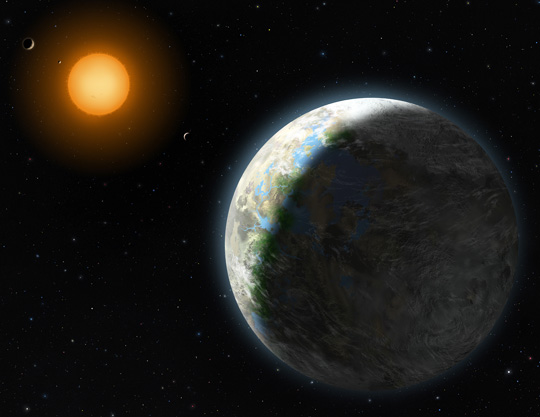
    Gliese 581g
    Gliese 581 is believed to host Gliese 581g, an Earth-size planet that orbits in the star's habitable zone. Artwork by Lynette Cook.

    Gliese 581, located 20 light years away from Earth in the constellation Libra, has a somewhat checkered history of habitable-planet claims. Two previously detected planets in the system lie at the edges of the habitable zone, one on the hot side (planet c) and one on the cold side (planet d). While some astronomers still think planet d may be habitable if it has a thick atmosphere with a strong greenhouse effect to warm it up, others are skeptical. ( For more, see Tidal Effects on the Habitability of Exoplanets: The Case of GJ 581 d).

    The most interesting of the two new planets announced is Gliese 581g, with a mass just over three times that of the Earth and an orbital period of just under 37 days. Its mass indicates that it is probably a rocky planet with a definite surface and that it has enough gravity to hold on to an atmosphere.

    Even more interesting, they write, "If the local stellar neighborhood is a representative sample of the galaxy as a whole, our Milky Way could be teeming with potentially habitable planets."

    "Our findings offer a very compelling case for a potentially habitable planet," said Steven Vogt, professor of astronomy and astrophysics at UC Santa Cruz. "The fact that we were able to detect this planet so quickly and so nearby tells us that planets like this must be really common."

    The findings are based on 11 years of observations at the W. M. Keck Observatory in Hawaii. "Advanced techniques combined with old-fashioned ground-based telescopes continue to lead the exoplanet revolution," said Paul Butler of the Carnegie Institution. "Our ability to find potentially habitable worlds is now limited only by our telescope time.  We had planets on both sides of the habitable zone--one too hot and one too cold--and now we have one in the middle that's just right." 

    Vogt and Butler lead the Lick-Carnegie Exoplanet Survey. 

    The planet is tidally locked to the star, meaning that one side is always facing the star and basking in perpetual daylight, while the side facing away from the star is in perpetual darkness. One effect of this is to stabilize the planet's surface climates, according to Vogt. The most habitable zone on the planet's surface would be the line between shadow and light (known as the "terminator"), with surface temperatures decreasing toward the dark side and increasing toward the light side.

    "Any emerging life forms would have a wide range of stable climates to choose from and to evolve around, depending on their longitude," Vogt said.

    The researchers estimate that the average surface temperature of the planet is between
    -24 and 10 degrees Fahrenheit (-31 to -12 degrees Celsius). Actual temperatures would range from blazing hot on the side facing the star to freezing cold on the dark side.

    If Gliese 581g has a rocky composition similar to the Earth's, its diameter would be about 1.2 to 1.4 times that of the Earth. The surface gravity would be about the same or slightly higher than Earth's, so that a person could easily walk upright on the planet, Vogt said.

    The new findings are based on 11 years of observations of Gliese 581 using the HIRES spectrometer (designed by Vogt) on the Keck I Telescope at the W. M. Keck Observatory in Hawaii. The spectrometer allows precise measurements of a star's radial velocity (its motion along the line of sight from Earth), which can reveal the presence of planets. The gravitational tug of an orbiting planet causes periodic changes in the radial velocity of the host star. Multiple planets induce complex wobbles in the star's motion, and astronomers use sophisticated analyses to detect planets and determine their orbits and masses.

    "It's really hard to detect a planet like this," Vogt said. "Every time we measure the radial velocity, that's an evening on the telescope, and it took more than 200 observations with a precision of about 1.6 meters per second to detect this planet."

    To get that many radial velocity measurements (238 in total), Vogt's team combined their HIRES observations with published data from another group led by the Geneva Observatory (HARPS, the High Accuracy Radial velocity Planetary Search project).

    In addition to the radial velocity observations, coauthors Henry and Williamson made precise night-to-night brightness measurements of the star with one of Tennessee State University's robotic telescopes. "Our brightness measurements verify that the radial velocity variations are caused by the new orbiting planet and not by any process within the star itself," Henry said.

    The researchers also explored the implications of this discovery with respect to the number of stars that are likely to have at least one potentially habitable planet. Given the relatively small number of stars that have been carefully monitored by planet hunters, this discovery has come surprisingly soon.

    "If these are rare, we shouldn't have found one so quickly and so nearby," Vogt said. "The number of systems with potentially habitable planets is probably on the order of 10 or 20 percent, and when you multiply that by the hundreds of billions of stars in the Milky Way, that's a large number. There could be tens of billions of these systems in our galaxy."

    But, they conclude their paper with a cautionary note, "it is important to keep in mind that, though all 6 planets presented here are well-supported by the calculated reduced chi-squared statistics and also by several different variants of FAP statistics, and the entire 6-planet system is consistent with the combined data set from both teams, caution is warranted as most of the signals are small.  And there may yet be unknown systematic errors in either or both data sets."

    Citation: Steven S. Vogt, R. Paul Butler, E. J. Rivera, N. Haghighipour, Gregory W. Henry,
    and Michael H. Williamson, 'The Lick-Carnegie Exoplanet Survey: A 3.1 M Planet in the
    Habitable Zone of the Nearby M3V Star Gliese 581', Astrophysical Journal (in press)  arXiv:1009.5733v1

    Comments

    It's a bugger that light travel is still so far away at the moment...

    "Our findings offer a very compelling case for a potentially habitable planet," said Steven Vogt, professor of astronomy and astrophysics at UC Santa Cruz. "The fact that we were able to detect this planet so quickly and so nearby tells us that planets like this must be really common."

    Uhh, no dude. You have exactly ONE data point, and that is hardly enough to make the claim that "...planets like this must be really common." The discovery of Gliese581g, in and of itself, says absolutely NOTHING about the commonality of similar planets. Ye Gods, I hate it when so-called scientists make asinine statements like this. How did this guy ever get to be a professor at a major university?

    this is because there are a number of exoplanets and systems already discoverd. if there is 1 in 100 then it is plausible to conclude that there is a 1% chance.

    Bonny Bonobo alias Brat
    "Any emerging life forms would have a wide range of stable climates to
    choose from and to evolve around, depending on their longitude," Vogt
    said.
    There would also probably be a problem for emerging life forms having only infra-red light as virtually no ultra-violet light is emitted from the red dwarf star Gliese 581. On Earth plants use energy mainly from the visible spectrum but down under the ocean near hot water gesers there are different energy sources for life, so maybe the same could apply on Gliese 581c?

    Also, according to Wikipedia “In October 2008, members of the networking website Bebo beamed A Message From Earth, a high-power transmission at Gliese 581 c, using the RT-70 radio telescope belonging to the National Space Agency of Ukraine. This transmission is due to arrive in the Gliese 581 system's vicinity by the year 2029; the earliest possible arrival for a response, should there be one, would be in 2049.”

    See http://en.wikipedia.org/wiki/Gliese_581
    Gerhard Adam
    "Any emerging life forms would have a wide range of stable climates to choose from and to evolve around, depending on their longitude," Vogt said.
    Actually if one had "emerging life forms" they'd already be a habitable planet and well down the evolutionary path.  All this speculation begs the question, whether the conditions for life to originate are there.  Since we don't know how life began, then we can't speculate on the conditions necessary for it to occur.

    Discussing the environment in which existing life forms can evolve is meaningless in considering "origin" questions.
    Hank
    What other sites are doing with this is maddening - we'll find ET tomorrow according to many of them - but these guys acknowledge this could be completely wrong.
    First, there is no question begging, habitable (habitability) is well defined depending on context, here it is the stars habitable zone. You are conflating habitability with inhabited. (Which is the source of your question begging.)

    Second, in astrobiology research the environment is _very important_ to elucidate possible pathways. Look up any astrobiology textbook!

    Gerhard Adam
    First, of all there is no "science of astrobiology", since there is no demonstrable biology outside of Earth. 

    In addition, "habitable zone", despite it's optimistic spin, simply means conditions are sufficiently Earth-like so we can speculate that Earth-like organisms that live in such environments here, may be able to do so there.  In the end, we have nothing scientific beyond the fact that this (and other planets) simply have temperature ranges (and a few other factors) that are within the parameters we experience on Earth. 

    The facts are that we are "hoping" that similar conditions may be sufficient to find some trace of life.  Beyond that we know nothing.  Therefore the question remains.  Without knowing enough about how life originates, we can only speculate on "habitable" environments it could adapt to if it exists in the first place.
    We know for definite that life started on earth, so even if don't yet fully understand how life started, looking for similar environments to that of earth is a good starting point in our quest to find extraterrestrial life. We have to assume that nature doesn't only do things like initiate life once to make any sense of looking for extraterrestrial life.

    Gerhard Adam
    The problem is that the environment we have on Earth is not the same as the one in which life originated, so the fundamental premise of looking for environments like the Earth today is flawed.
    Hank
    One thing we do know - we can complain about hype and conjecture in any science but astronomy has to be by far the most flagrant violator.   These findings come out literally every few months and researchers happily roll out the PR machine for every minor discovery.  Which is why ...
    Gliese 581, located 20 light years away from Earth in the constellation Libra, has a somewhat checkered history of habitable-planet claims. 
    ... was putting it nicely.   It's essentially harmless and gets people talking - hey, we carried it here obviously, along with the disclaimers from the article though, no "100% chance of life on another planet" and "Goldilocks planet" nonsense other places did, even though it is tidally locked and basically an inferno on one side and a moonscape on the other - but I wonder if it actually diminishes understanding of science.

    We're the only ones who carried their 'we make some assumptions that could be totally wrong' part of the study, I am sure of that.
    3 times the mass = how much gravity ?

    Even if this planet would have a breathable atmosphere and good temperature; if we cant walk because of gravity then we have to keep looking... But this is great news !

    Under loose assumptions (roughly same density) the gravity goes as the radius. So this planet has ~ 1.4 g gravity, which is feasible even for us non-adapted species. (Probably feels like walking with a heavy backpack.)

    Amateur Astronomer
    The gravity would be about 1.45 Earth gravity based on similar composition and a 11,380 mile diameter. Most healthy Earth people would be able to stand and walk, but for shorter distances than on Earth. Fish would not be inconvenienced much if any, provided there was liquid water of moderate temperature. I covered a topic of this type in one of my books “Habitat Of Red Dwarf Stars” more than 20 years ago. Other people were saying that a habitable world can only be found around G and F class stars. Locked rotation is interesting, because it can lead to permanent cloud cover and constant rain fall at the Equatorial Point. Flares on red dwarfs tend to be just as destructive as on larger stars, but the habitable zone is much closer to the flares of red dwarfs. So cloud cover or a low angle of star light incidence on the horizon might be preferred. Most living plants grow better in red light than they do in yellow light. Green light is reflected and largely ignored, but blue light is harmful and destructive to plant growth. It could be argued that red dwarf stars with cloudy planets in locked rotation are more favorable to life than yellow or green stars. Also the red dwarfs are far more plentiful giving more chances for a favorable climate. Remember that some of the larger red dwarfs have about half as much mass as the sun, but consume their fuel slowly enough to last longer than the age of the universe. If we ever find a more advanced civilization than ours it might well be located on a planet like Gliese 581g.
    My math yields a similar result for 3x the mass of Earth, however it could be heavier than that so I would bet twice as much gravity. It's do-able, but I would definitely avoid the stairs.

    Questions for you:
    1. How common would you suppose tidally locked habitable planets around Red Dwarf stars are?
    2. Would a climate around a tidally locked planet stagnant or stable? why?
    3. Why would there be so many rocky planets around a metal-poor star?
    4. Would 581g experience a lot of tidal flexing and consequent volcanism as with Jupiter's Io?
    5. What is the name of your book and how can I get a copy?

    Aitch
    Tee hee.....more stuff looking for somewhere 'to survive'
    Pity people just don't try liking the planet we presently occupy, instead of seeing it as Hell as is represented elsewhere

    http://www.science20.com/science_20/planning_my_trip_hell_part_1_finding_it

    It may be awhile before humanity actually needs to upsticks and move

    Aitch
    With one hemisphere permanently facing the host star and the other facing away from it, one hemisphere constantly receives energy while the other one constantly radiates energy into space. I would imagine that the resultant energy gradient would result in spectacular storms as energy is transferred from the hot hemisphere to the cold one, implying that the twilight zone between these two extremes, which has been muted as the location for life, would be a pretty violent place. Any thoughts?

    Bonny Bonobo alias Brat
    Wikipedia says that 'planets in the habitable zone of a red dwarf would be so close to the parent star that they would likely be tidally locked. This would mean that one side would be in perpetual daylight and the other in eternal night. This could create enormous temperature variations from one side of the planet to the other. Such conditions would appear to make it difficult for forms of life similar to those on Earth to evolve. And it appears there is a great problem with the atmosphere of such tidally locked planets : the perpetual night zone would be cold enough to freeze the main gases of its atmosphere, leaving the daylight zone nude and dry. On the other hand, recent theories propose that either a thick atmosphere or planetary ocean could potentially circulate heat around such a planet, or life could survive by migration.'
    Aitch
    I suppose what would be needed  would be a nice little nudge from a collision with another lump of rock, creating both a polar spin, and a new moon.....sound familiar?
    .....but didn't we do all this millions of years ago, and create planet Heart?
    ....then some dyslexic historian went and wrote Earth, and here we are.....trying to figure it all out
    Just a mis-placed H, is the key  wink

    Aitch
    Thanks Helen for your response. It's quite a challenge trying to work out what conditions would be like on a planet like this one, especially with so many unknowns like the atmosphere and quantity of water that may be present. Water appears to be fairly common in the universe so that could increase the chances of it's presence on this planet. The variety of habitats that support life on earth is a bit of a pointer to the flexibility of life!

    Yeah, i think that its to far away to determine that the water there is actually water and not some unknown substance to us. also the air. if there is any... may be toxic.

    i think it would be in earths best interest to just send a probe to the planet, of our culture and location and stuff...
    Hope that something finds it. and if it has the brain or the eyes may understand. who knows... they may come for us. in one way or another...

    Following that probe a drip in the patrimonial Oze of that Planet. a Specimen of humanity would be a great change of pace. no point in saving us now. its the future of humanity.
    Because the star is a dwarf, it would never go out. who knows. the planet may strive in billions of years from now...

    I'm bored now.

    Hank
    A probe would take 87,000 years to get there so we're better off just waiting and speculating on the Internet.
    Harvard's Howard K Smith offered his opinion on the possibility of life on Gliese 581g and its importance to us, even if we'll probably never get there.
    http://www.suite101.com/content/astrophysics-gliese-581g-and-the-use-of-...

    Hank
    I've never heard a researcher contend either of two things: (a) their field of research, no matter how esoteric, is not vitally important to the future and; (b) they could get by with less funding.    581g is a blip in a signal so what it can tell us about global warming or how life began from 20,000 light years away is nothing.

    His contention that "It makes a difference to how we see ourselves in the universe. Where and how it all began: these are questions of meaning, as well as of origins" is philosophy and not something taxpayers should be spending $20 billion a year on, right?    Good interview, though.
    Thanks. Dr. Smith was very gracious and very blunt and a little acerbic, which made our exchange a lot of fun.

    What is the circumfrence of this planet???

    Add a comment

    The content of this field is kept private and will not be shown publicly.
    • Allowed HTML tags: <sup> <sub> <a> <em> <strong> <center> <cite><TH><ul> <ol> <li> <dl> <dt> <dd> <img> <br> <p> <blockquote> <strike> <object> <param> <embed> <del> <pre> <b> <i> <table> <tbody> <div> <tr> <td> <h1> <h2> <h3> <h4> <h5> <h6> <hr> <iframe><u><font>
    • Web page addresses and e-mail addresses turn into links automatically.
    CAPTCHA
    If you register, you will never be bothered to prove you are human again. And you get a real editor toolbar to use instead of this HTML thing that wards off spam bots.