The Young People's Development Programme (YPDP) in England, a government-backed youth development pilot program aimed at reducing teenage pregnancies, drunkenness and cannabis use not only didn't reduce teenage pregnancies or drunkenness or marijuana use, it might actually have increased pregnancies, according to research led by Meg Wiggins of the Institute of Education, University of London and Chris Bonell at the London School of Hygiene and Tropical Medicine.
They were commissioned by the Department of Health to carry out an independent evaluation of the YPDP, which was initiated in 2004.
I have pondered writing about the transhumanism movement for a while, and the opportunity has finally landed on my desktop when I read a brief article by Kyle Munkittrick of the Institute for Emerging Ethics&Technologies. The article is in the form of a FAQ expressly addressing the question of whether aging is a moral good, and in it Munkittrick briefly explains and (thinks that he) refutes some of the standard arguments against transhumanism. Let’s take a look.
 Patrick Draper is a graduate student in physics at the University of Chicago and Argonne National Lab. He is a native of Illinois and lives in Hyde Park, Chicago with his wife Karen and parrot Felix, to whom he is grateful for their love, patience, and correcting his sign errors. He is a supporter of the international effort to put a muon collider on Mars, and is waiting for NASA to return his phone calls.
I asked Patrick to write here about his studies on the discovery reach for a MSSM Higgs boson after I saw his paper on the arxiv a month ago, and am now glad I did. Enjoy!
"We understand the relation between houses and walls. But it would be hard to cross the gap between houses and bricks without having enough intermediate concepts such as that of the wall."
(Marvin Minsky, Society of Mind, 1985)
"Problems cannot be solved at the same level of awareness that created them."
(Albert Einstein, 1920)

theorem among many from which is possible to be obtained by analysis of Parcelatories, is the called
Parcelatories' Powers that corresponds to the following statement:
Just what would time travel look like? This question was posed to me by a movie director in L.A.. It turns out there are three parts to this question-- what physics suggests, what movies have done in the past, and what looks good.
The last is up to her and her special effects staff. The middle one-- Hollywood traditions for time travel-- are worth examining to scope out possibilities. I'll then conclude with what I think physics suggests is most likely.
Were I to invent categories for movie time travel effects, I'd create the following:
- techno with lots of lights and whooshing (ala 2001, though that wasn't time travel)
- high speed vehicle (similar to techno, but with speed lines)
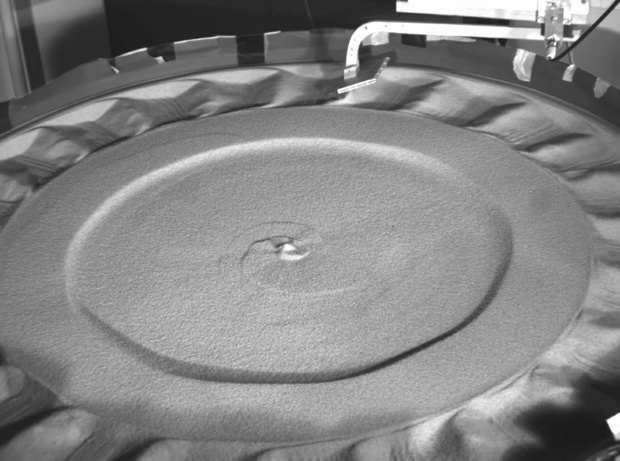
Any road with a loose surface like or gravel or snow can develop ripples that make driving a very shaky experience. A team of physicists from Canada, France and the United Kingdom have recreated this "washboard" phenomenon in the lab with surprising results: ripples appear even when the springy suspension of the car and the rolling shape of the wheel are eliminated. The discovery may smooth the way to designing improved suspension systems that eliminate the bumpy ride.
"The hopping of the wheel over the ripples turns out to be mathematically similar to skipping a stone over water," says University of Toronto physicist, Stephen Morris, a member of the research team.
The Amazon River has been around for 11 million years ago and in its shape for the last 2.4 million years ago, according to a study on two boreholes drilled in proximity of the mouth of the Amazon River by Petrobras, the national oil company of Brazil.
Until recently the Amazon Fan, a sediment column of around 10 kilometres in thickness, proved a hard nut to crack, and scientific drilling expeditions such as Ocean Drilling Program could only reach a fraction of it. Recent exploration efforts by Petrobras lifted the veil, and sedimentological and paleontological analysis on samples from two boreholes, one of which 4.5 kilometres below sea floor, now permit an insight into the history of both Amazon River and Fan.
In the 1980s, a popular hypothesis was that any number of people were suffering from trauma they knew nothing about; dissociative amnesia, or repressed memories.
At issue is how to prove whether memories of trauma, such as childhood sexual abuse, could be repressed and then resurface later in life. Overzealous therapists and willing victims led to any number of false allegations and the resulting damage to families can't be overstated. Even a hint of child abuse is guilt in the minds of many.
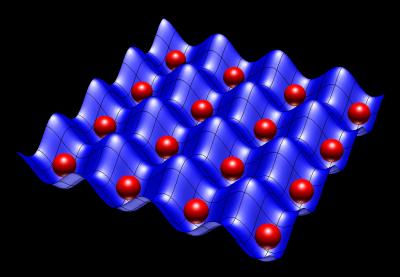
Physicists at the National Institute of Standards and Technology (NIST) have devised a viable way to manipulate a single 'bit' in a quantum processor without disturbing the information stored in its neighbors, using polarized light to create "effective" magnetic fields.
A great challenge in creating a working quantum computer is maintaining control over the carriers of information, the "switches" in a quantum processor while isolating them from the environment. These quantum bits, or "qubits," have the uncanny ability to exist in both "on" and "off" positions simultaneously, giving quantum computers the power to solve problems conventional computers find intractable – such as breaking complex cryptographic codes.
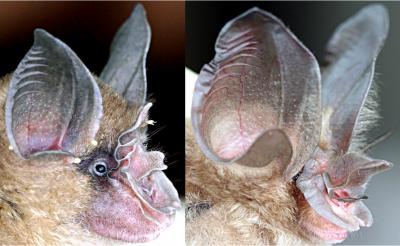
The mystery of a rare bat's unusually large nose has been solved, according to an article in Physical Review Letters.
The adult Bourret's horseshoe bat, known scientifically as the Rhinolophus paradoxolophus meaning paradoxical crest, has a nose roughly 9 millimeters in length but the typical horseshoe bat's nose is half that long, said Rolf Mueller, an associate professor with the Virginia Tech mechanical engineering department and director for the Bio-inspired Technology (BIT) Laboratory in Danville, Va. "This nose is so much larger than anything else," among other bats of the region, he said.