House of Straw
Use six straws to create the classic house shape (a rectangular body with two straws forming the roof, all laying flat on the table). Bet that you can make four equal triangles by moving only three straws. Try it! To all but the most creatively freethinking, this is impossible. The trick is to go 3D—pick up the three straws that make the bottom and sides of the rectangle and replace them so that one end of each straw is rooted in a corner of the triangle with all three moved straws touching above the center of the original triangle, like a tent or teepee—four, equal triangles, each the size of the original roof.
Paper Match
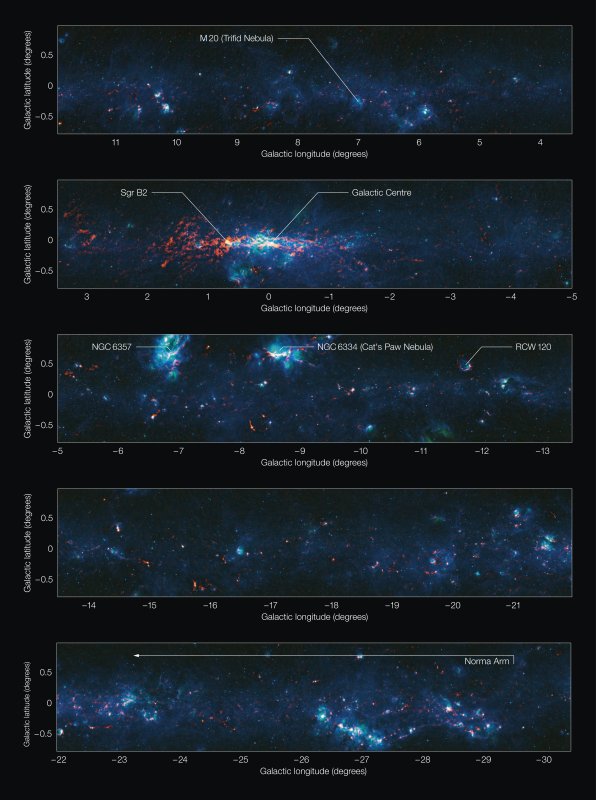
Astronomers have unveiled a new atlas of the inner regions of the Milky Way - that's our home galaxy, if you're from someplace else - and it's peppered with thousands of previously undiscovered dense knots of cold cosmic dust, the potential birthplaces of new stars. Using observations from the APEX telescope in Chile, this survey is the largest map of cold dust so far.
This new guide for astronomers, known as the APEX Telescope Large Area Survey of the Galaxy (ATLASGAL) shows the Milky Way in submillimetre-wavelength light (between infrared light and radio waves. Images of the cosmos at these wavelengths are vital for studying the birthplaces of new stars and the structure of the crowded galactic core.
Do friends wear the same clothes or see the same movies because they have similar tastes, part of the reason they became friends or, once a friendship is established, do individuals influence each other to adopt like behaviors?
Social scientists don't know for sure and are still trying to understand the role social influence plays in the spreading of trends because the real world doesn't keep track of how people acquire new items or preferences.
But the virtual world of "Second Life" does. Researchers from the University of Michigan have tried to use this information to study how "gestures" make their way through this online community. Gestures are code snippets that Second Life avatars must acquire in order to make motions such as dancing, waving or chanting.
For some thousands of years “logic” was viewed as the “theory of inquiry” – “inquiry into inquiry” if you will. This was almost certainly the case with Plato, definitely the case with Aristotle, and by and large true throughout the history of Western thought right up to the revolution in symbolic logic that occurred with Frege, Dedekind and Peano in the late 19th Century. However, with these changes the notion of logic came to be swallowed up by formal and symbolic concerns.
Logic as the theory of inquiry was lost sight of leaving mathematical logic as the sole claimant to the title of “Logic.”
Ecological Niche Modeling is a great tool for conservation biology, phylogeography and evolutionary biology. However, as
Jeff Lozier and colleagues point out in
a paper in the Journal of Biogeography that the models are only as good as the data they are based on.
The basic premise of the ENM approach is to predict the occurrence of species on a landscape from georeferenced site locality data and sets of spatially explicit environmental data layers that are assumed to correlate with the species’ range.
A Science Of Human Language - Part #9
True Math Genius
This trick will bring a smile to the face of even the most hardened math geek. First, lay matches on a table to form the equation I + II + III = IIII (crossed matches make the plus signs and parallel matches make the equals sign). Challenge your opponent to make this statement true by moving only one match and without messing with the sum after the equals sign. The trick is to pick up one match from the II, and lay it across the middle match in the III, making the full equation read:
I + I + I + I =IIII.
Two Glasses II
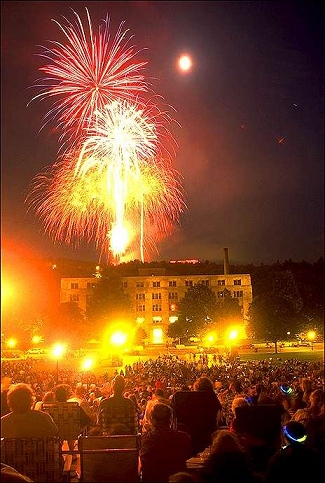
If you're like us, you are eagerly awaiting those July 4 fireworks displays because you get to blow stuff up using science (not just the US, Canada too, though they picked the wrong day by using July 1 for Canada Day celebrations) - if only we could have awesome fireworks yet not ruin the planet.
Maybe we can. A new generation of "green" fireworks is trying to take off. Hint: that's "green" as in environmentally friendly. And take off as in ... oh, never mind.
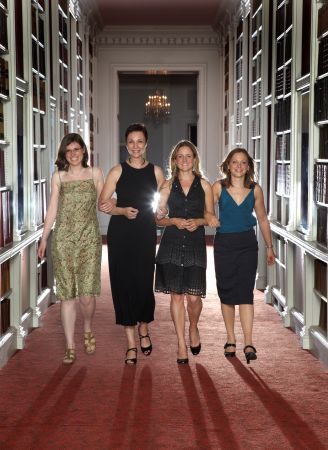
L'Oréal and New Scientist today announced the results of a poll revealing the most inspirational female scientists of all time. Nuclear physicist and chemist Marie Curie topped the poll which was created to celebrate 10 years of the L'Oréal-UNESCO For Women In Science program, with around a quarter (25.1%) of the vote.
Voted for by more than 800 members of the scientific community and visitors to
http://www.NewScientist.com, the poll highlights the absence of modern role models on the list; Astrophysicist Dame Susan Jocelyn Bell Burnell (4.7%), responsible for the discovery of radiopulsars, and Jane Goodall, the primatologist (2.7 per cent) were the only scientists in the top ten to have research published in recent years, polled 4th and 10th, respectively.
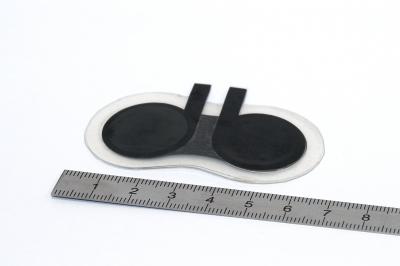
A new printable battery that can be produced cost-effectively on a large scale has been developed by a research team led by Prof. Dr. Reinhard Baumann of the Fraunhofer Research Institution for Electronic Nano Systems ENAS in Chemnitz together with colleagues from TU Chemnitz and Menippos GmbH.
Like your t-shirt, the batteries are printed using a silk-screen method.
They are also different from conventional batteries in that these printable versions weigh less than one gram, are less than a millimeter thick and can even be integrated into bank cards.