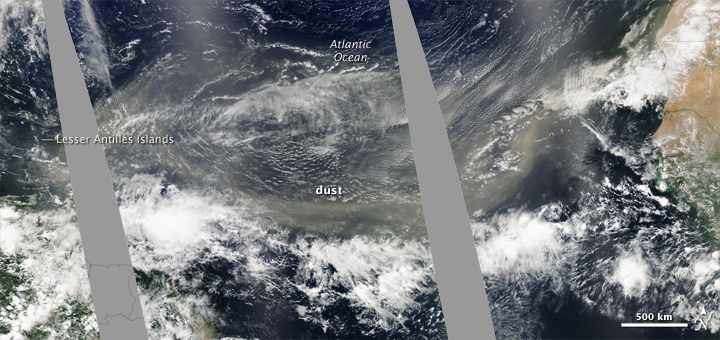
When glaciers advanced over much of the planet's surface during the last ice age, what kept Earth from freezing over entirely? Climate scientists are unsure because popular numerical models indicated that over the past 24 million years geological conditions should have caused carbon dioxide levels in the atmosphere to plummet, possibly leading to runaway "icehouse" conditions - yes, we needed CO2-related global warming, they said - but researchers writing in Nature claims plants are a missing piece of the puzzle.
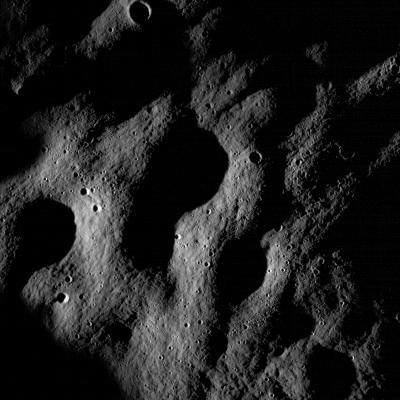
NASA's Lunar Reconnaissance Orbiter has transmitted its first images since reaching the moon on June 23. The spacecraft's two cameras, collectively known as the Lunar Reconnaissance Orbiter Camera, or LROC, were activated June 30. The cameras are working well and have returned images of a region in the lunar highlands south of Mare Nubium (Sea of Clouds).
As the moon rotates beneath LRO, LROC gradually will build up photographic maps of the lunar surface.
Just when you thought evolution couldn't get attacked by anyone else, a zoologist writing in Science and his colleagues are contending that changing winter conditions due to global warming are causing Scotland's wild Soay sheep to get smaller despite the evolutionary benefits of having a large body. Yep, climate change can trump natural selection, it turns out.
So much for adapting to the environment. Too bad Darwin didn't know about CO2.
As a kid, there were few things more satisfying to me that being given a helium balloon... and then almost immediately letting it go for the pure enjoyment of seeing it float out of sight into the sky. For some reason, seeing a small balloon set against a vast blue background gave me a small sense of power simply from knowing that I was the one that put it up there. A silly grin would spread across my face as I stared at the small dot in the sky, knowing that only a minute earlier I held that very same balloon in my own little hand. I felt like a small part of me was launched along with it, and had just started off on a grand adventure. Since I was never able to actually go along for the ride, it was up to the limits of my imagination to envision where the balloon would land.
In
Was Michael Jackson A Pedophile? we dismissed the idea that Michael Jackson was gay and the unlikeliness of his being a clinical pedophile along with being an autogynephile. So what was he?
This is a review of a recent article,
cooperation in Defense against a predator, in the Journal of Theoretical Biology by Jozsef Garay of the Research Group of Theoretical Biology and Ecology of Hungarian Academy of Sciences. Here’s the abstract:
The origin and the evolutionary stability of cooperation between unrelated indivi
The predictably massive postmortem analysis of
Michael Jackson has focused on both his enormous talent and his spectacular strangeness. Although there is lively debate whether Jackson or Elvis Presley is the all time King of Pop, there is no question which of them is the King of Weird.
Elvis Presley had his quirks—secret meetings with Nixon, shooting at television sets, and of course, drug abuse. But these did not compare with Michael Jackson's bizarre physical appearance, abetted by untold plastic surgeries; child-like speech; enjoyment in sleeping with (and perhaps "sleeping with") boys; obsession with Peter Pan; and of course, drug abuse.
On television, police technicians zoom in on a security camera video to read a license plate or capture the face of a hold-up artist but, in real life, enhancing this low-quality video to focus in on important clues hasn't been an easy task.
It just got a little easier. Prof. Leonid Yaroslavsky of Tel Aviv University and colleagues have developed a new video "perfection tool" to help investigators enhance raw video images. Commissioned by a defense-related company to improve what the naked eye cannot see, the tool can be used with live video or with recordings, in color or black-and-white.
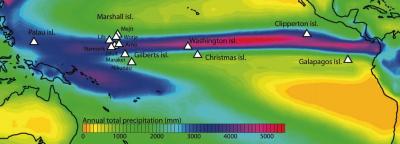
The rain band near the equator that determines the supply of freshwater to nearly a billion people throughout the tropics and subtropics has been creeping north for more than 300 years, according to research published in Nature Geoscience.
If the band continues to migrate at just less than a mile (1.4 kilometers) a year, which is the average for all the years it has been moving north, then some Pacific islands near the equator – even those that currently enjoy abundant rainfall – may be drier within decades and starved of freshwater by midcentury or sooner.
Global warming? Maybe. But if it is, the arid event could happen even sooner than current projections.
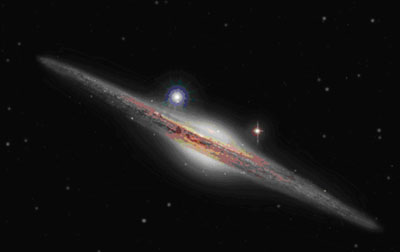
Astronomers using ESA’s XMM-Newton X-ray observatory have discovered a black hole they labeled HLX-1 (Hyper-Luminous X-ray source 1), which lies towards the outskirts of the galaxy ESO 243-49, approximately 290 million light-years from Earth and weighs more than 500 solar masses, making it a 'missing link' between lighter stellar-mass and heavier supermassive black holes. This discovery is the best detection to date of a new class that has long been searched for: intermediate mass black holes.
The discovery has been made by an international team of researchers working with XMM-Newton data, led by Sean Farrell from the Centre d’Etude Spatiale des Rayonnements, now based at the University of Leicester.