Today I visited the 53rd international art exposition at the Biennale di Venezia, which this year is titled "Fare Mondi" (making worlds). I am posting below a few pictures I took of the installations I saw there, for those of you who are not insensitive to contemporary arts. But before I do, let me add a personal note.
D'you dig the Geek Off? Did you email your answers to
geekoff@gmail.com? If not, too late sucka! That is, too late until Monday morning, when we play another round of the feud. Yep, every week there's a Geek Off and every week you can win a free
Geeks' Guide to World Domination: Be Afraid, Beautiful People. Check the quiz Monday, email your answers 'til Friday at midnight EST, then check the answers and fight about corrections starting Saturday
morning.
Here are the answers to last week's geek off:
1. Geek Culture/Ephemera
Faces: Hulk Hogan, Junkyard Dog, Captain Lou Albano, Wendi Richter, Superfly Jimmy Snuka, Hillbilly Jim
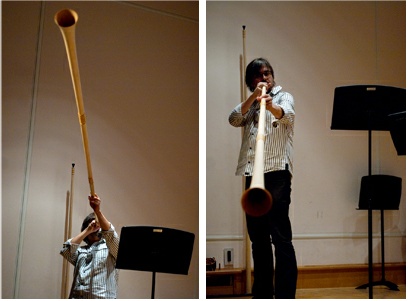
21st century computer modelling software has enabled a long-lost, trumpet-like instrument called the Lituus to be recreated – even though no one alive today has heard, played or even seen a picture of this forgotten instrument - allowing a work by Bach to be performed as the composer may have intended for the first time in nearly 300 years.
Generally acknowledged to be one of the greatest composers of all time, Johann Sebastian Bach was born in the German town of Eisenach in 1685 and produced over 1000 sacred and secular musical compositions. He died in Leipzig in 1750, at the age of 65.
Kin selection is one of those special considerations derived from “selfish gene theory” that postulates that it is the degree of relatedness between organisms that will determine the likelihood that altruistic actions will occur. This also clearly implies the existence of a social group, of some type, so it isn’t expected that it would play a role between members of different species, or among asocial animals (although it could).
In general the idea of “kin selection” is that individuals are more apt to behave altruistically to “blood relatives” than to others in the interest of propagating their genes into future generations. A classic example occurs in eusocial insects where sterile females help maintain the colony for the reproductive queen.
I wrote about
the opening of the World Science Festival 2009 and Edward O. Wilson's 80th birthday at the Lincoln Center in New York City but he was not the only august personage in attendance. Present to give tribute to him was also molecular biologist, Nobel laureate and co-discoverer of the structure of DNA, James Watson.
Fingerprints are essential for crime dramas and look nicely distinct for each of us but what are fingerprints really for?
According to Roland Ennos, from the University of Manchester, other primates and tree-climbing koalas have fingerprints and some South American monkeys have ridged pads on their tree-gripping tails, so everyone presumed that fingerprints are there to help us hang onto objects that we grasp. This theory that fingerprints increase friction between the skin and whatever we grab onto has been around for over 100 years, but no one had directly tested the idea.
From 1958 to 1970 Wladimiro Dorigo, my father, directed a political and cultural magazine called "Questitalia" ("This italy"), where emerging political issues were discussed, and the ongoing transformations of Italian society were dissected by a distinguished group of intellectuals. I own a copy of all the 150 issues of that publication, and every once in a while I pick one of them out of the lot at random, and learn what Italy was 40 or 50 years ago.
Injury of the peripheral nerves, such as the nerves in your arms, is common and often results in a loss of function or sensation. Although these nerves have the capacity to regenerate and reconnect, recovery is often limited to short distances and outcomes remain relatively poor.
With school budgets already sub-par, and the purse strings futher tightened in this current economic state, teachers have to find ways to do more with less. One suggestion, if I may, is to combine chemistry and history. Checking off the list of U.S. presidents while also teaching children about the periodic table is a great way to kill two birds with one stone, and who knows, it may even help retention of each subject.
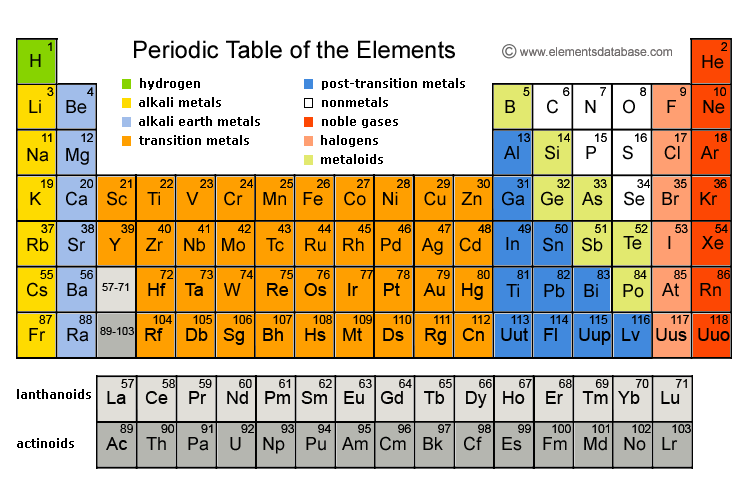
(I use U.S. presidents as one example; you could easily apply the venerable Table to a whole host of subjects.)
Let's start easy.
The idea of the “selfish gene” was intended to shift focus from the organism to the gene to provide a different perspective on natural selection. It was been described as a metaphor, or simply a semantic issue. However, without precision in our use of such words, we risk creating assumptions and assigning values where none exist. This is the same problem that occurs in describing animal behavior when one anthropomorphizes.
“The key question, as we shall see, is how natural selection can produce selfish genes that prescribe unselfishness.”
Bert Hölldobler and Edward.O.Wilson, The Ants