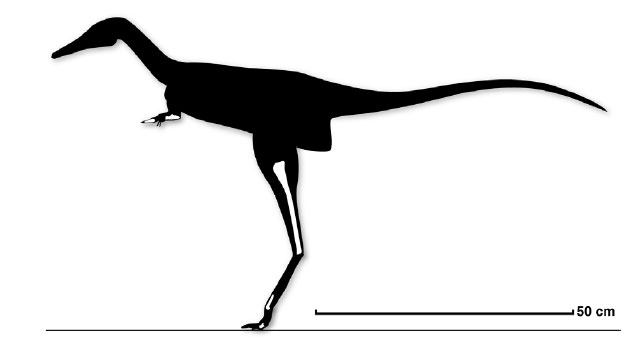









When you think of dinosaurs, you don't often think of critters the size of chickens that ran around the ancient forests of America gobbling up termites but that's just what the smallest dinosaur species found in North America was like, according to University of Calgary researcher Nick Longrich, who analyzed bones found during an excavation near Red Deer, Alberta.

Called Albertonykus borealis, the slender bird-like creature is a new member of the family Alvarezsauridae and is one of only a few such fossils found outside of South America and Asia. In a paper published in Cretaceous Research, Longrich and University of Alberta paleontologist Philip Currie describe the anteater-like specimen and explain how it likely specialized in consuming termites by using its small but powerful forelimbs to tear into logs.

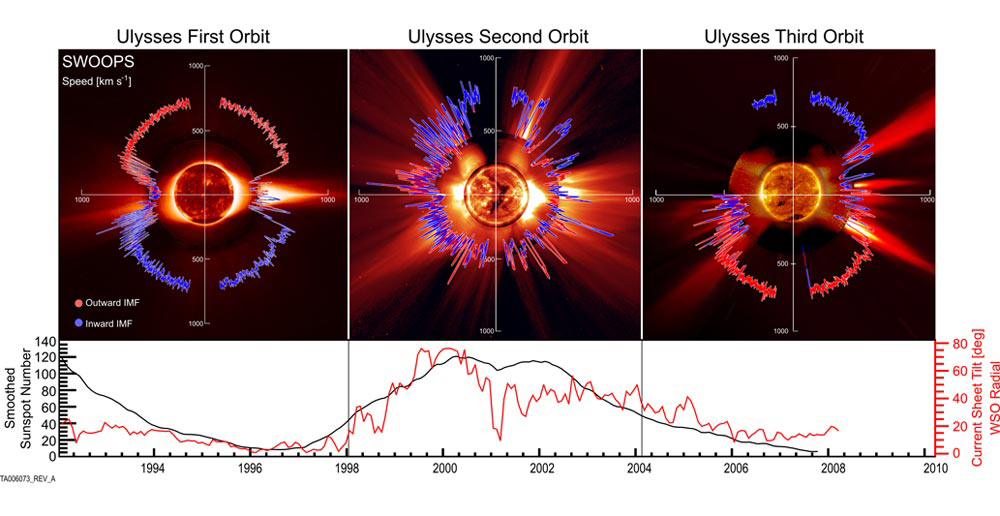
Data from the Ulysses mission show that the Sun has reduced its output of solar wind to the lowest levels since we've had readings and it could reduce the natural shielding that envelops our Solar System.

The Sun's solar wind plasma is a stream of charged particles that are ejected from the upper atmosphere of the Sun. The solar wind interacts with every planetary body in our Solar System. It even defines the border between our Solar System and interstellar space.

This border, called the heliopause, is a bubble-shaped boundary surrounding our Solar System where the solar wind's strength is no longer great enough to push back the wind originating from other stars. The region around the heliopause also acts as a shield for our Solar System, warding off a significant portion of the cosmic rays outside the galaxy.

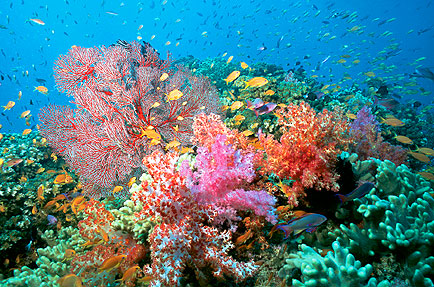
The rise in atmospheric CO2 levels has been a talked-about subject for quite some time, but while scientists and politicians are coming to what they call a “solution,” the impact on marine environments is being ignored.

Proposed emission cuts are aiming to significantly lower the amount of CO2 produced within the United States, but what impact does this value have outside the human world? Scientists say that even the lowest proposed percentages aren’t nearly enough to halt oceanic damage.


CO2 is a soluble gas that is easily absorbed into the ocean’s waters. When CO2 is combined with H2O, the reaction releases what is known as Carbonic Acid, or H2C03. When the carbonic acid is dissolved, it loses a hydrogen ion resulting in HCO3, leaving the H+ ion to move freely. This process is known as ocean acidification and is ultimately responsible for the rise in seawater acidity.

Ghrelin is a peptide, produced mainly in the stomach but also found in the brain, that is known to affect food intake by increasing feelings of hunger and the urge to eat. A new study has examined ghrelin's role in other addictive behaviors and findings indicate that variations in the genes producing ghrelin and its receptor are more common in individuals considered heavy drinkers.

"Previous research had shown that ghrelin levels in blood plasma are altered in addictive behaviours such as alcohol dependence and compulsive overeating," said Jörgen Engel, professor of pharmacology at the Sahlgrenska Academy, University of Gothenburg. "It may be that common mechanisms in the brain underlie different forms of addictive behaviours, including compulsive overeating, pathological gambling and drug dependence."

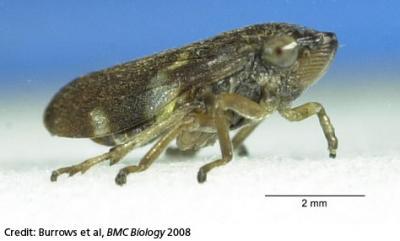
Froghoppers, also known as spittlebugs, are the champion insect jumpers, capable of reaching heights of 700 mm - more than 100 times their own body length. Research published today in BMC Biology reveals that they achieve their prowess by flexing bow-like structures between their hind legs and wings and releasing the energy in one giant leap in a catapult-like action.

Images of the insects flexing and jumping are described in the research carried out by Malcolm Burrows from the University of Cambridge and his colleagues. Burrows' research focused on determining how the energy generated by the insects' muscles is stored before powering a jump.

He said, "A froghopper stores energy by bending a paired bow-shaped part of its internal skeleton called a 'pleural arch' which is a composite structure made of layers of hard cuticle and a rubbery protein called resilin. When the froghopper contracts its muscles to jump, these arches flex like a composite archery bow, and then on recoil catapult it forwards with a force that can be over 400 times its body mass."

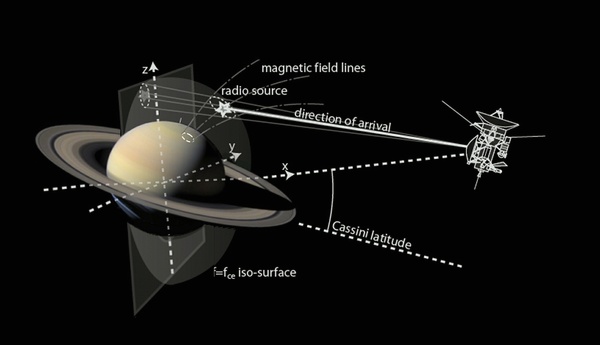
Observations from NASA’s Cassini spacecraft have been used to build, for the first time, a 3-D picture of the sources of intense radio emissions in Saturn’s magnetic field, known as the Saturn Kilometric Radiation (SKR).

Saturn Kilometric Radiation is the most intense component of radio emissions from Saturn. It was discovered by NASA’s Voyager spacecraft in 1980. The radio emissions have frequencies between about 10 kilohertz and 1.2 megahertz. This corresponds to the Long Wave and Medium Wave broadcasting bands.

The results were presented by Dr Baptist Cecconi, of LESIA, Observatoire de Paris, at the European Planetary Science Congress on Tuesday 23rd September.

The SKR radio emissions are generated by high-energy electrons spiralling around magnetic field lines threaded through Saturn’s auroras. Previous Cassini observations have shown that the SKR is closely correlated with the intensity of Saturn’s UV aurora and the pressure of the solar wind.

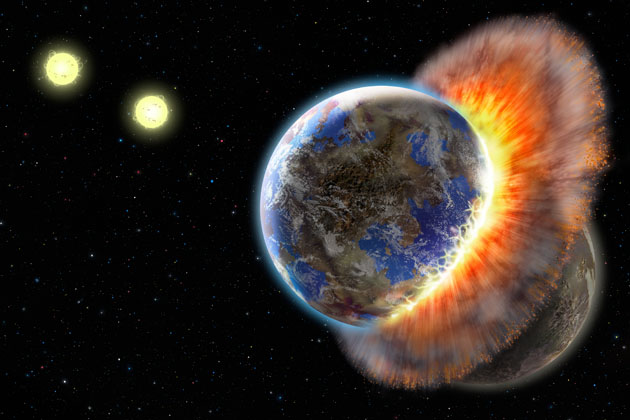
Two terrestrial planets in orbit around a sun-like star, BD +20 307, recently suffered a violent collision, astronomers at University of California Los Angeles, Tennessee State University, and California Institute of Technology will report in a December issue of the Astrophysical Journal, the premier journal of astronomy and astrophysics.

“It’s as if Earth and Venus collided with each other,” said Benjamin Zuckerman, UCLA professor of physics and astronomy and a co-author on the paper. “Astronomers have never seen anything like this before; apparently major, catastrophic, collisions can take place in a fully mature planetary system.”

After several years of detective work, philologists at the University of Stavanger in Norway have collected a unique collection of texts online and they're about to start the most comprehensive analysis of middle English ever.

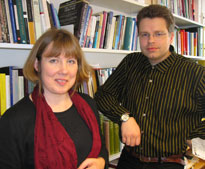
During the last few years, associate professor Merja Stenroos and post doctor Martti Mäkinen at the University of Stavanger have travelled around Britain and read original handwritten leather manuscripts from the 1300s–1500s.

"It is as natural for us in Stavanger to research Middle English as it is for English researchers. None of us have this language as our mother tongue anyway, says Merja Stenroos, who is managing the project titled MEG - Middle English Grammar.

 Merja Stenroos Martti Mäkinen  15th century Book of Hours Folio

Whether young people get drunk as a purposeful behavior or as an unintended consequence depends on what country they live in, according to new research on young people in seven countries. The research finds that young people's views on alcohol and drunkenness were influenced more by culture than by factors such as age and sex.

The research, sponsored by the International Center for Alcohol Policies (ICAP), also finds striking similarities about drinking among young people in different parts of the world including:

A nesting behavior study has detailed some previously unconsidered effects of biodiversity loss and climate change - changing seabird biodiversity is resulting in more ammonia in the atmosphere.

Ammonia emissions from seabirds have been shown to be a significant source of nitrogen in remote coastal ecosystems, contributing to nutrient enrichment (eutrophication) and acidification. While most ammonia emissions originate from domesticated animals such as poultry and pigs, seabirds are the most significant emitters of ammonia to the atmosphere in remote regions.

