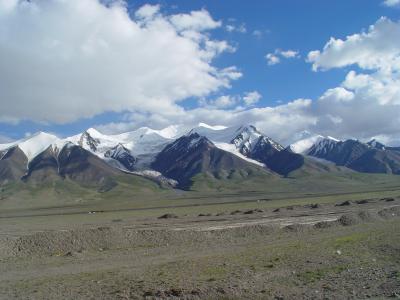
New fossil evidence from the rock desert and cold, treeless steppes of Tibet's desolate Himalayan-Tibetan Plateau that now comprise Earth's highest land mass suggests a literally groundbreaking possibility:

Major tectonic changes on the Tibetan Plateau may have caused it to attain its towering present-day elevations -- rendering it inhospitable to the plants and animals that once thrived there -- as recently as 2-3 million years ago, not millions of years earlier than that, as geologists have generally believed. The new evidence calls into question the validity of methods commonly used by scientists to reconstruct the past elevations of the region.

Benfotiamine, a popular vitamin supplement is being advertised with claims that are demonstrably untrue, as revealed by research published in the open access journal BMC Pharmacology.

Benfotiamine is a synthetic derivative of thiamine (vitamin B1). It is marketed heavily as a dietary supplement using a selection of unsubstantiated, 'not-quite-medical' claims that tend to characterize this field. A large part of this campaign has been built around the belief that benfotiamine is lipid-soluble and, therefore, more physiologically active.

Scientific research led by Dr Lucien Bettendorff of the Center for Cellular and Molecular Neurobiology at the University of Liège, Belgium, has entirely disproved these claims.

The proteins upon which life depends share an attribute with paper airplanes: Unless folded properly, they just won't fly.

But researchers have been puzzled by how the long, linear proteins cranked out by the ribosome factories in a cell are folded into the shapes they must assume to perform their function. They only have known that for many of the most complex and essential proteins, the folding takes place out of sight, hidden in the inner cavity of a type of molecule called a chaperonin.

Now Stanford researchers have begun prying open the lid, literally, on the inner workings of chaperonin molecules by deducing the mechanism by which the lid operates on a barrel-shaped chaperonin called TRiC.

Marine bacteria have the capacity to take up and capture carbon dioxide with the help of sunlight, say researchers at Kalmar University in Sweden in collaboration with colleagues in Spain, Australia, and Russia.

This can be compared to a simple form of photosynthesis, where marine bacteria use energy from sunlight to absorb carbon dioxide. It was previously known that bacteria in oxygen-starved lakes can have this capacity, but it's new knowledge that bacteria in the open seas can do so as well. This challenges earlier knowledge that algae are the only organisms that capture carbon dioxide in the surface water exposed to sunlight. It remains unknown just how much carbon dioxide is captured by these bacteria.

Organic, natural food is all the rage but in some instances it reaffirms why people only lived to be 35 years old.

A comparison of swine raised in antibiotic-free and conventional pork production settings revealed that pigs raised outdoors without antibiotics had higher rates of three food-borne pathogens than did pigs on conventional farms, which remain indoors and receive preventive doses of antimicrobial drugs.

The study was funded by a grant from the National Pork Board so if funding sources lead you to believe that results are biased, stop reading now.

The woolly mammoth was not one large homogenous group, as scientists previously had assumed, and it did not have much genetic diversity, according to a new genetic study.

Woolly mammoths, descended from ancestors in Africa, were widespread in northern Europe, Asia, and North America during the last Ice Age. However, by 11,000 years ago, they all had died out, except for tiny isolated populations that held out for another few thousand years.

The research marks the first time scientists have dissected the structure of an entire population of extinct mammal by using the complete mitochondrial genome -- all the DNA that makes up all the genes found in the mitochondria structures within cells. Data from this study will enable testing of the new hypothesis presented by the team, that there were two groups of woolly mammoth -- a concept that previously had not been recognized from studies of the fossil record.

"The population was split into two groups, then one of the groups died out 45,000 years ago, long before the first humans began to appear in the region," said Stephan C. Schuster, associate professor of biochemistry and molecular biology at Penn State University and a leader of the research team. "This discovery is particularly interesting because it rules out human hunting as a contributing factor, leaving climate change and disease as the most probable causes of extinction."
Sometimes you just get lucky but overconfident CEOs never talk about good luck when things go well, just bad luck when there are problems, according to a paper in the current issue of Management Science.

Whether to engage in mergers and acquisitions is one of the most important decisions top managers make, the authors write. While many of the factors influencing these decisions may be based on objective financial metrics, there is increasing evidence that behavioral biases play an important role in managerial decision making.

Professors Matthew T. Billett and Yiming Qian of the University of Iowa based their results on a sample of public acquisitions between 1985 and 2002. Over this period, U.S. public companies acquired $3.7 trillion worth of other U.S. public companies.

The temperature inside a healthy, photosynthesizing tree leaf is affected less by outside environmental temperature than originally believed, according to new research from biologists at the University of Pennsylvania.

Surveying 39 tree species ranging in location from subtropical to boreal climates, researchers found a nearly constant temperature in tree leaves. These findings provide new understanding of how tree branches and leaves maintain a homeostatic temperature considered ideal for photosynthesis and suggests that plant physiology and ecology are important factors to consider as biologists tap trees to investigate climate change.

Tree photosynthesis, according to the study, most likely occurs when leaf temperatures are about 21°C, with latitude or average growing-season temperature playing little, if any, role. This homeostasis of leaf temperature means that in colder climates leaf temperatures are elevated and in warmer climates tree leaves cool to reach optimal conditions for photosynthesis. Therefore, methods that assume leaf temperature is fixed to ambient air require new consideration.

Rice University computer engineers have created a way to design integrated circuits that can contain many multiple 'selves.'

The chips can assume one identify or a subset of identities at a time, depending on the user's needs. New research shows that multiple "personalities" in an integrated circuit can be even a more powerful security mechanism that can be used for a variety of digital rights management tasks as well as for circuit optimization and customization without sacrificing the related power, delay and area metrics.

The technology is being unveiled today at the Design Automation Conference (DAC) in Anaheim and could be used for enhanced device security, content provisioning, application metering, device optimization and more.

In a bid to control greenhouse gas emissions linked to climate change, the European Union has been operating the world's first system to limit and to trade carbon dioxide. Despite its hasty adoption and somewhat rocky beginning three years ago, the EU "cap-and-trade" system has operated well and has had little or no negative impact on the overall EU economy, according to an MIT analysis.

The MIT results provide both encouragement and guidance to policy makers working to design a carbon dioxide (CO2)-trading scheme for the United States and for the world. A key finding may be that everything does not have to be perfectly in place to start up similar systems.

"This important public policy experiment is not perfect, but it is far more than any other nation or set of nations has done to control greenhouse-gas emissions-and it works surprisingly well," said A. Denny Ellerman, senior lecturer in the MIT Sloan School of Management, who performed the analysis with Paul L. Joskow, the Elizabeth and James Killian Professor in the Department of Economics.