




A carnivorous plant is a delight for people because everyone knows plant don't catch and eat animals - except some do. Like us, they need animals for nutrition.

Do carnivorous plants also sometimes shake off nature and become vegetarians? 

It seems so. The aquatic carnivorous bladderwort, which can be found in many lakes and ponds worldwide, eats little animals but also mixes it up by consuming algae and pollen grains in aquatic habitats where prey animals are rare, and that leads to increased evolutionary fitness if the animals and algae are caught in a well-balanced diet. 

Young children with type 1 diabetes have slower brain growth compared to children without diabetes, finds a new study in Diabetes.

The authors suggest that continued exposure to hyperglycemia, or high blood sugars, may be detrimental to the developing brain. They studied brain development in children ages four to nine years old with
type 1 diabetes
using structural magnetic resonance imaging (MRI) and cognitive tests to determine if abnormal blood glucose levels impact brain structure and function at a young age. Children with
type 1 diabetes
also underwent blood sugar monitoring using continuous glucose sensors. 

A European team is working on the world’s first W-band wireless system -  millimeter wave technology for high speed wireless mobile and fixed point Internet - as part of a £2.8 million TWEETHER project.

Millimeter waves - found in the spectrum between microwaves and infrared waves - are considered the most promising and cost effective solution for the future. The TWEETHER project will result in a powerful and compact transmission hub, based on a traveling wave tube power amplifier and an advanced chipset in a compact terminal, with performance far outweighing any other technology.
Scientists have demonstrated that mobility can be restored in patients with Parkinson's disease, the major degenerative disease of the motor system worldwide. 

The experiments used stem cells to generate dopaminergic nerve cells and reactivate the production of dopamine in the brains of rats with symptoms of shaking palsy or Parkinson's disease. 

Ben Allanach, guest blogger, is a Professor of Theoretical Physics at the University of Cambridge. He is grumpy about the way that public funds are being unnecessarily directed to scientific publishing houses. So I am offering this space to him to hear what he has to say about that...
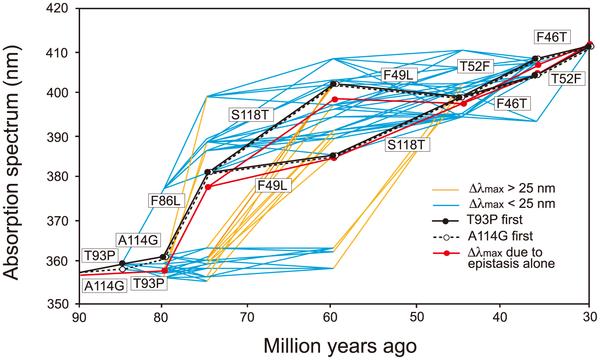


The evolution of trichromatic color vision in humans occurred by first switching from the ability to detect UV light to blue light between 80 and 30 million years ago and then by adding green-sensitivity(between 45-30 million years ago to the preexisting red-sensitivity in the vertebrate ancestor, according to Shozo Yokoyama et al. in PLOS Genetics.

Auroras are the most visible manifestation of the sun's effect on Earth, but many aspects of these spectacular displays are still poorly understood.

One particular type of very high-latitude aurora is known as a theta aurora -- seen from above it looks like the Greek letter theta, an oval with a line crossing through the center -- which sometimes occurs closer to the poles than normal aurora. While the genesis of the auroral oval emissions is reasonably well understood, the origin of the theta aurora has been undetermined.

Predictions about specific effects of climate change were once common - but they turned out to be spectacularly wrong so there are fewer these days. In 2006, former Vice-President Al Gore said by 2016 it would be too late to do anything, while the Intergovernmental Panel on Climate Change (IPCC) said African farmers would be suffering 50% yield drops by 2020 and the Himalayan glaciers would be gone by 2035. 

Today, the IPCC is more scientific and cautions against attributing specific weather events to global warming. They recognize that the public loses confidence in science itself when scientists engage in advocacy. But without reliable metrics, it is hard to know how pressing the issue is so someone has to put in some numbers. 

City folk may not think much of rural living - but they are healthier.

A new study finds that diabetes, once rather uncommon, is now affecting 387 million people worldwide - and 77 percent of it is in developed nations.

The reason is stress, write the authors of a paper in the Journal of Clinical Endocrinology&Metabolism. City life - noise, crime and traffic all lead to higher stress and the body producing more of the stress hormone cortisol. Cortisol can counteract insulin, the hormone that regulates blood sugar, and slow the body's production of it and that makes people more susceptible to diabetes. 

Computers don't really boot up any faster than they have in decades and that is due to limitations in electric currents (and ignoring the bloated software rolled out after every new chip), which are also a significant power drain.

The solution may be on the horizon. A team has created a room-temperature magnetoelectric memory device, equivalent to one computer bit, that could lead to next-generation nonvolatile memory: magnetic switchability, in two steps, with nothing but an electric field. When data can be encoded without current - for example, by an electric field applied across an insulator - it requires much less energy and that means low-power, instant-on computing is a reality.



