





By Simon Redfern, University of Cambridge

How is it that Earth developed an atmosphere that made the development of life possible? A study published in the journal Nature Geoscience links the origins of Earth’s nitrogen-rich atmosphere to the same tectonic forces that drive mountain-building and volcanism on our planet. It goes some way to explaining why, compared to our nearest neighbors, Venus and Mars, Earth’s air is richer in nitrogen.

Thermodiffusion is when a temperature difference establishes a concentration difference in a mixture. Two recent studies build on recent experimental results from the IVIDIL (Influence Vibration on Diffusion in Liquids) research project performed on the International Space Station under microgravity to avoid motion in liquids.

Baron Manfred von Richthofen, the Red Baron, with other members of his unit. Credit: Germany Army.

By Ingrid Sharp, University of Leeds

The idea of a war hero is still strong in the UK and in the other Allied countries.

War memorials are a central feature of the regular commemoration services, Churchill is regularly rolled out in biographical and fictional form, and there are soon to be a total of 888,246 ceramic poppies for 888,246 war heroes adorning the Tower of London.

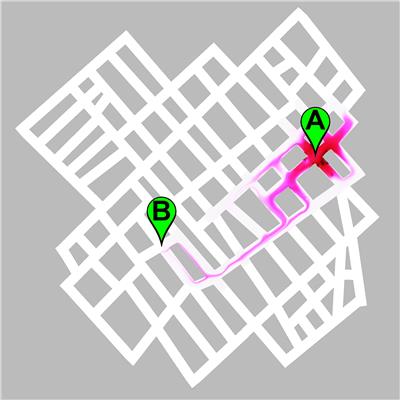
Researchers on an international team recently showed a way to quickly and reliably find the fastest way through a city maze. But rather than using a satellite navigation system, they used chemistry.

It needs a little work before UPS can use it, since the chemical processor was in alkaline liquid, bit it is intriguing proof of concept.

A novel method to test for vitamin B12 deficiency is sensitive enough to work on anyone, including newborn babies and large swaths of the general population. It uses a single drop of blood collected from a finger prick which is then blotted and dried overnight on a card consisting of filter paper.

The dried blood spot card analysis is sensitive enough to measure the amount of methylmalonic acid (MMA), an indicator of a person's B12 level, according to study author Yvonne Lamers of the University of British Columbia. "This minimally invasive approach helps us measure deficiency in an easier and more convenient way, especially in large samples of people. Our method is the first to make dried blood spot analysis sensitive enough to test healthy people for B12 deficiency."

Each year, nearly 600,000 children die from severe, dehydrating diarrhea and millions more are hospitalized. Enterotoxigenic Escherichia coli (ETEC)
may be the first enteric illness encountered by many infants, and it causes several hundred million cases of diarrhea each year, mainly in children.


Country music's soaring popularity in the Northeast isn't so much a novelty as it is a rebirth. Image: US Navy

By Clifford Murphy, University of Maryland, Baltimore County

A team of astronomers recently reported discovering a pulsating star that appears to shine with the energy of 10 million suns. A pulsar is a type of rotating neutron star that emits a bright beam of energy that regularly sweeps past Earth like a lighthouse beacon.

What are the odds finding another one so bright? According to one of the paper's authors, quite good. 

Professor Deepto Chakrabarty of the Kavli Institute for Astrophysics and Space Research at the Massachusetts Institute of Technology says he is optimistic that astronomers will find additional ultra-bright pulsars now that they know such objects exist.


There are four factors to making the perfect cup of coffee. Credit: Andy Ciordia/Flickr, CC BY-NC-ND

By Don Brushett

It’s hard to get a bad coffee these days.

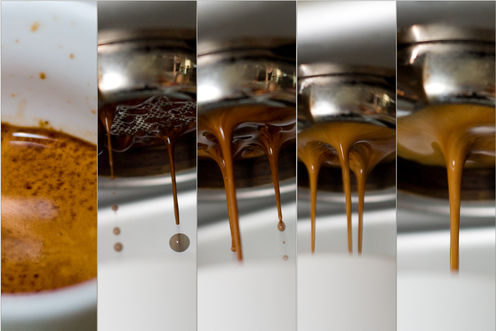
Plenty of baristas have fine-tuned the process of making espresso, but really there are only a handful of variables they can control:

The Large Hadron Collider at the CERN laboratories in Geneva is currently in shutdown, finalizing the upgrades that will allow it to restart next year at the  centre-of-mass energy of 13 TeV - over 60% more than the last 8 TeV run. ATLAS and CMS have collected no more proton-proton collisions since almost two years ago; yet the collaborations are as busy as ever producing physics results from the analysis of the 2012 data.

Rather than focusing on any single result, below I give some highlights of the most recent publications by CMS. Another post will discuss ATLAS results in a few days.


