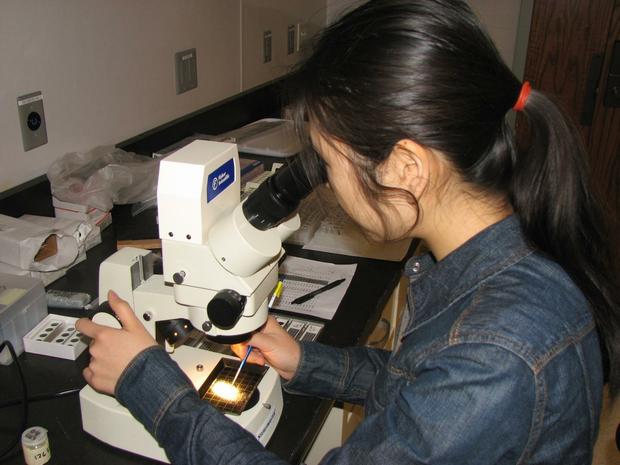







By pairing chemical analyses with micropaleontology, the study of tiny fossilized organisms, researchers believe they can decipher how global marine life was affected by a rapid warming event more than 55 million years ago.  

The work revolves around the Paleocene-Eocene Thermal Maximum (PETM), a well-studied analogue for modern climate warming. Documenting the expansion of OMZs during the PETM is difficult because of the lack of a sensitive, widely applicable indicator of dissolved oxygen.  

Patients with severe psoriasis are more likely to have uncontrolled hypertension, according to a cross-sectional study using information collected from a medical records database, which the authors say provides further evidence of a strong link between psoriasis and hypertension. 

Yesterday the ATLAS collaboration published the results of a new search for dark matter particles produced in association with heavy quarks by proton-proton collisions at the CERN Large Hadron Collider. Not seeing a signal, ATLAS produced very tight upper limits on the cross section for interactions of the tentative dark matter particle with nucleons, which is the common quantity on which dark matter search results are reported. The cross section is in fact directly proportional to the rate at which one would expact to see the hypothetical particle scatter off ordinary matter, which is what one directly looks for in many of today's dark matte search experiments.

The extraordinary synod of bishops on family is meeting for two weeks at the Vatican. Credit: EPA/L'Osservatore Romano

By Timothy Jones, La Trobe University


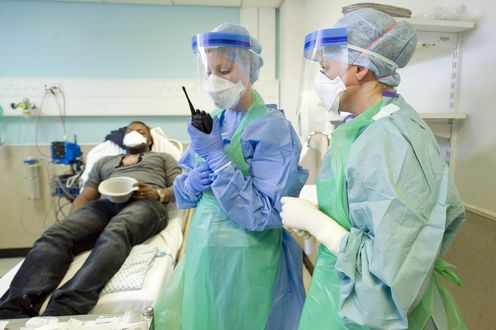
Lab scientists working with Ebola use respirators, while surgical masks are deemed adequate for nurses at the front line. Credit: EPA/Anne-Marie Sanderson/DOH 

By C Raina MacIntyre


Should academics be disciplined by their universities for things said over Twitter? Credit: Opensource.com/ Flickr, CC BY-SA

By Janna Thompson, La Trobe University

Academic freedom has been put in the spotlight with two universities recently coming down hard on academics for comments on social media.

Diversity in medical education used to be simple - more black people, more women - but it is not just a numbers game anymore. 

Instead of focus just on recruiting under-represented students, modern education needs to be about creating an optimal learning environment, where people with different ideas, cultures, opinions, and experiences feel comfortable amongst each other and part of a larger dialogue to come together to solve tomorrow's health care problems, says
Mark A. Attiah, a medical student pursuing both a Master's in translational research and bioethics
at the University of Pennsylvania.

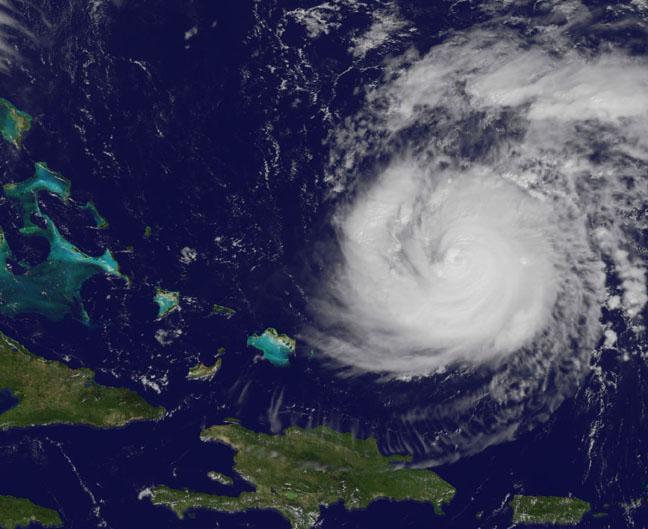
Though the continental United States hasn't had a major hurricane in almost 10 years, the rest of the world hasn't been so lucky. Japan just had a typhoon, India a cyclone, and, with Gonzalo, Bermuda is about to have its first major Atlantic hurricane in three years.

Hurricane Gonzalo has made the jump to major hurricane status and on
October
15th was a Category 4 storm on the Saffir-Simpson Hurricane Scale. NOAA's GOES-East satellite provided imagery of the storm. According to the National Hurricane Center, Gonzalo is the first category 4 hurricane in the Atlantic basin since Ophelia in 2011.

Having children young and a dysfunctional romantic relationship are the two most frequently cited reasons when low-income mothers are asked about why they find themselves in poverty, say sociology scholars Kristin Mickelson of the School of Social and Behavioral Sciences at Arizona State University, and Emily Hazlett of Kent State University in Sex Roles.

They believe that how a woman answers the question of "why me?" when thinking about her own impoverished state influences her mental health and that such answers can also provide clues to whether the woman believes she will ever rise out of poverty. 

They concluded this after analysis of a set of close-ended questions that were put to a community sample of 66 low-income mothers. 

The Miocene climatic optimum, was a period from about 15 to 17 million years ago and it had wild swings in temperature, the amount of continental ice on the planet and CO2 levels.

Historically, CO2 had inconsistent relationships to temperature. When levels were 10X higher than they are now, the temperature was 2 degrees higher. What has been lacking is a solid relationship between them outside the last few decades and a new paper in Paleoceanography finds that during the
Miocene climatic optimum  has found that these changes in temperature and ice volume were matched by equally dramatic shifts in atmospheric CO2.

