Welcome back, Moa. Scientists say they have performed the first DNA-based reconstruction of the giant extinct moa bird using prehistoric feathers recovered from caves and rock shelters in New Zealand.
The researchers from the University of Adelaide and Landcare Research in New Zealand have identified four different moa species after retrieving ancient DNA from moa feathers believed to be at least 2500 years old.
The giant birds, measuring up to 2.5 meters and weighing 250 kilograms, were the dominant animals in New Zealand’s pre-human environment but were quickly exterminated after the arrival of the Maori around 1280 AD.
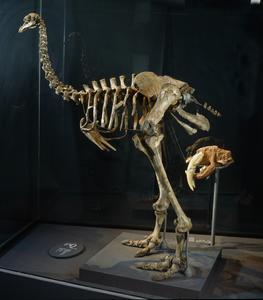 Moa bird
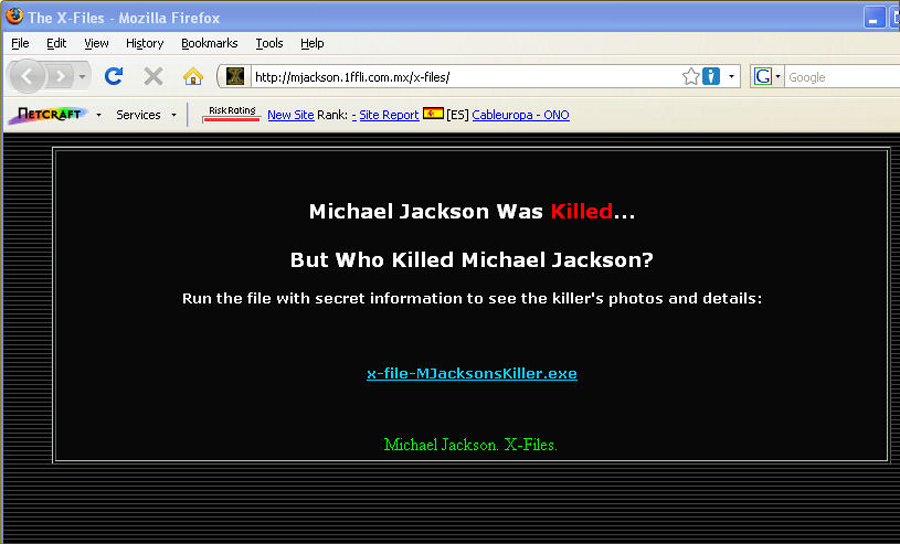
Interested in Michael Jackson now that he is dead? So are cyber criminals who are exploiting public interest in his death with spam messages that infect computers with a virus able to steal bank account numbers and passwords, according to Gary Warner, University of Alabama at Birmingham (UAB) director of research in computer forensics. Warner and the other researchers at the UAB Spam Data Mine began tracking the celebrity-focused spam early on Tuesday, June 30.
“We’ve been tracking the cyber criminals behind this spam and the associated virus for many weeks, but it is just today that they have shifted their strategy by embedding their virus into an e-mail that claims to link you to a Web site that will reveal Michael Jackson’s killer,” Warner said.
With the increasing popularity of
whitening teeth, and some studies showing
negative effects of teeth whitening, researchers at the Eastman Institute for Oral Health at the University of Rochester Medical Center set out to learn if there are negative effects on the tooth from using whitening products.
Eastman Institute's YanFang Ren, DDS, PhD, and his team determined that the effects of 6 percent hydrogen peroxide, the common ingredient in professional and over-the-counter whitening products, are insignificant compared to acidic fruit juices. Orange juice markedly decreased hardness and increased roughness of tooth enamel.
A team of researchers from the University of Alcalá de Henares (UAH) says that human beings can develop echolocation, the system of acoustic signals used by dolphins and bats to explore their surroundings. Producing certain kinds of tongue clicks helps people to identify objects around them without needing to see them, obviously something that would be useful for the blind, if it's true.
The team has started a series of tests, the first of their kind in the world, they say, to make use of human beings' under-exploited echolocation skills.
 Much cooler than Man-Bat. ©Marvel Comics Group
There's a reason religious cults do things in groups; peer pressure and mutual awareness keeps them on message. Likewise, young people are more likely to participate in conservation if their peers do - a tendency that should be exploited when it comes to protecting the environment, according to results of a new study.
The research, which focused on a mammoth government initiative called Grain-to-Green that pays Chinese farmers to convert cropland back to forest, is the first to focus on the phenomenon of social norms in the context of China's conservation efforts, said scientist Jianguo "Jack" Liu of Michigan State University (MSU).
The front portion of the brain that handles tasks like decision-making, the left inferior frontal sulcus, also helps decipher different phonetic sounds, according to new Brown University research. This section of the brain treats different pronunciations of the same speech sound (such as a 'd' sound) the same way, they say, and in determining this they believe they have solved a mystery.
In a few days, scores of Italian post-doctoral researchers in experimental particle physics will get tested on their knowledge of the matter, without any promise of a position, but just to get one further "stamp" on their curriculum, testifying that they are competent enough to be worth offering a temporary position by INFN, the Italian Institute for (sub)Nuclear Physics. So this is a national exam, with the sole purpose of giving a green light to be admitted to two-year positions , which are typically paid less than 1400 euros a month, and which are so far not available. Frankly, I feel ashamed, since I myself work for INFN, and I strongly disagree with its current recruitment policies.
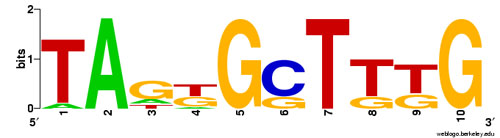
How proteins recognize specific stretches of DNA is one of the key questions of gene regulation. One would like to be able to look at the regulatory DNA sequence adjacent to a gene, and predict which regulatory proteins bind there, and control the adjacent gene. In other words, we want to, just by running a few computer programs over a genome, know how the genes in that genome are regulated.
Elsevier today announced the highlights of its journal impact factor performance in 2008. Elsevier overall saw 75% of its journal impact factors (IF) increase from 2007 to 2008. According to the 2008 Journal Citation Report(R) published by ThomsonReuters, Elsevier journals took the #1 position in 51 categories (of 229) across all of the sciences and social sciences.
In addition, 30 Elsevier journals got their first impact factor this year. Cell Stem Cell (http://www.cell.com/cell-stem-cell/home) (16.826) entered the Cell Biology category ranked 6th (of 157 journals), while Cell Host Microbe (http://www.cell.com/cell-host-microbe/home) (7.436) entered the Microbiology category ranked 10th (of 91 journals).
An international team of researchers has modified chlorophyll from an alga so that it resembles the extremely efficient light antennae of bacteria. The team was then able to determine the structure of these light antennae. This is the first step to converting sunlight into energy using an artificial leaf.
Leiden researcher Swapna Ganapathy has obtained her PhD based on this subject, under the supervision of Professor Huub de Groot, one of the initiators of the research.