Fat people require more food and that requires more farming and greenhouse gas emissions. Therefore, maintaining a healthy body weight is also good for the environment, according to a study which appears today in the International Journal of Epidemiology.
They highlight poor, third world countries like Vietnam as a model because they they can't afford food so they consume almost 20% less of it (and therefore cause fewer greenhouse gases to be produced) than a population in which over 40% of people are obese, where the USA and a few nations in Europe are heading by 2020.
Global warming gets all the press today but there was a time when pollution-caused global cooling was the concern - and if you map the planet's recent history, 90,000 out of every 100,000 years were ice ages and it's been 12,000 years since the last one so the historical reason for concern was not unfounded. A new book, "
The Late Eocene Earth - Hothouse, Icehouse, and Impacts" tackles what global cooling was like.
New evidence gleaned from CT scans of fossils locked inside rocks may flip the order in which two kinds of four-limbed animals with backbones were known to have moved from fish to landlubber.
Both extinct species, known as Ichthyostega and Acanthostega, lived an estimated 360-370 million years ago in what is now Greenland. Acanthostega was thought to have been the most primitive tetrapod, that is, the first vertebrate animal to possess limbs with digits rather than fish fins.
Health and death have genetic risk factors. International research has linked ten gene variations to sudden cardiac death (SCD). What is SCD? It is death resulting from an abrupt loss of heart function -- cardiac arrest. Was this perhaps what the first famous poly-marathoner suffered?
Recent - The American Heart Association (AHA) says about 850 Americans die each day without being hospitalized or admitted to an emergency room. Most are sudden deaths caused by cardiac arrest. Death occurs within minutes after symptoms appear. Yet this health problem has received much less publicity than heart attack.
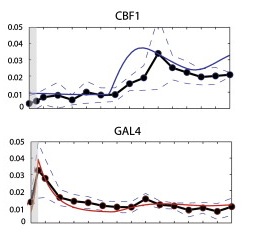
Many computational biologists are interested in taking gene expression data, and using that data to computationally infer the underlying regulatory network that controls the observed pattern of gene expression.
Why? Because doing the experiments to determine the structure of these regulatory networks is hard; if we could use more easily obtained data to reliably tease out the network structure, we'd be able to quickly characterize networks in unexplored cell types or in poorly studied microbes.
Kepler has First Light. It is On! Team is a Go! Photons are Arriving!
This provocativly-titled
NASA release states "NASA's Kepler Captures First Views of Planet-Hunting Territory", and has a good explanation of Kepler's capabilities. What I wish to tackle is why Kepler matters.
Kepler is a new space telescope with an awesomely wide field of view, seeing a huge 100 square degrees in a single frame, then zooming in closer with two other 'scopes. It is primarily a planet-hunting mission, but there will be much good science coming from Kepler-- some of which we can't even imagine yet.
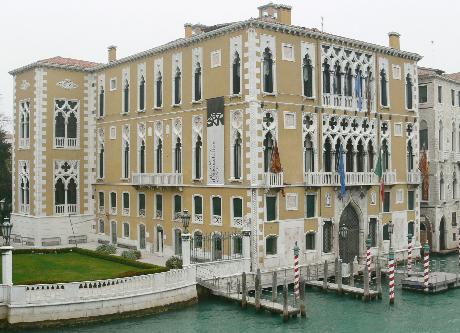
I participated with pleasure last month to a four-day conference devoted to neutrino telescopes,
NEUTEL 2009, in Venice. Venice is my home town, and walking in the morning to the conference venue in Palazzo Franchetti (see left), a big and beautiful palace on the Canal Grande, was a pleasant change from my usual commute by train with Padova.
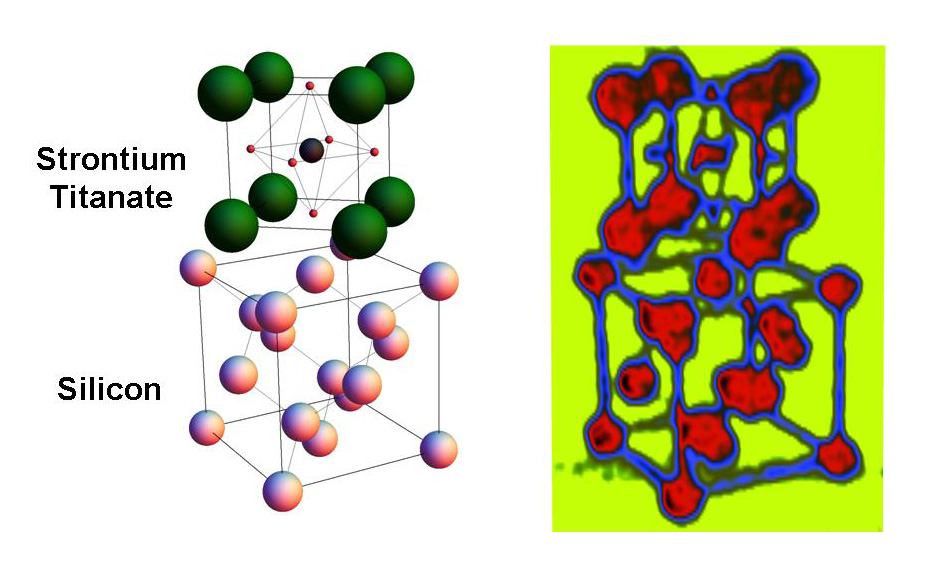
The ferroelectric materials found in today's "smart cards" used in subway, ATM and fuel cards soon may eliminate the time-consuming booting and rebooting of computer operating systems by providing an "instant-on" capability as well as preventing losses from power outages.
Researchers supported by a National Science Foundation (NSF) nanoscale interdisciplinary research team award and three Materials Research Science and Engineering Centers at Cornell University, Penn State University and Northwestern University recently added ferroelectric capability to material used in common computer transistors, a feat scientists tried to achieve for more than half a century.
New studies indicate the three drugs used to treat male impotence, phosphodiesterase Type 5 inhibitors Viagra, Levitra and Cialis also appear to work in females, albeit a little differently, and might be worth a second look to potentially help the 40 percent of women who report sexual dysfunction, researchers say.
In one of the first studies of the effect of the phosphodiesterase Type 5 inhibitors on the pudendal arteries that supply the penis, vagina and clitoris the blood needed to produce a satisfying sexual experience, Medical College of Georgia researchers showed the drugs relax the artery in male and female rats.
If you're a man and have Lou Gehrig's Disease - Amyotrophic lateral sclerosis (ALS) - there is good news if you drink caffeine. Antioxidants, such as in coffee, can help. The bad news is you still have ALS and there is no caffeine benefit for women found so far.
Amyotrophic lateral sclerosis is a fatal disease that damages key neurons in the brain and spinal cord. The disease causes progressive paralysis of voluntary muscles and often death within five years of symptoms. Although ALS (Lou Gehrig’s disease) was discovered over a century ago, neither the cause nor a cure have been found, but several mechanisms seem to play a role in its development, including oxidative stress.