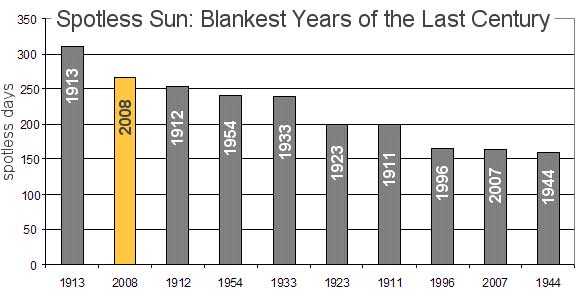
The sunspot cycle is behaving a little like the stock market. Just when you think it has hit bottom, it goes even lower.
2008 was a bear. There were no sunspots observed on 266 of the year's 366 days (73 percent). To find a year with more blank suns, you have to go all the way back to 1913, which had 311 spotless days. Prompted by these numbers, some observers suggested that the solar cycle had hit bottom in 2008.
Maybe not. Sunspot counts for 2009 have dropped even lower. As of March 31st, there were no sunspots on 78 of the year's 90 days (87 percent).
A team of astronomers, led by Stefan Kraus and Gerd Weigelt from the Max-Planck-Institute for Radio Astronomy (MPIfR) in Bonn, used ESO's Very Large telescope Interferometer (VLTI) to obtain the sharpest ever image of the young double star Theta 1 Ori C in the Orion Trapezium Cluster, the most massive star in the nearest high-mass star-forming region.
We all know that people sometimes change their behavior when someone is looking their way. A new study in Current Biology shows that jackdaws, birds related to crows and ravens with eyes that appear similar to human eyes, can do the same.
"Jackdaws seem to recognize the eye's role in visual perception, or at the very least they are extremely sensitive to the way that human eyes are oriented," said Auguste von Bayern, formerly of the University of Cambridge and now at the University of Oxford.
Long before they became famous as barbaric raiders, Vikings played nice with British and Irish culture, according to findings at a recent Cambridge University conference.
The conference, entitled "Between the Islands", was organized by the University's Department of Anglo-Saxon, Norse and Celtic and its Centre for Research in the Arts, Social Sciences and Humanities (CRASSH) and had more than 20 cutting-edge studies which reveal how the Vikings shared technology, swapped ideas and often lived side-by-side in relative harmony with their Anglo-Saxon and Celtic contemporaries.
Smokers who do not want to quit right now but would like to at least reduce their smoking are twice as likely to stop smoking in the long-term if they use nicotine replacement therapy (NRT) to help them cut down gradually, according to research published on bmj.com.
The research is the first of its kind to focus on sustained smoking abstinence using NRT for smokers who have no immediate plans to stop smoking.
If we tell you the next laser in the works by the National Nuclear Security Administration (NNSA) will be the size of a football stadium and will have 192 individual beams, each about 40 centimeters square, beaming into a spot about one-half millimeter in diameter at the center of its 10 meter diameter target chamber, delivering huge amounts of energy with extreme precision in billionths of a second, what will you think?
You'll think
the residents of Alderaan had better start packing suitcases, right?
Hi, I’m the Science Cyclops.
I was created from molecules of caffeine and genetically engineered organic pluats. I was sent here by Zeus to inspire humans through my tales of terror and physical improbabilities while not helping him fight the Titans, because of the economy and all.
First things first, let’s get this out in the open. I get stopped on the street quite often and people always want to know one thing; how is your depth perception in battle so accurate when you only have one eye?
With all the "bro's" and "ho's" we hear about in the rap world, I think it's safe to say that as a society, we all agree that the rap industry could use a drastic image change. Furthermore, if that image change could include an educational aspect, then that would definitely be beneficial for our children.
Just imagine, all the cool and funky beats of rap music coupled with the wholesome words we use in science class. What a concept! And please, don't be hatin' on me because you didn't think of it first.
Just before dawn on Oct. 7, 2008, an SUV-sized asteroid entered Earth's atmosphere and exploded harmlessly over the Nubian Desert of northern Sudan. Scientists expected the asteroid, called 2008 TC3, had blown to dust in the resulting high-altitude fireball.
What happened next excited the scientific community.
Peter Jenniskens, a meteor astronomer with the SETI Institute in Mountain View, Calif., who works at NASA's Ames Research Center in Moffett Field, Calif., joined Muawia Shaddad of the University of Khartoum in Sudan to search for possible extraterrestrial remnants from the asteroid.
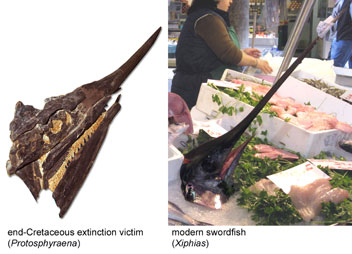
It wouldn't seem logical today that big predators are at the greatest risk for extinction, but they are, and a group of researchers sees a number of similarities between extinctions of 65 million years ago and today.
Studies of modern fishes demonstrate that large body size is linked to large prey size and low rates of population growth, while fast-closing jaws appear to be adaptations for capturing agile, evasive prey—in other words, other fishes. The fossil record provides some remarkable evidence supporting these estimates of function: fossil fishes with preserved stomach contents that record their last meals.