Two new greenhouse gases are accumulating in the atmosphere, according to an international research team led by scientists from the Scripps Institution of Oceanography in the US and CSIRO scientist, Dr Paul Fraser, from the Centre for Australian Weather and Climate Research.
Nitrogen trifluoride (NF3) and sulfuryl fluoride (SO2F2) are powerful greenhouse gases that have recently been discovered to be growing quickly in the global background atmosphere.
These gases are used in industrial processes, partly as alternatives to other harmful greenhouse and ozone depleting gases.
Johns Hopkins researchers have discovered a new energy-making biochemical twist in determining the lifespan of yeast cells, one so valuable to longevity that it is likely to also functions in humans.
Their findings, published in the March 20 issue of Cell, reveal that making glucose is highly influenced by a large enzyme complex already known to fix damaged DNA, and which apparently affects yeast life span through a common chemical process—acetylation.
In a series of experiments, the Hopkins team showed that when continuously acetylated, the so-called NuA4 enzyme complex causes yeast cells to live longer than they would under normal conditions.
There was once a theory in manufacturing and business; 'planned obsolescence.' If you didn't make products with limitations, no one would ever buy new ones.
Then along came a bunch of Asian companies who made better products and American manufacturing took a dive. Made In America became a political point of pride rather than a mark of quality.
But quality is making a comeback because warranty costs are the next big cost items, write researchers in the International Journal of Six Sigma and Competitive Advantage - so manufacturers need to design for reliability.
A receptor for glutamate, the most prominent neurotransmitter in the brain, plays a key role in the process of "unlearning," report researchers at the Salk Institute for Biological Studies. Their findings in the Journal of Neuroscience, could eventually help scientists develop new drug therapies to treat a variety of disorders, including phobias and anxiety disorders, particularly post-traumatic stress disorder.
Post-traumatic stress disorder or PTSD is an anxiety disorder that can develop after exposure to a terrifying event or ordeal in which grave physical harm occurred or was threatened. PTSD is affecting approximately 5.2 million Americans, according to the National Institute of Health. As many as one in eight returning soldiers suffer from PTSD.
Continued from Part 2, A Scientific Approach to Science Education - Research On Learning
On average, students have more novicelike beliefs after they have completed an introductory physics course than they had when they started; this was found for nearly every introductory course measured. More recently, my group started looking at beliefs about chemistry. If anything, the effect of taking an introductory college chemistry course is even worse than for taking physics.
“Let’s say tomorrow some crazy guy bombs America or poisons all your river or puts a lot of nuclear radiation out and all your livestock is poisoned. What you will eat?”
“Vegetables!” I answered.
If you're in the racism industry, an icy chill has gone down your spine in 2009, with an African-American president and both major political parties run by black people.
As always, a psychologist will find an answer for how society can do those things and still be racist; it turns out you will be less biased against people of other races in your social group but you will still be prejudiced against people of other races you don't have beer with. Likewise, if you voted for Obama he is not the black person you automatically dislike the way you automatically dislike all other black people.
If you haven’t the infinite ammo of the late Hunter S. Thompson or the lightning-fast trigger finger (and impressive spray radius) of a recent Vice President, it actually takes considerable skill to shoot a fish in a barrel (exact difficulty proportional to size of barrel and fish depth and inversely proportional to size of fish). Some of this trickiness is due to refraction, or the change in speed and thus direction of light waves as they move from air to water.
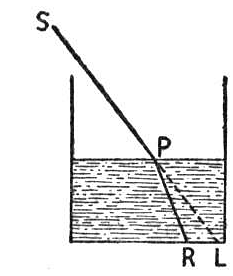
Wait a minute!? Isn’t the speed of light constant?
Yes. But only in a vacuum.
Prions first made their notorious media debut in the mid-1980’s when British cattle contracted Mad Cow disease. As a result, over 150 people in Europe were infected and died from the human form known as Creutzfeldt-Jakob disease—a fatal neurological disorder with similar symptoms as Mad Cow.
Although prions are infectious agents with a bad reputation, research suggests that prions also play a role in epigenetic regulation. Recently, a Nature Cell Biology study conducted by molecular biologists at the University of Illinois at Chicago, discovered a new prion in yeast that raises further questions about the biological role of prions in gene regulation.
Physicists at Michigan Technological University have filled in some longtime blank spaces on the periodic table, calculating electron affinities of the lanthanides, a series of 15 elements known as rare earths.
"Electron affinity" is the amount of energy required to detach an electron from an anion, or negative ion (an atom with an extra electron orbiting around its nucleus). Elements with low electron affinities (like iron) give up that extra electron easily. Elements with high electron affinities (like chlorine) do not.
"I remember learning about electron affinities in 10th grade chemistry," said Research Associate Steven O'Malley. "When I began working as a grad student in atomic physics, I was surprised to learn that many of them were still unknown."