Scientists at the Sol Goldman Pancreatic Cancer Research Center at the Johns Hopkins Kimmel Cancer Center have used "personalized genome" sequencing on an individual with a hereditary form of pancreatic cancer to locate a mutation in a gene called PALB2 that is responsible for initiating the disease. The discovery marks their first use of a genome scanning system to uncover suspect mutations in normal inherited genes.
The coding error in PALB2, which stands for "partner and co-localizer of BRCA2" causes a shortened version of the protein encoded by this gene, rendering it incapable of working with another cancer-related gene, BRCA2, to repair broken DNA. Mutations in BRCA2 are also known to cause hereditary forms of cancer.
In the past two years, University of Texas Southwestern researchers have used a computer-based text-searching tool they developed, called eTBLAST, to analyze millions of abstracts randomly selected from Medline, one of the largest databases of biomedical research articles. They turned up nearly 70,000 highly similar citations.
Their subsequent analysis of a small sampling of these, including human inspection of the articles in question, revealed 207 pairs of articles with signs of potential plagiarism.
In a commentary appearing in Science, the UT Southwestern researchers outline the wide range of reactions they received when they followed up with both victims and perpetrators of possible misconduct, as well as responses from journal editors.
Nature -- presumably through the mechanism of Darwinian selection -- has endowed us with a balanced system of pains and pleasures that correspond respectively to the sort of things we should avoid or seek in order to further our survival and reproduction. It is not surprising that the brain produces a sensation of pain when we bleed: if it didn't we may run the risk of bleeding to death without noticing (or noticing too late). Similarly, it is hardly surprising that our brain releases pleasure chemicals (literally, neural drugs) to reward us when we do something useful, like finding and eating a sugar or fat-ladened substance.
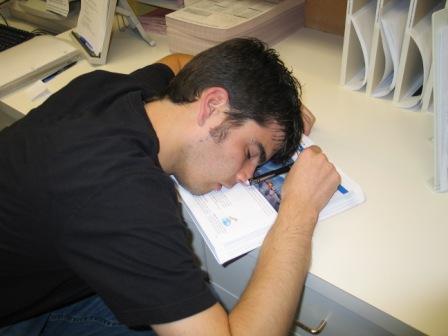
The latest news on napping would have you believe that it’s a harbinger of doom. The Research Institute at the California Pacific Medical center studied communities of elderly women and linked napping and excess sleep in general to increased death from anything. By this logic, the entire nap-happy nation of Spain should watch out for falling pianos.
Show Me The Science Month Day 22

How do genes work together to build body traits? This is one of the hottest questions in genetics today, and the answer holds implications not only for our understanding of evolution, but also health, agriculture, and wildlife conservation. A
recent paper in Science (by Scientific Blogging's own
Redneck Geneticist) takes a look at how genetic variants work together to generate the physical diversity that we see in living organisms.
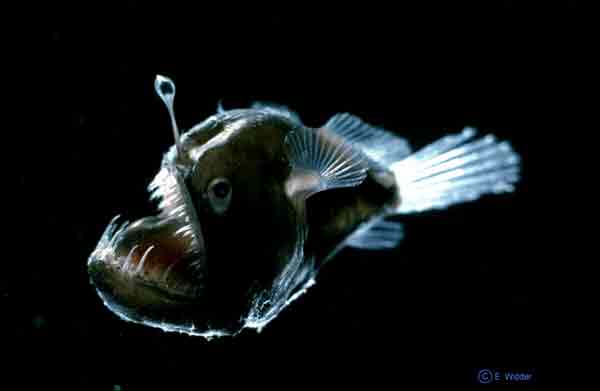
Contrary to popular belief (trekkies especially) space is not yet the final frontier - we still have plenty of unexplored frontier closer to home yet farther away from pop culture imagination: the oceans. The deep ocean remains one of the last truly explored regions, and it remains almost as mysterious as any distant galaxy.
According to Discovery Channel’s epic documentary, Blue Planet, Seas of Life, "Over 60% of our planet is covered by water more than a mile deep. The deep sea is the largest habitat on earth and is largely unexplored. More people have traveled into space than have traveled to the deep ocean realm."
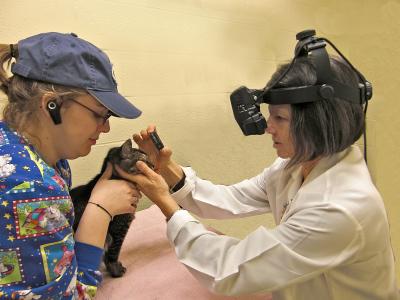
About one in 3,500 people are affected with retinitis pigmentosa (RP), a disease of the retina's visual cells that eventually leads to blindness. Now, a University of Missouri researcher has identified a genetic link between cats and humans for two different forms of RP. This discovery will help scientists develop gene-based therapies that will benefit both cats and humans.
Researchers examined the genetic mutations in two groups of cats; one with a congenital form of RP and another with a late-onset form and were able to identify the genes responsible for both forms of the disease in cats.
While number of calories taken in versus used will always be the the biggest factor in weight loss, the type of diet can make a difference too. If you want to lose fat instead of muscle, for example, or if you want to lower your triglyceride levels so you'll be less likely to develop diabetes and heart disease.
A new study by Donald Layman, a University of Illinois professor emeritus of nutrition, followed the weight-loss efforts of 130 persons at two sites, the U of I and Penn State University, during 4 months of active weight loss and 8 months of maintenance.
As researchers continue to examine the role of sweeteners in the diet, it's important that people understand the differences among various ingredients used in scientific studies, according to the Corn Refiners Association (CRA). Interchanging two distinctly different ingredients, such as pure fructose and high fructose corn syrup, creates factually incorrect conclusions and misleads consumers.
Recent studies using pure fructose that purport to show that the body processes high fructose corn syrup differently than other sugars due to fructose content are a classic example of this problem because pure fructose cannot be extrapolated to high fructose corn syrup. The abnormally high levels of pure fructose used in these studies are not found in the human diet.
72.28 percent of drug addicted men claim to have consumed drugs to be able to have sexual relations and most of them (58%) choose cocaine for this purpose. Of course, they're drug-addicted men so they may also say they do it to cook dinner.
The irony is that it's self-defeating, since cocaine is the most debilitating common drug when it comes to sexual performance.
It's not just men. 37.50% of drug addicted women do the same thing, resorting to cocaine (37%), speed balls (the colloquial term for intravenous use of heroin and cocaine together) at 25% and alcohol at 25%.