I am traveling back from Brown University (on Amtrak's Acela Express train, ah, the civilization of the Northeast!), where I participated in a panel discussion on evolution and religion together with Ed Larson (Pepperdine University, author of the Pulitzer winning Summer for the Gods on the Scopes trial), art historian Mary Bergstein (Rhode Island School for Design), and Brown's own
What had once been impossible has now been shown to be possible – an alloy between two incompatible elements.
A research team led by Professor H.K. Mao from Carnegie Institution of Washington and Professor Rajeev Ahuja from UU have used high pressure experiments and theoretical calculations to study the behavior of Ce3Al under high pressure.
"We were surprised to find that Cerium and Aluminium formed a so called substitutional alloy under high pressure. Forming these alloys has been limited to elements close in atomic radii and electronegativity up until now", sais Professor Rajeev Ahuja of Uppsala University.
You may know of people who ridicule lottery players because the odds are so great and, it would seem, they can't do simple math. But most people don't ridicule stock market investors even though the same circumstances - a lack of real knowledge and a field of competitors doing the same thing - make it less likely they will be successful unless fortune makes their decisions align with people who know what they are doing.
The riskier investors tend to act, the more socioeconomic characteristics they share with people who play state lotteries and, just like the lottery, returns on average are lower for those who invest this way in the stock market, research from The University of Texas at Austin shows.
A system of opposing genetic forces determines why mammals develop a single row of teeth, while sharks sport several, according to a study published today in the journal Science. When completely understood, the genetic program described in the study may help guide efforts to re-grow missing teeth and prevent cleft palate, one of the most common birth defects.
Ancient footprints show that some of the earliest humans walked like us and did so on anatomically modern feet 1.5 million years ago.
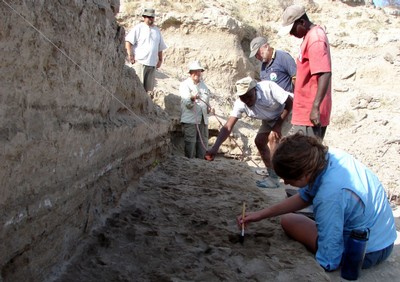
This anatomical interpretation is the conclusion of Rutgers Professor John W.K. Harris and an international team of colleagues. Harris is a professor of anthropology, a member of the Center for Human Evolutionary Studies and director of the Koobi Fora Field Project.
Harris is also director of the field school which Rutgers University operates in collaboration with the National Museums of Kenya. From 2006 to 2008, the field school group of mostly American undergraduates, including Rutgers students, excavated the site yielding the footprints.
Ice in Antarctica suddenly appeared — suddenly in geologic terms being a little different than how we think of it — about 35 million years ago. For the previous 100 million years the continent had been essentially ice-free. Even after Antarctica had drifted to near its present location, its climate remained subtropical but then, 35.5 million years ago, ice formed on Antarctica in only about 100,000 years, which is an "overnight" shift in geological terms.
What triggered the sudden shift?
Like it or not, your mouth is home to a thriving community of microbial life. More than 600 different species of bacteria reside in this "microbiome," yet everyone hosts a unique set of bugs, and this could have important implications for health and disease. In a new stud, scientists have performed the first global survey of salivary microbes, finding that the oral microbiome of your neighbor is just as different from yours as someone across the globe.
Researchers at The Scripps Research Institute in La Jolla, California have identified a common Achilles' heel in a wide range of seasonal and pandemic influenza A viruses.
The study found an infection-fighting protein, or human antibody, that neutralizes various influenza A virus subtypes by attaching to these viruses in the same place. This common attachment site provides a constant region of the flu virus for scientists to target in an effort to develop a so-called universal flu vaccine.
Such a vaccine would overcome the annual struggle to make the seasonal flu vaccine match next year's circulating flu strains and might help blunt emerging pandemic influenza viruses as well.
The universe is a lazy place. If a system of particles can find a way exist in a lower-energy state, you’d better believe that the system will seek it out. A group of researchers from Amherst and Berkeley are capitalizing on this universal tendency toward calculated sloth by using self-assembly to create denser storage media.
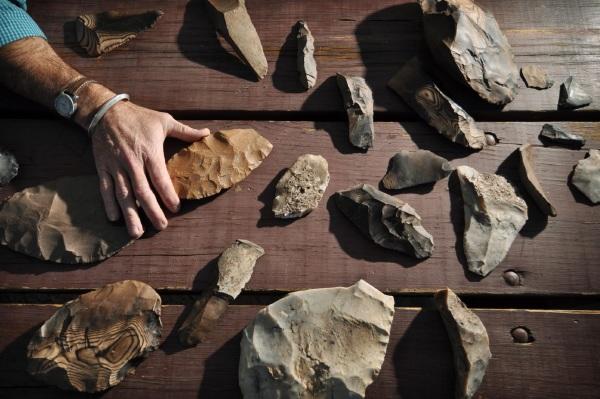
A biochemical analysis of a rare Clovis-era stone tool cache recently unearthed in the city limits of Boulder, Colo., indicates some of the implements were used to butcher ice-age camels and horses that roamed North America until their extinction about 13,000 years ago, according to a University of Colorado at Boulder study.
The study is the first to identify protein residue from extinct camels on North American stone tools and only the second to identify horse protein residue on a Clovis-age tool, said CU-Boulder Anthropology Professor Douglas Bamforth, who led the study. The cache is one of only a handful of Clovis-age artifact caches that have been unearthed in North America, said Bamforth, who studies Paleoindian culture and tools.