A congressionally mandated report from the National Research Council finds serious deficiencies in the nation's forensic science system and calls for major reforms and new research. Rigorous and mandatory certification programs for forensic scientists are currently lacking, the report says, as are strong standards and protocols for analyzing and reporting on evidence. And there is a dearth of peer-reviewed, published studies establishing the scientific bases and reliability of many forensic methods. Moreover, many forensic science labs are underfunded, understaffed, and have no effective oversight.
A study from the Harokopio University of Athens (Greece) says that adherence to a dietary pattern close to the Mediterranean diet, with high consumption of fish and olive oil and low red meat intake, has a significant impact in women skeletal health.
Results suggest that this eating pattern could have bone-preserving properties throughout adult life.
Diet is one of the modifiable factors for the development and maintenance of bone mass. The nutrients of most obvious relevance to bone health are calcium and phosphorus because they compose roughly 80% to 90% of the mineral content of bone; protein, other minerals and vitamins are also essential in bone preservation.
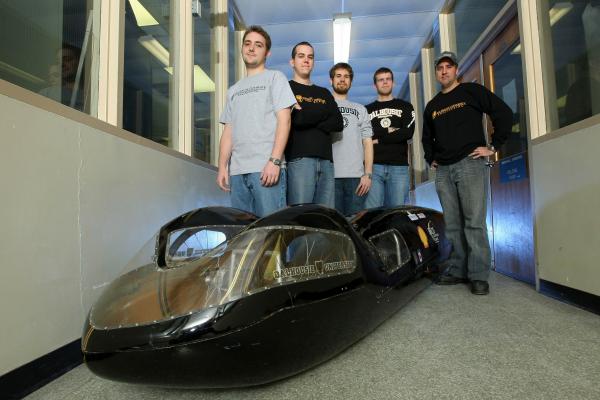
With its light body made of Kevlar, sleek aerodynamic design and three Olympic-racing wheelchair tires, it looks like something that escaped from the Batcave but it’s actually a school project by a team of six Dalhousie University senior mechanical engineering students.
The ultimate in fuel efficiency, the “Maritime Mileage Machine” will be entered in the 2009 Shell Eco-marathon Americas taking place on April 15 to 18 at the Auto Club Speedway in Fontana, California. The event challenges high school and post-secondary students across Canada, the U.S., Mexico and South America to design and build a vehicle that will drive the farthest using the least amount of energy.
Can you connect the dots? Playboy playmates, Barbie, and Wired Magazine.
Give up? Wired featured a charticle in the February issue on the BMI of Playmates, starting back in 1953 with Marilyn Monroe to the recent January 2009 cover girl, versus those of the average woman. No surprise, the bunnies are trending toward Barbie (who turns 50 this year), while the average woman is slowly crawling up the BMI scale.

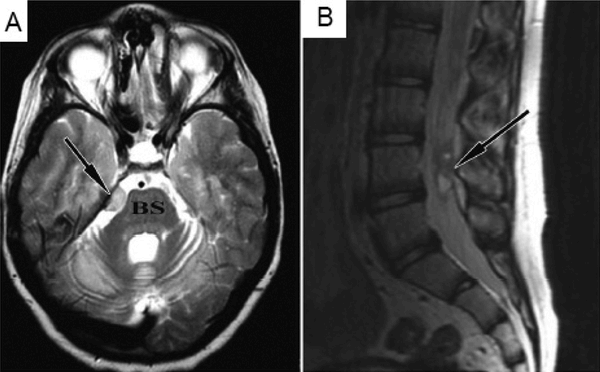
A case report published in PLoS Medicine describes a rare side effect of human fetal stem cell therapy. Ninette Amariglio and Gideon Rechavi from the Sheba Medical Center, Tel Aviv, Israel, and colleagues report the case of a boy with a rare genetic disease, Ataxia Telangiectasia, who underwent human fetal stem cell therapy at an unrelated clinic in Moscow and who, four years after the therapy began, was shown to have abnormal growths in his brain and spinal cord.
Show Me The Science Month Day 16

Black wolves look like creatures out of frightening fairy tales, but their black color actually came from pet dogs. Today's evolution paper is about a potentially beneficial mutation for black coat color picked up by wolves as the result of interbreeding with dogs. This story
got some press, so it may sound familiar, but here we're going to focus on just how scientists could know where the black color gene came from. This research is a great example of the genetic sleuthing that's now possible with easy, affordable DNA sequencing.
Increasing numbers are risking their health just because they want to have a tan, say researchers in an editorial published on bmj.com today.
The authors, led by Michael Evans-Brown from Liverpool John Moores University, argue that while the actual number of people having 'tan jabs' (the drugs Melanotan I and Melanotan II) is unknown, they are easily available via the internet and in some tanning salons and hairdressers. A thriving online community of users exist, the largest of which is Melanotan.org with over 5,000 members.
Scientists have discovered a mutation responsible for cancer progression, a finding with potential implications for the development of treatment against not one, but a series of cancer types, since this mutation can be linked to an abnormality recently discovered to exist in all malignancies. The discovery has just been published in Nature Genetics.(1)
Time to put New York Times’ columnist Stanley Fish in his place, again. Fish is a rather interesting kind of animal: an academic through and through (he is, after all a professor of law at Florida International University and dean emeritus of the College of Liberal Arts and Sciences at the University of Illinois at Chicago, and before that has taught at the University of California at Berkeley, Johns Hopkins and Duke University), who nevertheless relishes harsh criticism of academia.
The Rift Valley fever virus is a mosquito-borne African virus that causes fever in humans, inflicting liver damage, blindness and even death on a small percentage of the people it infects. Rift Valley fever also afflicts cattle, goats and sheep, resulting in a nearly 100 percent abortion rate in these animals. Its outbreaks periodically cause economic devastation in parts of Kenya, Somalia, Sudan and Zimbabwe, and bioterrorism experts warn that its introduction to the United States would cripple the North American beef industry.
Researchers at the University of Texas Medical Branch at Galveston say they have discovered a key tactic that the Rift Valley fever virus uses to disarm the defenses of infected cells.