Electronic implants that dispense medicines automatically or via a wireless medical network are on the horizon and Australian and US researchers warn of the security risks that will follow.
With the advent of personalized medicine, advances in diagnostics and the miniaturization of sensors and control systems for delivering drugs automatically, the Remote Intelligent Drug Delivery System (RIDDS) may soon be a reality. Such devices, implanted under the skin, would remove the inconvenience of manual drug delivery. By connecting a RIDDS to a wireless medical control center wirelessly patients with physical disabilities, learning difficulties, or who are otherwise unable to give themselves medication could benefit.
According to popular stereotype, young teenagers are shortsighted, leaving them prone to poor judgment and risky decision-making when it comes to issues like taking drugs and having sex and a new study confirms that. Teens 16 and younger do think about the future less than adults but the reasons may have less to do with impulsivity and more to do with a desire to do something exciting.
The study, by scientists at Temple University, the University of California, Los Angeles, Georgetown University, the University of California, Irvine, and the University of Colorado, is published in the the journal Child Development.
Losing weight is good for all overweight people but for sufferers of obstructive sleep apnea (OSA), a new study shows that losing weight is perhaps the single most effective way to reduce OSA symptoms and associated disorders. The study is in the American Journal of Respiratory and Critical Care Medicine.
We may be a long way off from using genetics to reliably gauge our risks for specific diseases, say researchers at the University of Pittsburgh Graduate School of Public Health. Yet, many companies currently offer personalized genetic testing for diseases like cancer, heart disease and diabetes, and tout the ability of DNA testing to predict future health risks.
Molecular and cellular biologists have made tremendous scientific advances by dissecting apart the functions of individual genes, proteins, and pathways. Researchers at the University of Wisconsin-Madison College of Engineering are looking to expand that understanding by putting the pieces back together, mathematically.
It's hard to avoid the omnipresent rhetoric being tossed around regarding the economy these days. Nearly everybody has an opinion on the state of our economy and how to fix it - and lately, on President Obama's economic stimulus package in general. In speeches, the president keeps making the point that we'll be investing heavily in green energy and science and then correlates that investment directly with job creation. So the big question is: how exactly does the economic recovery package (should it pass the impending Senate vote) try to create jobs in the science industry?
In recent decades, viral epidemics have risen in ferocity and quantity in continents around the globe. More and more people in not only places like Africa and South America, but also in Asia and parts of Europe have been affected by the spread of emergent and prolific viral diseases.
In honor of the bicentennial of Charles Darwin's birthday on February 12, 2009,
Mike White at
Adaptive Complexity decided to engage in a massive undertaking; 30 days of science in
Show Me The Science month. Nothing new, you might think, because we do science 365 days a year and some people who are just bloggers post 5 things every day.
Throughout history, scientists, philosophers, mathematicians and PhD students lacking funding for actual research have turned to the thought experiment in hopes of discovering something publishable, thereby retaining tenure and/or attracting the admiration of comely undergraduates.
The best thought experiments throw light into dark corners of the universe and also provide other scientists, philosophers, mathematicians and destitute Phd students a way to kill time while waiting for the bus.
Below is a classic thought experiment, pillaged from my book The Geeks' Guide to World Domination (Be Afraid, Beautiful People). I'll post a new thought experiment each day this week.
The Chinese Room
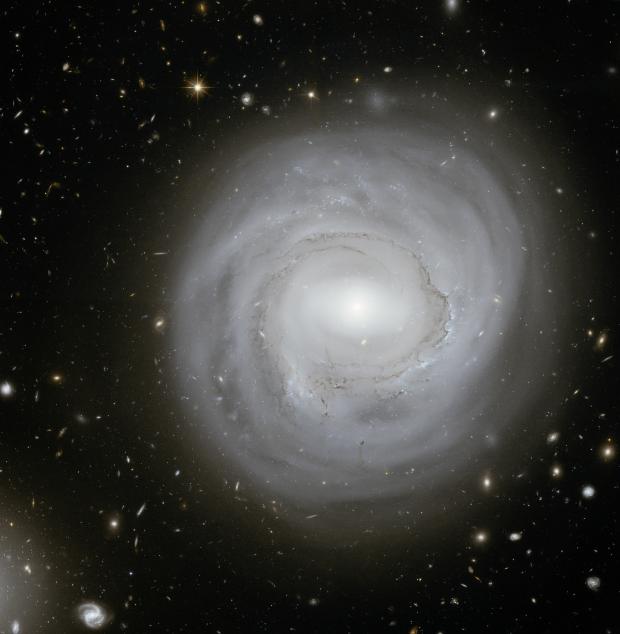
An unusual spiral galaxy in the Coma galaxy cluster has been imaged using data obtained by the Advanced Camera for Surveys on the Hubble Space Telescope. It reveals fine details of the galaxy, NGC 4921, and an extraordinary rich background of more remote galaxies stretching back to the early Universe.
The Coma galaxy cluster, in the northern constellation of Coma Berenices, the hair of Queen Berenice, is one of the closest, very rich collections of galaxies in the nearby Universe. The cluster, also known as Abell 1656, is about 320 million light-years from Earth and contains more than 1000 members. The brightest galaxies, including NGC 4921 shown here, were discovered back in the late 18th century by William Herschel.