ScientificBlogger Matthew Brown had the chance to sit down with Dr. Kathryn Flanagan, the head of the Mission Office for NASA’s James Webb Space Telescope to talk about her NASA missions, her public service, and why it’s normal even for an astrophysicist to have self-doubt.

"When the moment comes when you’re absolutely desperate, and you’re pretty sure you’re never going to be able to do what you’ve always wanted to do, don't worry—you’re right on schedule."


The MIT-educated astrophysicist is helping to explore some of science’s deepest wonders: how the universe came into being, whether there is life on other planets, and the origins of humankind. She’s doing it with technology that's challenging even the previous limits of explorations into space and time, and she’s doing it all with a tangible excitement, a genuine humility, and an altruistic spirit. Dr. Kathy Flanagan, head of the Mission Office for the James Webb Space Telescope (JWST). The JWST, scheduled for launch in 2013, will study everything from the first galaxies formed by the Big Bang, to the formation of other solar systems capable of supporting life.

I have made the point several times on this blog that creationists (among whom I squarely classify so-called intelligent design proponents) simply don’t get it (or refuse to get it) when they claim that scientific controversies are a sign that there is something seriously wrong with science. Au contraire, mon amis, science makes conceptual progress largely through discussions and disagreements among scientists, which eventually get settled because of new empirical discoveries. Now, controversies about the Bible, on the other hand... But I digress.

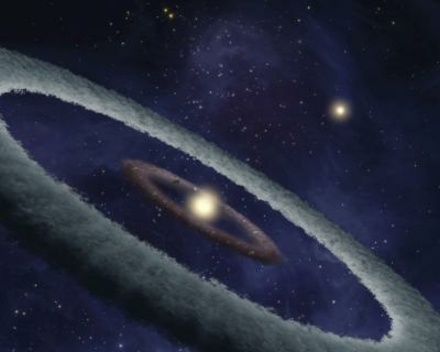
The mystery of how young stars can form within the deep gravity of black holes has been solved by a team of astrophysicists at the Universities of St Andrews and Edinburgh.

The team, partly funded by the Science and Technology Facilities Council (STFC), made the discovery after developing computer simulations of giant clouds of gas being sucked into black holes. The new research may help scientists gain better understanding of the origin of stars and supermassive black holes in our Galaxy and the Universe.

Until now, scientists have puzzled over how stars could form around a black hole, since molecular clouds - the normal birth places of stars - would be ripped apart by the black hole's immense gravitational pull.

They have worked for almost seven years in secret.

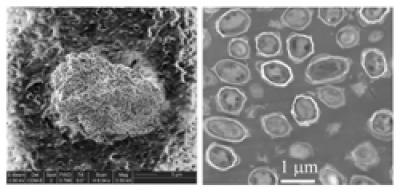
Most people did not know that the work in Ray Goehner's materials characterization department at Sandia National Laboratories was contributing important information to the FBI's investigation of letters containing bacillus anthracis, the spores that cause the disease anthrax. The spores were mailed in the fall of 2001 to several news media offices and to two U.S. senators. Five people were killed.

Sandia's work demonstrated to the FBI that the form of bacillus anthracis contained in those letters was not a weaponized form, a form of the bacteria prepared to disperse more readily. The possibility of a weaponized form was of great concern to investigators, says Joseph Michael, the principal investigator for the project. This information was crucial in ruling out state-sponsored terrorism.

Air circulates above the Earth in four distinct cells, with two either side of the equator, says new research out today in Science.

The new observational study describes how air rises and falls in the atmosphere above the Earth’s surface, creating the world’s weather. This process of atmospheric circulation creates weather patterns and influences the climate of the planet. It is important to understand these processes in order to predict weather events, and to improve and test climate models.

Previous theories have claimed that there are just two large circular systems of air in the atmosphere, one either side of the equator. These theories suggested that air rises at the equator and then travels towards either the north or south polar regions, where it falls.

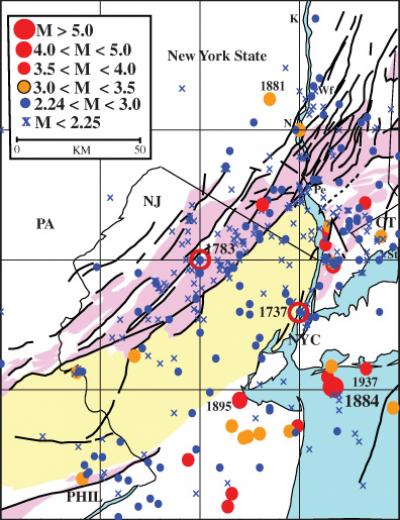
A study by a group of prominent seismologists suggests that a pattern of subtle but active faults makes the risk of earthquakes to the New York City area substantially greater than formerly believed. Among other things, they say that the controversial Indian Point nuclear power plants, 24 miles north of the city, sit astride the previously unidentified intersection of two active seismic zones.

There are two big problems we face; energy and health. Zhiyou Wen, assistant professor of biological systems engineering in Virginia Tech's College of Agriculture and Life Sciences, has found a way to tackle both using biodiesel.

The typical American diet often lacks omega-3 fatty acids despite clinical research that shows their potential human health benefits and biodiesel plants leave behind approximately 10 percent crude glycerol during the production process.

This has led the price of glycerol, a chemical compound widely used in the pharmaceutical and cosmetic industries, to drop in recent years. The rise in biodiesel production over the last decade means that the market can no longer absorb all the extra glycerol so biodiesel producers must find alternative means for disposing of crude glycerol, which is prohibitively expensive to purify for industry use.

For Charles Darwin, the problem of the peacock's tail, in light of his theory of natural selection, was vexing in the extreme.

Indeed, in 1860, writing to Asa Gray, his most ardent American champion, Darwin confessed: "The sight of a feather in a peacock's tail, whenever I gaze at it, makes me sick!"

In his struggle to explain why such extravagant and seemingly burdensome features existed, the great English naturalist struck upon the idea of sexual selection -- that showy traits such as the Peacock's ornamentation were an advantage in the mating game that outweighed other disadvantages.

Noise can be irritating and possibly harmful for everything from mice to humans – and maybe even 60-foot whales in the Gulf of Mexico. That's why in recent years, there has been concern that man-made noise may be a cause of stress for dolphins, whales and other marine mammals, but the results of a five-year study show that noise pollution – especially noise generated by seismic airguns during geophysical exploration for oil and gas – seems to have minimal effect on endangered sperm whales in the Gulf of Mexico, say researchers from Texas A&M University who led the project and released their 323-page report today at the Houston Museum of Natural Science.

The multi-year $9 million study, the largest of its type ever undertaken and formally titled Sperm Whale Seismic Study in the Gulf of Mexico, was conducted by the Minerals Management Service and featured cooperation with the Office of Naval Research, the National Science Foundation and the National Fish and Wildlife Foundation. The project brought together researchers from eight universities, but it was managed overall by Texas A&M's Department of Oceanography, with research scientist Ann Jochens and professor Doug Biggs serving as principal investigators.

Children's refusal to swallow liquid medication, or even vomit it back up, can be an important public health problem that means longer or more serious illness for thousands of kids each year.

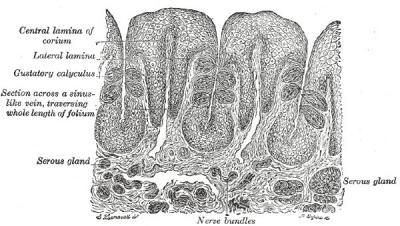
In a report presented today at the 236th National Meeting of the American Chemical Society, Julie A. Mennella, Ph.D., described how knowledge from basic research on the chemical senses explains why a child's rejection of bitter medicine and nutritious but bitter-tasting foods like spinach and other green vegetables is a reflection of their basic biology.

She says that children are born with a much stronger preference for sweet flavors, naturally attracting infants to mother's milk. This heightened preference for sweets continues even in their teenage years. By late adolescence, kids start to outgrow their sugary predilection.