A possible future way to prevent relapses into drug dependence has been discovered by researchers at Linköping University and the German cancer research center DKFZ. The target is the dopamine-producing nerve cells in the midbrain.

Earlier research has shown that these cells become more excitable when a person takes drugs. To find out the functional meaning of this, these researchers used a mouse model for cocaine dependence. When they blocked the cells’ receptors for glutamate - the brain’s most important signal substance -the risk of relapsing into addiction vanished. The findings are being published in the highly ranked journal Neuron.

Dopamine-producing nerve cells are central to the brain’s reward system.

Preliminary research led by Dr. Lawrence Cheskin, MD, Director of John Hopkins Weight Management Center, suggests increasing intake of low-energy density foods like mushrooms in place of high-energy-density foods like lean ground beef is a strategy for preventing or treating obesity. This is good news for the more than one-third of U.S. adults age 20 and older who are obese, according to the Center for Disease Control and who therefore have a greater risk factor for cardiovascular disease, certain types of cancer, and type 2 diabetes. (1)

In a Mushroom Council study led by Dr. Cheskin, study participants were randomly chosen to receive either beef or mushroom lunch entrées over four days – lasagna, napoleon, sloppy Joe and chili. Subjects then switched entrées to consume the other ingredient (mushroom or beef) the following week.

Michael Phelps, Nastia Liukin, Misty May-Treanor and Lin Dan are four Olympic athletes who have each spent most of their life learning the skills needed to reach the top of their respective sports, swimming, gymnastics, beach volleyball and badminton (you were wondering about Lin, weren't you...) 

Their physical skills are obvious and amazing to watch.  For just a few minutes, instead of being a spectator, try to step inside the heads of each of them and try to imagine what their brains must accomplish when they are competing and how different the mental tasks are for each of their sports.

A middle school in East Harlem recently implemented a new invention in the area of rules. It can be described in two words—attendance court. In the area of tardiness, truant individuals may be able to add science as another excuse to their ongoing list.

“Telling a late person just to be on time is a little like telling a dieter to simply stop eating so much,” is a widely used quote from the San Francisco time management consultant Diana DeLonzor’s book "Never Be Late Again: 7 Cures for the Punctually Challenged." It is so simple that it’s a concept easily overlooked.

In her book DeLonzor attacks the issue of what she calls a "lifelong habit" as more than just a matter of poor time management, or rudeness.

Being late is something that DeLonzor suggests has a sort of appeal. “Repetitive lateness is more often related to personality characteristics such as anxiety or a penchant for thrill-seeking,” she writes. “Some people are drawn to the adrenaline rush of that last minute sprint to the finish line, while others receive an ego boost from over-scheduling and filling each moment with activity.”

Scientists at Michigan State University have identified a new protein necessary for chloroplast development that they say could ultimately lead to plant varieties tailored specifically for biofuel production.

Chloroplasts, which are specialized compartments in plant cells, convert sunlight, carbon dioxide and water into sugars and oxygen ("fuel" for the plant) during photosynthesis. The newly discovered protein, trigalactosyldiacylglycerol 4, or TGD4, offers insight into how the process works.

When a cell begins to multiply in a dangerously abnormal way, a series of death signals trigger it to self-destruct before it turns cancerous. In research in the August 15th issue of Genes & Development, Rockefeller University scientists using mice have figured out a way to amplify the signals that tell these precancerous cells to die. The trick: Inactivating a protein that normally helps cells to avoid self-destruction.

The work, led by Hermann Steller, Strang Professor and head of the Laboratory of Apoptosis and Cancer Biology, is the first to reveal the mechanism by which a class of proteins called IAPs regulates cell death. By exposing the mechanism in a living animal, the finding also marks a breakthrough in the field and opens the door for developing a new class of drugs that could aid in cancer therapy and prevention.

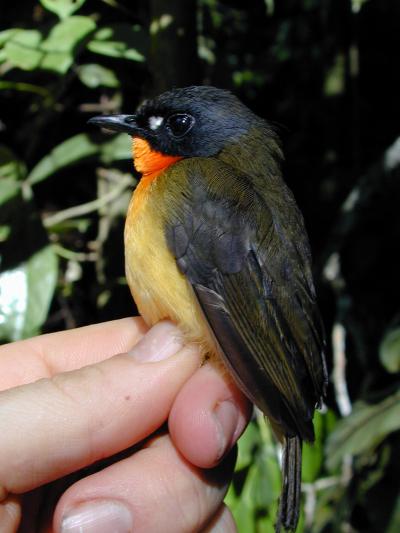
Scientists at the Smithsonian Institution have discovered a new species of bird in Gabon, Africa, that was, until now, unknown to the scientific community. Their findings were published in the international science journal Zootaxa today, Aug. 15.

The newly found olive-backed forest robin (Stiphrornis pyrrholaemus) was named by the scientists for its distinctive olive back and rump. Adult birds measure 4.5 inches in length and average 18 grams in weight. Males exhibit a fiery orange throat and breast, yellow belly, olive back and black feathers on the head. Females are similar, but less vibrant. Both sexes have a distinctive white dot on their face in front of each eye.

The bird was first observed by Smithsonian scientists in 2001 during a field expedition of the National Zoo's Monitoring and Assessment of Biodiversity Program in southwest Gabon. It was initially thought, however, to be an immature individual of an already-recognized species. Brian Schmidt, a research ornithologist at the Smithsonian's National Museum of Natural History and a member of the MAB program's team, returned to Washington, D.C., from Gabon in 2003 with several specimens to enter into the museum's bird collection. When he compared them with other forest robins of the genus Stiphrornis in the collection, Schmidt immediately noticed differences in color and plumage, and realized the newly collected birds might be unique.
In the world of alternative fuels, there may be nothing greener than pond scum.

Algae are tiny biological factories that use photosynthesis to transform carbon dioxide and sunlight into energy so efficiently that they can double their weight several times a day, producing oil in the process — 30 times more oil per acre than soybeans, according to the U.S. Department of Energy. Like soybean oil, the algae oil can be burned directly in diesel engines or further refined into biodiesel.

A new systematic analysis of the relationship between the neoplastic and developmental transcriptome provides an outline of trends in cancer gene expression. The research, published recently in Genome Biology, describes how cancers can be divided into three groups distinguished by disparate developmental signatures.

Isaac S Kohane from Children's Hospital Boston and Harvard University, US, led a team of researchers who performed a comprehensive comparison of genes expressed in early developmental stages of various human tissues and those expressed in different cancers affecting these tissues. He says, "Our study reveals potentially clinically relevant differences in the gene expression of different cancer types and represents a reference framework for interpretation of smaller-scale functional studies".

The NHS and private healthcare are not providing good enough basic care to a large portion of the population in England, especially older and frailer people, according to a study published on bmj.com today.

Overall, only 62% of the care recommended for older adults is actually received, conclude the authors.

The large-scale independent study of quality of care involved 8 688 people aged 50 and over and looked at 13 different health conditions including heart disease, diabetes, stroke, depression and osteoarthritis.








