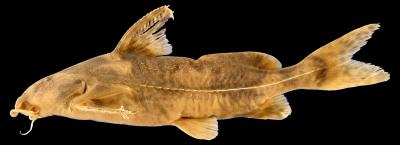







He's not well known like President Bush and musician Neil Young, but Philadelphian Frank Gallagher now has something in common with them: He has a new species named after him.

Gallagher was The Academy of Natural Sciences' affable mailroom supervisor for 37 years before retiring in 2003. "They used to call me 'the grapevine,'" said Gallagher, because he not only distributed the mail to the staff but also passed along the latest gossip. Now he is the inspiration for Rhinodoras gallagheri, a new species of catfish described by Academy fish scientist Dr. Mark Sabaj Pérez in the March issue of Copeia.

New species often are named for prominent scientists, generous benefactors or even spouses. A biologist recently named a new trapdoor spider after popular singer-songwriter Neil Young. A few years ago an entomologist named a new slime-mold beetle after the president. Rarely, if ever, has a new species been named for a postman.

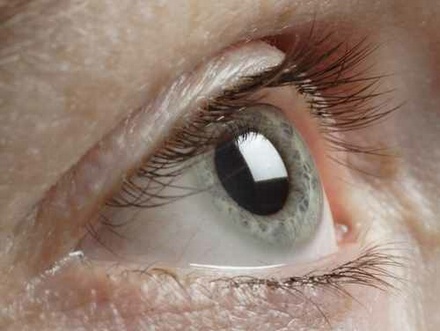
Biometrics is commonly associated with retinal scans, iris recognition and DNA databases but researchers in India are working on another form of biometrics that could allow law enforcement agencies and airport security to recognize suspects - their characteristic gait.

C. Nandini of the Vidya Vikas Institute of Engineering & Technology and C.N. Ravi Kumar of the S.J. College of Engineering in Mysore, India, explain that human gait typifies the motion characteristics of an individual. Viewed from the side, we each have a unique gait that makes us easily recognizable.

They point out that a camera with a side view can record a set of key frames, or stances, as a person heads for the security desk at an airport, military installation or bank, for instance. Key frames over the person's complete walk cycle, can then be converted into silhouette form and statistical analysis using so-called Shannon entropy, together with height measurements and the periodicity of the gait used to classify the person's gait.

A clinical study on patients who have suffered a heart attack found that a partially purified extract of Chinese red yeast rice, Xuezhikang (XZK), reduced the risk of repeat heart attacks by 45%, revascularization (bypass surgery/angioplasty), cardiovascular mortality and total mortality by one-third and cancer mortality by two-thirds.

The multicenter, randomized, double-blind study, was conducted on almost 5,000 patients, ranging in age from 18-70 over a five-year period at over 60 hospitals in the People's Republic of China. Corresponding author David M. Capuzzi, M.D., Ph.D, director of the Cardiovascular Disease Prevention Program at Jefferson's Myrna Brind Center of Integrative Medicine and Zonliang Lu, M.D., Ph.D, from the Fuwai Hospital at the Chinese Academy of Medical Science report their findings in the June 15th edition of the American Journal of Cardiology.

Scientists, reporting in the current issue of the online journal Marine Drugs, state that an increase of epileptic seizures and behavioral abnormalities in California sea lions can result from low-dose exposure to domoic acid as a fetus.

The findings follow an analysis earlier this year led by Frances Gulland of the California Marine Mammal Center that showed this brain disturbance to be a newly recognized chronic disease.

John Ramsdell of NOAA's Center for Environmental Health and Biomolecular Research in Charleston, SC, in partnership with Tanja Zabka, a veterinary pathologist at the Marine Mammal Center, conducted the first-of-its kind analysis of poisoning by the algal toxin, domoic acid, during fetal brain development. The results, analyzed across multiple animal species, point to the toxin as a cause for behavioral changes and epilepsy that does not become evident until later in life.

A 115-year-old woman who had remained mentally alert throughout her life had no evidence of Alzheimer's disease, according to a study in the August issue of Neurobiology of Aging, questioning the assumption that Alzheimer's disease or other forms of dementia will inevitably develop, if people live long enough.

Prof. dr. Gert Holstege of University Medical Centre Groningen, The Netherlands and colleagues had a unique chance to test the mental functioning of one of the world's oldest humans, and then to compare their findings with the condition of the subject's brain after death.

The patient was a Dutch woman who, at age 82, made arrangements to donate her body to science after death. At age 111, she contacted the researchers to ask whether her body would still be useful for research or teaching purposes. They assured her that, contrary to what she thought, they were especially interested because of her age: "She was very enthusiastic about her being important for science," Dr. Gert Holstege and colleagues write.

By disrupting the potassium channel of the malaria parasite, a team of researchers has been able to prevent new malaria parasites from forming in mosquitoes and has thereby broken the cycle of infection during recent animal tests.

By genetically altering the malaria parasite through gene knock-out technol-ogy, a research team consisting of scientists at the University of Copenha-gen and John Hopkins University, Baltimore, has prevented the parasite from going through the normal stages of its life cycle and developing a cyst (egg-like structure or occyst), which spawns new infectious parasites."

As it is exclusively the parasites from these oocysts that can infect new individu-als, we were able to prevent the disease from being transmitted to the animals in our tests", explains Assistant Professor, Peter Ellekvist from the University of Copenhagen.

Arsenic is acutely toxic and a highly potent carcinogen, but is widespread in the earth's crust and easily taken up and accumulated in crops. Contaminated water is the main source of arsenic poisoning, followed by ingestion of arsenic-rich food, especially rice that has been irrigated with arsenic-contaminated water. According to the WHO, arsenic has been found approaching or above guideline limits in drinking water in Argentina, Australia, Bangladesh, Chile, China, Hungary, India, Mexico, Peru, Thailand, and the US.

Amid recent reports of dangerous levels of arsenic being found in some baby rice products, scientists have found a protein in plants that could help to reduce the toxic content of crops grown in environments with high levels of this poisonous metal. A team of Scandinavian researchers has revealed a set of plant proteins that channel arsenic in and out of cells.

Researchers from University of Leicester Archaeological Services have recently completed work on the results of three closely related Bronze Age round barrows excavated at Cossington, Leicestershire and show how the ancient cemetery was reused by successive communities.

Their excavations revealed a variety of burial practices from Bronze Age, Iron Age, Roman and Anglo Saxon times. They offer the first definite example of an Anglo Saxon cemetery sited on an earlier monument to be found in Leicestershire.

One of the barrows included the crouched burial of a child of around eight years, who lay with grave offerings including two pots, a stone bowl and three flint knives. One of the knives had been made from a much earlier object, perhaps making a physical link to past ‘ancestors.’

The world needs to develop a means of securing the supply of clean fresh water within the next 10 years if we are to tackle a looming water shortage, says a leading expert on water purification and director of the National Science Foundation’s Science and Technology Centre for Advanced Materials for the Purification of Water.

Dr. Mark Shannon is giving a speech at the 2nd Global Innovation Imperatives (Gii) conference in New Delhi, India on 19-20 June 2008 and will warn top scientists, government, industrialists, academics and business people that just as food shortages have led to fierce fighting and unrest in parts of the world, water shortages triggered by climate change, population growth and poor water management will be next unless tackled now.

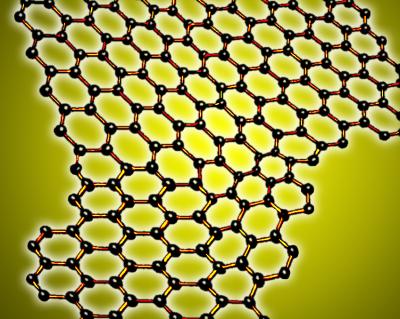
The familiar pencil-lead form of carbon, graphite, consists of layers of carbon atoms tightly bonded in the plane but only loosely bonded between planes; because the layers move easily over one another, graphite is a good lubricant. In fact these graphite layers are graphene.

Graphene is the two-dimensional crystalline form of carbon: a single layer of carbon atoms arranged in hexagons, like a sheet of chicken wire with an atom at each nexus. As free-standing objects, such two-dimensional crystals were believed impossible to create -- even to exist -- until physicists at the University of Manchester actually made graphene in 2004.

Due to the material's unexpected electronic properties, it could have novel practical applications like tunable optical modulators for communications and other nanoscale electronics.


