









Star Trek: The Next Generation's holodeck allowed crewmembers to walk through their childhood home, re-enact famous historical events or watch performances of famous plays. It was also a consistent source of story lines for Star Trek writers who had nothing left to fall back on, because the holodeck offered so many opportunities to just make things up that didn't rely on logic or the Star Trek universe's core mythology.

Of course, if leisure time permitted they could also learn new skills or execute training drills by simulating surgery, flight, and engine repairs in a truly realistic environment but most of the time it involved being Sherlock Holmes or something like that.

Virtual life seemed pretty good on TV but it's still just science fiction for us. However, last year researchers took the first steps towards it with the COHERENT project, an EU-funded research project to create a commercial, true 3-D display.

They could have called it Holodeck 1.0. They went with HoloVizio instead.

One of the great scientific challenges is to understand the design principles and origins of the human brain. New research has shed light on the evolutionary origins of the brain and how it evolved into the remarkably complex structure found in humans.

The research suggests that it is not size alone that gives more brain power, but that, during evolution, increasingly sophisticated molecular processing of nerve impulses allowed development of animals with more complex behaviors.

The study shows that two waves of increased sophistication in the structure of nerve junctions could have been the force that allowed complex brains - including our own - to evolve. The big building blocks evolved before big brains.

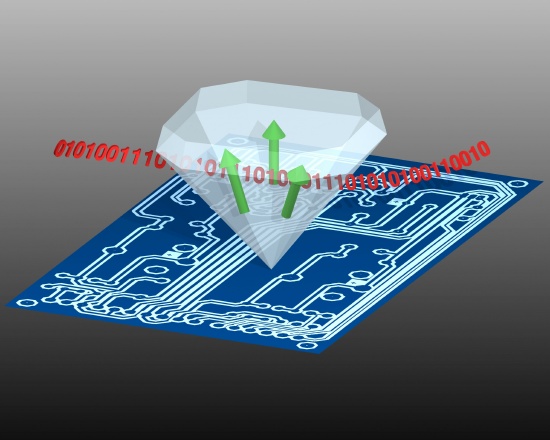
Researchers from the Physikalisches Institut of the University of Stuttgart have create entangled quantum states in diamond, which means there is finally a diamond men care about - namely the one that might some day be inside a quantum computer working at room temperature, a feat so far considered impossible for other materials.

While physicists have long described the world of atoms by quantum mechanics, one of its strangest characteristics, and the one that defies easy description, allows the linking of two objects without any noticeable interaction over a distance.

Einstein called this a 'spooky interaction.'

One of the most spectacular experiments based on this unusual entanglement characteristic is quantum teleportation, where the properties of one quantum object are transferred to another one at a remote location.

Maternal diet influences the chances of having male or female offspring, according to research in Reproductive Biology and Endocrinology. The study says that ewes fed a diet enriched with polyunsaturated fats for one month prior to conception have a significantly higher chance of giving birth to male offspring.

Polyunsaturated fats are essential nutrients. It is believed that the dietary ratio between omega-3 and omega-6 fats has important biological effects, especially in terms of inflammation, immunity and central nervous system signalling. The omega-6 fats used in this study were protected from digestion by naturally occurring rumen bacteria to ensure that they would be absorbed through the intestines of the sheep.

Synthetic biology seeks to apply the principles of engineering to biological systems and processes. Scientists believe that it may lead to new applications, such as new energy production systems, medical therapies, biological computers and innovative ways to clean up hazardous waste. In common with other modern technologies, it is potentially controversial because it raises issues of ownership, misuse, unintended consequences, and accidental release.

A report of an independent review of social and ethical challenges associated with synthetic biology and commissioned by the Biotechnology and Biological Sciences Research Council's (BBSRC) Bioscience for Society Strategy Panel is part of its program to analyze issues raised by this rapidly emerging area of science and technology.

Segregation or choice? That's always the concern when one gender is over-represented in one occupation, like psychology and education, and under-represented in others, like physics.

But one other aspect must be considered. At the cutting edge of science, things are competitive and women who combine raising children with research are going to have a tougher time, according to new figures presented in the latest Woman and Science report which shows that over 60% of researchers (six out of ten men and seven out of ten women) consider combining scientific activity with looking after children very difficult.

It's unlikely any society can ever have true balance in every field but if women are only highly represented in certain fields, like biology and medicine, there will be a search for reasons.

Seeing images inside the body is nothing new, either with an endoscope or even a camera the size of a candy. In the case of a camera, the inside of the intestine can be seen as it makes its way through the intestine and transmits images of the intestinal villi to an external receiver which the patient carries on a belt. This device stores the data so that the physician can later analyze them and identify any hemorrhages or cysts.

However, that sort of camera is not suitable for examinations of the esophagus and the stomach because it only takes about three or four seconds to make its way through the esophagus, producing two to four images per second, and once it reaches the stomach its roughly five-gram weight causes it to drop very quickly to the lower wall of the stomach. For examinations of the esophagus and the stomach, therefore, patients still have to swallow a rather thick endoscope.

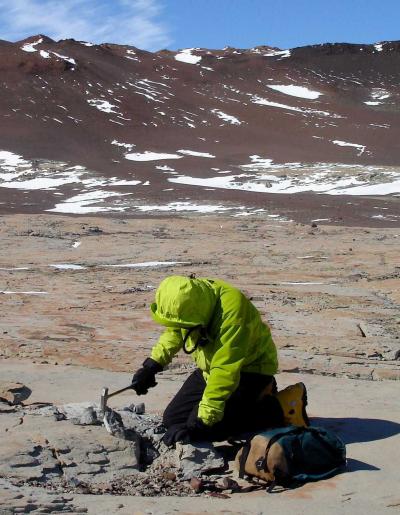
Paleontologists working in Antarctica have found fossilized burrows of tetrapods - land vertebrates with four legs or leglike appendages – dating from the Early Triassic epoch, about 245 million years ago.

The fossils were created when fine sand from an overflowing river poured into the animals' burrows and hardened into casts of the open spaces. The largest preserved piece is about 14 inches long, 6 inches wide and 3 inches deep. No animal remains were found inside the burrow casts, but the hardened sediment in each burrow preserved a track made as the animals entered and exited.

In addition, scratch marks from the animals' initial excavation were apparent in some places, said Christian Sidor, a University of Washington assistant professor of biology and curator of vertebrate paleontology at the Burke Museum of Natural History and Culture at the UW.

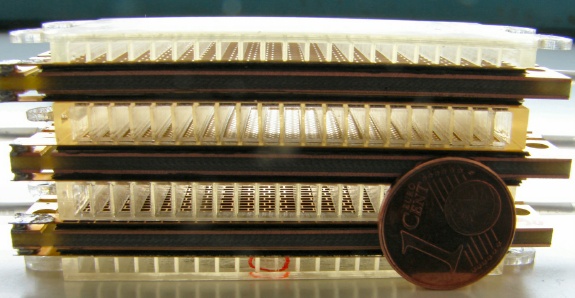
A chronic issue with fuel cells is that, in order to deliver a high enough power output, a lot of them have to be connected in series. Traditionally that has meant stacking the fuel cells – creating a structure consisting of several metal plates, each containing one channel for air and one for hydrogen - but this makes the fuel cell stack quite heavy.

Researchers from the Fraunhofer Institute for Reliability and Microintegration IZM, together with colleagues at the Technical University of Berlin, have developed a fuel cell that weighs only 30 grams yet has an output of 12 watts.

The high power density of 400 watts per kilogram has so far only been achieved in considerably larger systems weighing several hundred grams. The fuel cell is light enough to power a twenty-centimeter helicopter. It is being developed by the participants in an EU project, and will be used in future for missions such as locating victims trapped in fallen buildings, monitoring traffic or investigating tracts of land that have been contaminated by chemical accidents.

Technology-development studies at Cornell University and Jefferson Laboratory are showing how to use the brightest X-ray light ever generated for the scientific examination of everything from human proteins to forged art.

X-ray beams from an energy-recovery linac (linear accelerator) could be both a thousand times brighter and a thousand times faster--with pulses as brief as one ten-thousandth of a billionth of a second--than current state-of-the-art synchrotron X-ray sources.

"We're closer than ever to building a kind of universal toolkit for all the science and engineering disciplines," says Joel D. Brock, a Cornell University professor of applied and engineering physics.


