By studying heat-loving microbes, two research teams have gained new insight into how seemingly small differences in a single protein involved in DNA transcription and repair can lead to strikingly different genetic disorders in humans.

The two studies in the May 30th issue of Cell, a Cell Press publication, uncover the crystal structure and biochemical activity of an enzyme known as XPD helicase taken from Sulfolobus archaea, microbes distinct from bacteria that share many fundamental genes with humans.

For reasons that had remained rather mysterious until now, point mutations in human XPD—sometimes at neighboring sites—can spell the difference between cancer-prone xeroderma pigmentosa, the aging disorder known as Cockayne syndrome and another aging disorder called trichothiodystrophy.

The traditional Mediterranean diet provides substantial protection against type 2 diabetes, according to a study published on bmj.com today.

The Mediterreanean diet is rich in olive oil, grains, fruits, nuts, vegetables, and fish, but low in meat, dairy products and alcohol.

Current evidence suggests that such a diet has a protective role in cardiovascular disease, but little is known about its role on the risk of developing diabetes in healthy populations.

The SUN prospective cohort study involved over 13 000 graduates from the University of Navarra in Spain with no history of diabetes, who were recruited between December 1999 and November 2007, and whose dietary habits and health were subsequently tracked.

Do you ever get the feeling that science figures out a problem a few years after the fact, but then discovers that their methods for fixing the problem are also hopelessly outdated or just plain wrong, which puts us back another several years and at that point we may as well just give up and have wine with breakfast and hot fudge brownie sundaes for dinner? We know that Americans are fat. (If you don't believe me, look down - do you have a lap?) We also know that kids are getting fatter, which leads to a whole host of problems that will further tax our already overburdened health care system. Now, it seems as if maybe we're not getting fat as fast as we thought they were - although it could be a statistical aberration - and even if they are, we aren't sure if the diagnostic tools we have are relevant!
“Scientists these days tend to keep up a polite fiction that all science is equal. Except for the work of the misguided opponent whose arguments we happen to be refuting at the time, we speak as though every scientist's field and methods of study are as good as every other scientist's, and perhaps a little better. This keeps us all cordial when it comes to recommending each other for government grants.” Fighting words about the nature of the scientific enterprise as seen from the inside by a participating scientist. And what makes these sentences even more remarkable is that they were not uttered behind close doors in a room full of smoke, but printed in one of the premiere scientific magazines in the world, Science. It was 1964, the year I was born, and the author was John R. Platt, a biophysicist at the University of Chicago. The debate between scientists on what constitutes “hard” (i.e., good, sound) and “soft” (i.e., bad, sloppy) science has not subsided since.

Superconductivity was discovered in 1911 and has perplexed, astounded and inspired scientists since, but to most it can be thought of as "frictionless" electricity. In conventional electricity, heat is generated by friction as electrons (electric charge carriers) collide with atoms and impurities in the wire. This heating effect is good for appliances such as toasters or irons, but not so good for most other applications that use electricity.

In superconductors, however, electrons glide unimpeded between atoms without friction. If scientists and engineers ever harness this phenomenon at or near room temperature in a practical way, untold billions of dollars could be saved on energy costs.

That's a big "if." Superconductivity is still impractical in routine engineering use because it requires a very cold environment attainable only with the help of expensive cryogens such as liquid helium or liquid nitrogen. Past discoveries have helped scientists inch their way up the thermometer, from superconductors requiring minus 452 degrees Fahrenheit (or 4.2 Kelvin) to newer materials that superconduct at around minus 200 degrees F (138 K) Ñ still frigid, but substantially warmer and more practical.

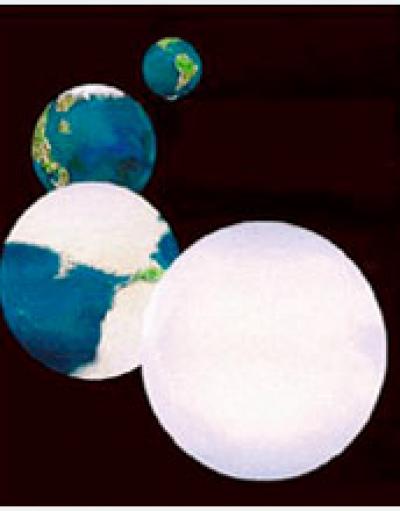
The snowball Earth hypothesis posits that the Earth was covered from pole to pole in a thick sheet of ice for millions of years at a time. 635 million years ago, an abrupt release of methane from ice sheets that extended to Earth's low latitudes spiked global warming and ended the last "snowball" ice age, say researchers. The researchers believe that the methane was released gradually at first and then very quickly from clathrates - methane ice that forms and stabilizes beneath ice sheets.

Also called marsh gas, methane is a colorless, odorless gas. As a greenhouse gas, it is about 30 times more potent than carbon dioxide. When the ice sheets became unstable, they collapsed, releasing pressure on the clathrates. The clathrates then began to de-gas.

This transition "from 'snowball Earth' into a warmer period shows the compelling need for research on abrupt climate change in Earth's history," said H. Richard Lane, program director in NSF's Division of Earth Sciences.

"The universe is a big place, and weird things can happen. I was flipping through archived Spitzer data of the object, and that's when I noticed it was surrounded by a ring we'd never seen before, "said Stephanie Wachter of NASA's Spitzer Science Center at the California Institute of Technology about a mysterious infrared ring a dead star that displays a magnetic field trillions of times more intense than Earth's.

NASA's Spitzer Space Telescope detected the ring around magnetar SGR 1900+14 at two narrow infrared frequencies in 2005 and 2007. The ringed magnetar is of a type called a soft gamma repeater (SGR) because it repeatedly emits bursts of gamma rays.

We started off discussing the value of consumerism to even the most devout naturalists with In Praise Of Consumerism - It Appeals To The Thoreau In You and then discussed the materialistic greed of nature herself in In Praise Of Consumerism - Bees, Bacteria And The Value Of Wasted Time. Now now we're going to wrap things up by suggesting that consumerism is not the root of all evil. In fact, we’re going to propose the opposite.

Consumerism is responsible for some of the most important events in Western civilization. Consumerism has produced empowerments that have radically upgraded the lives of even the poorest people on the planet. And consumerism has even advanced the grand ambition of biomassto kidnap, seduce, and dragoon as many iinanimate atoms as possible into the 3.85-billion-year-old enterprise of life.

We left off last time with a not-so-simple question; what does consumerism do for human beings? To answer that, let me show you how spirit spun into material goods lifts other spirits down the line.

The traders of Venice in 1270 AD were motivated by sheer consumerist lust. They were driven by the hunger of Europe’s rich to do what bower birds and stags do - show off luxuries rarer than those of their neighbors.

The son of a wealthy trading family, a family powered by consumer lust, would change history and our vision of nearly everything we see. He was financed and set into motion by the luxury consumer goods industry. But he left behind a seed of spirit that, like Jack’s magic bean turned to a giant stalk, would put the Western World on a heady climb.

What he planted in the Western mind would uplift the spiritual ruminations of Thoreau and his friend, Ralph Waldo Emerson, plus your spiritual aspirations and mine.


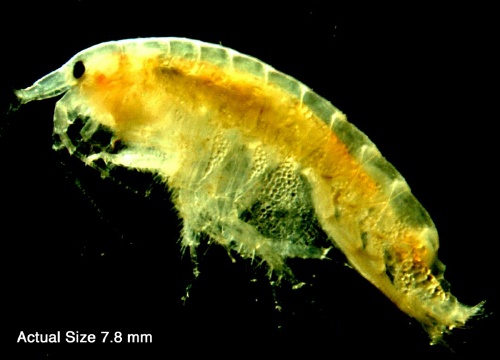
Throughout the overlooked depths of Lake Michigan and other Great Lakes, a small but important animal is rapidly disappearing.

Until recently, the animal - a shrimplike, energy-dense creature called Diporeia - was a major food source for commercially important species like lake whitefish and many prey fish upon which salmon, trout and walleye rely.

Scientists are employing new research methods in a quest to explain their population freefall, which threatens to negatively affect the Lakes' ecosystems and $4 billion sport fishing industry, said Purdue University researcher Marisol Sepúlveda.

Would you like a side of food poisoning with that salad?

Salmonella can infect plant cells and successfully evade all the defense mechanisms of plants so cleaning the surfaces of raw fruits and vegetables, e.g. by washing, is not sufficient to protect against food poisoning, according to a study published today.

The results of the project are based on a model plant, which also represents the ideal basis for future development work on treatment and testing systems in the area of food safety.

1.5 billion (!) cases of food poisoning are caused by Salmonella bacteria each year (World Health Organisation). If the bacteria survive particularly well in a person, they can even infect intestinal cells and persist for longer. Previously, the only known sources of infection were infected meat products and plants that had come into contact with contaminated water.