The government in the UK is proposing to change their NHS in response to complaints about waste, delays in treatment and quality concerns.

The new idea is to create 'polyclinics' - general practitioners and specialists in one location. Will it lead to better care or just more cost? The public is against it. Recent data from 1562 patients across 24 Primary Care trusts suggests that only 1 in 10 patients favor the polyclinic model over their current practice.

Michael Dixon, Chair of the NHS Alliance and Stewart Kay, Chair of the Londonwide Local Medical Committees (LMC’s), debated the issue on BMJ.com today - here and here.

An international team of scientists surveying the waters of the continental shelf off the West Coast of North America has discovered for the first time high levels of acidified ocean water within 20 miles of the shoreline, raising concern for marine ecosystems from Canada to Mexico.

Researchers aboard the Wecoma, an Oregon State University research vessel, also discovered that this corrosive, acidified water that is being “upwelled” seasonally from the deeper ocean is probably 50 years old, suggesting that future ocean acidification levels will increase since atmospheric levels of carbon dioxide have increased rapidly over the past half century.

“When the upwelled water was last at the surface, it was exposed to an atmosphere with much lower CO2 (carbon dioxide) levels than today’s,” pointed out Burke Hales, an associate professor in the College of Oceanic and Atmospheric Sciences at Oregon State University and an author on the Science study. “The water that will upwell off the coast in future years already is making its undersea trek toward us, with ever-increasing levels of carbon dioxide and acidity.

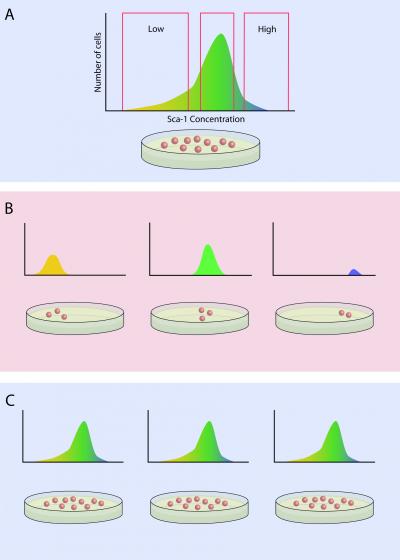
How does a stem cell decide what specialized identity to adopt – or simply to remain a stem cell? A new study suggests that the conventional view, which assumes that cells are “instructed” to progress along prescribed signaling pathways, is too simplistic. Instead, it supports the idea that cells differentiate through the collective behavior of multiple genes in a network that ultimately leads to just a few endpoints – just as a marble on a hilltop can travel a nearly infinite number of downward paths, only to arrive in the same valley.

The findings, published in the May 22 issue of Nature, give a glimpse into how that collective behavior works, and show that cell populations maintain a built-in variability that nature can harness for change under the right conditions. The findings also help explain why the process of differentiating stem cells into specific lineages in the laboratory has been highly inefficient.

Led by Sui Huang, MD, PhD, a Visiting Associate Professor in the Children’s Hospital Boston Vascular Biology Program (now also on the faculty of the University of Calgary), and Hannah Chang, an MD/PhD student in Children’s Vascular Biology Program, the researchers examined how blood stem cells “decide” to become white blood cell progenitors or red blood cell progenitors.
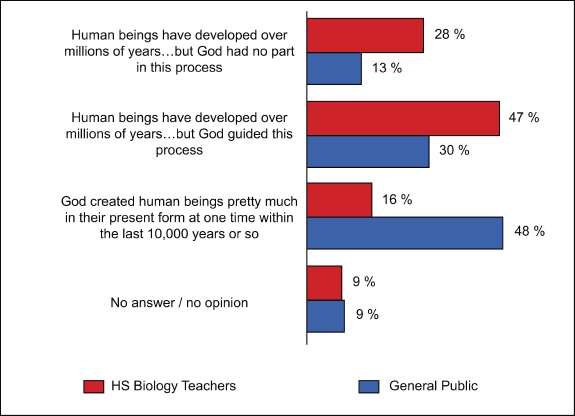
It is no exaggeration to call evolution “the central concept of biology.” So why is the fact of evolution denied by half of our population? A new article in PLoS Biology by Michael Berkman, Julianna Pacheco, and Eric Plutzer suggests it might be on account of their lack of education at the high school level. Since only ~25% of the US population obtains a college degree, it is the duty of high school teachers to provide a proper scientific education to our citizens. Model high school curriculum guidelines provided by the National Science Teachers Association, the National Research Council, and the American Association for the Advancement of Science, strongly suggest that teachers “provide evidence that evolution has attained its status as a unifying theme in science.”

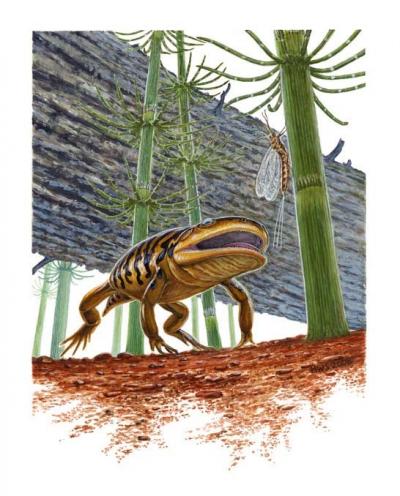
The description of an ancient amphibian that millions of years ago swam in quiet pools and caught mayflies on the surrounding land in Texas has set to rest one of the greatest current controversies in vertebrate evolution. The discovery was made by a research team led by scientists at the University of Calgary.

The examination and detailed description of the fossil, Gerobatrachus hottoni (meaning Hotton’s elder frog), proves the previously disputed fact that some modern amphibians, frogs and salamanders evolved from one ancient amphibian group called temnospondyls.

“The dispute arose because of a lack of transitional forms. This fossil seals the gap,” says Jason Anderson, assistant professor, University of Calgary Faculty of Veterinary Medicine and lead scientist in the study.

New imaging research shows that brain activity differs in sleep-deprived and well-rested people. The study, in the May 21 issue of The Journal of Neuroscience, shows that individuals who are sleep-deprived experience periods of near-normal brain function, but these periods are interspersed with severe drops in attention and visual processing.

They have shown for the first time what happens to the visual perceptions of healthy but sleep-deprived volunteers who fight to stay awake, like people who try to drive through the night. The scientists found that even after sleep deprivation, people had periods of near-normal brain function in which they could finish tasks quickly. However, this normalcy mixed with periods of slow response and severe drops in visual processing and attention.

During imaging, participants did a task that required visual attention. Researchers showed them large letters composed of many smaller letters. Participants were asked to identify either the large or small letters and to indicate their responses by pushing a button.

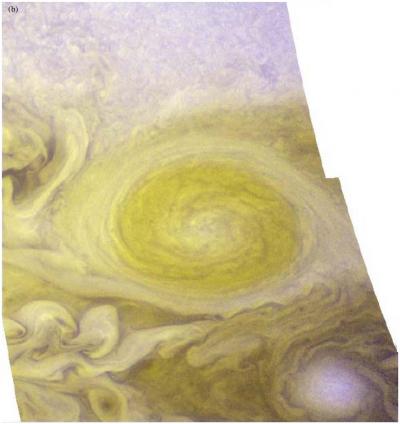
Using data from NASA’s New Horizons spacecraft and two telescopes on or near Earth, an international team of scientists has found that one of the solar system’s largest and newest storms – Jupiter’s Little Red Spot – has some of the highest wind speeds ever detected on any planet.

Jupiter’s "LRS" is an anticyclone, a storm whose winds circulate in the opposite direction to that of a cyclone – counterclockwise, in this case. It is nearly the size of Earth and as red as the similar, but larger and more well known, Great Red Spot (GRS). The dramatic evolution of the LRS began with the merger of three smaller white storms that had been observed since the 1930s. Two of these storms coalesced in 1998, and the combined pair merged with a third major Jovian storm in 2000. In late 2005 -- for reasons still unknown -- the combined storm turned red.

Researchers from the Laboratory of Intelligent Systems at Ecole Polytechnique Fédérale de Lausanne (EPFL) have unveiled unveiling a grasshopper-inspired jumping robot that weighs a miniscule 7 grams but can jump 1.4 meters - more than 27 times its body size. That's ten times farther for its size and weight than any existing jumping robot.

These jumpers could be fitted out with tiny sensors to explore rough, inaccessible terrain or to aid in search and rescue operations. "This biomimetic form of jumping is unique because it allows micro-robots to travel over many types of rough terrain where no other walking or wheeled robot could go," explains EPFL Professor Dario Floreano. "These tiny jumping robots could be fitted with solar cells to recharge between jumps and deployed in swarms for extended exploration of remote areas on Earth or on other planets."

A "CatCam” that captures feline-centric video of a forest and a new mathematical model are two elements of a new effort to explain how the brain’s visual circuitry processes real scenes.

The new model of the neural responses of a major visual-processing brain region promises to significantly advance understanding of vision.

The researchers sought to develop the new model because until now, studies of the visual system have used simple stimuli such as dots, bars and gratings.

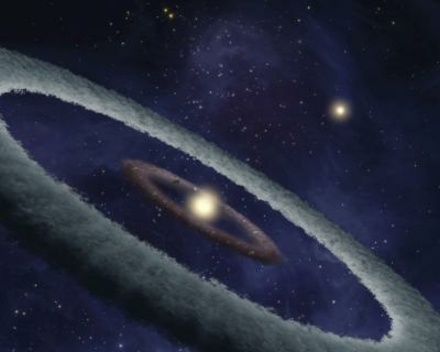
Two new exoplanets mean that the COROT mission(1) has now found a total of four new exoplanets in its 510 day journey. COROT started observations of its sixth star field at the beginning of May and, during this observation phase which will last 5 months, will simultaneously observe 12,000 stars.

The two new planets are gas giants of the hot Jupiter type, which orbit very close to their parent star and tend to have extensive atmospheres because heat from the nearby star gives them energy to expand. But an oddity dubbed ‘COROT-exo-3b’ has raised particular interest among astronomers. It appears to be something between a brown dwarf, a sub-stellar object without nuclear fusion at its core but with some stellar characteristics, and a planet. Its radius is too small for it to be a super-planet.