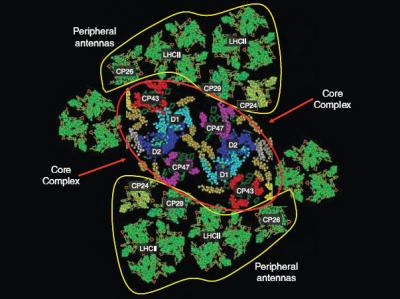









Photosynthesis is of great interest outside biology, specifically in the energy industry. Using photosynthesis, green plants are able to harvest energy from sunlight and convert it to chemical energy at an energy transfer efficiency rate of approximately 97 percent and if scientists can create artificial versions of photosynthesis, the dream of solar power as the ultimate green and renewable source of electrical energy could be realized.

However, a potential pitfall for any sunlight-harvesting system is that if the system becomes overloaded with absorbed solar energy, it most likely will suffer some form of damage. Plants solve this problem on a daily basis with a photo-protective mechanism called energy-quenching. Excess energy, detected by changes in pH levels, is safely dissipated from one molecular system to another, where it can then be routed down relatively harmless chemical reaction pathways.

In a study of the molecular mechanisms by which plants protect themselves from oxidation damage should they absorb too much sunlight during photosynthesis, a team of researchers has discovered a molecular “dimmer switch” that helps control the flow of solar energy moving through the system of light harvesting proteins. This discovery holds important implications for the future design of artificial photosynthesis systems that could provide the world with a sustainable and secure source of energy.

An international study has discovered 10 new genes related to human growth.

This meta-analysis, published in the latest issue of Nature Genetics, is based on data from more than 26,000 study participants. It verifies two already known genes, but also discovered ten new genes. Altogether they explain a difference in body size of about 3.5 centimeters.

The analysis produced some biologically insightful findings. Several of the identified genes are targeted by the microRNA let-7, which affects the regulation of other genes. This connection was completely unknown until now. Several other SNPs may affect the structure of chromatin, the chromosome-surrounding proteins. Moreover, the results could have relevance for patients with inherited growth problems, or with problems in bone development, because some of the newly discovered genes have rare mutations, known to be associated with anomalous skeletal growth. Further functional studies are necessary to completely elucidate the biological mechanisms behind this growing list of genes related to height.

A protein that is indispensable for passing on an accurate copy of the genome from mother to daughter cells can be compared to a cowboy’s lasso, say scientists at the The FIRC Institute of Molecular Oncology Foundation (IFOM).

It 'catches' chromosomes and ties them to a transitory structure assembled during cell division. Once they have been neatly tied up, the chromosomes await the end of replication to be equally distributed between the two daughter cells. But if the lasso doesn’t catch them, chromosomes end up being randomly scattered, with potentially disastrous genetic effects: should cells survive this, they receive the wrong genetic inheritance, with dire consequences.

This study opens up new avenues of research to reduce the toxicity of chemotherapy in the treatment of cancer.

Socrates (470-399 BC) may have lived centuries ago but the methods connected with him never go out of date.

Socratic methods(1) have developed independently in various countries. They all describe similar methodological steps - an opening question is answered by all participants and followed by cooperative, critical analysis. Finally, the new ideas are connected to the everyday life experience of the participants.

This formal structure helps participants to try new, bold ideas that they might otherwise not have tested. By cooperating when examining the ideas they also seem to learn a way to address problems on their own without teacher intervention.

The majority of people prefer to start counting on their left hand, regardless of whether they are left- or right-handed, found a recent set of experiments.

In a subsequent odd-even task, the left-starters had more consistent spatial-numerical associations than the right-starters.

Simple numerical tasks, such as classifying digits as odd or even by pressing left or right buttons reveal that we like to associate small numbers with left space.

Where does this preference come from?


Credit: Storyblocks

Designer labels aren't just cool to pretentious New York women - they're also the dream of nuclear physicists.

Designer isotopes, the relatively new power scientists have to make specific rare isotopes to solve scientific problems and open doors to new technologies, will compete with nanotechnology for big breakthroughs, according to Bradley Sherrill, a University Distinguished Professor of physics and associate director for research at the National Superconducting Cyclotron Laboratory at Michigan State University.

Isotopes are the different versions of an element. Their nuclei have different numbers of neutrons, and thus give them different properties. Rare isotopes don’t always exist in nature – they must be coaxed out with high-energy collisions created by special machines, like those in MSU’s Coupled Cyclotron facility. As technology advances, newer equipment is needed.

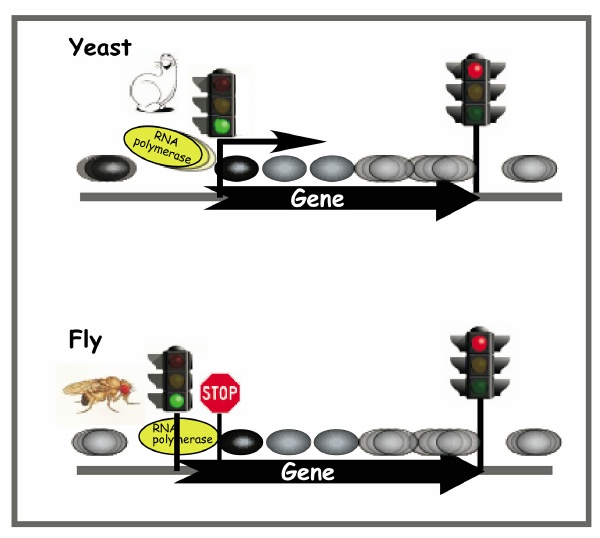
A team of scientists has provided, for the first time, a detailed map of how the building blocks of chromosomes, the cellular structures that contain genes, are organized in the fruit fly Drosophila melanogaster. The work identifies a critical stop sign for transcription, the first step in gene expression, and has implications for understanding how the AIDS virus regulates its genes.

The scientists found that nucleosomes--chromosomal building blocks made up of proteins around which DNA is coiled--occur at precise locations along genes that are actively undergoing transcription. They also showed that RNA polymerase--the enzyme that reads genes as the first step in making proteins--is stopped at the first nucleosome, where it remains idle until it is directed to continue moving forward.

Like video games? Want to also solve puzzles for science?

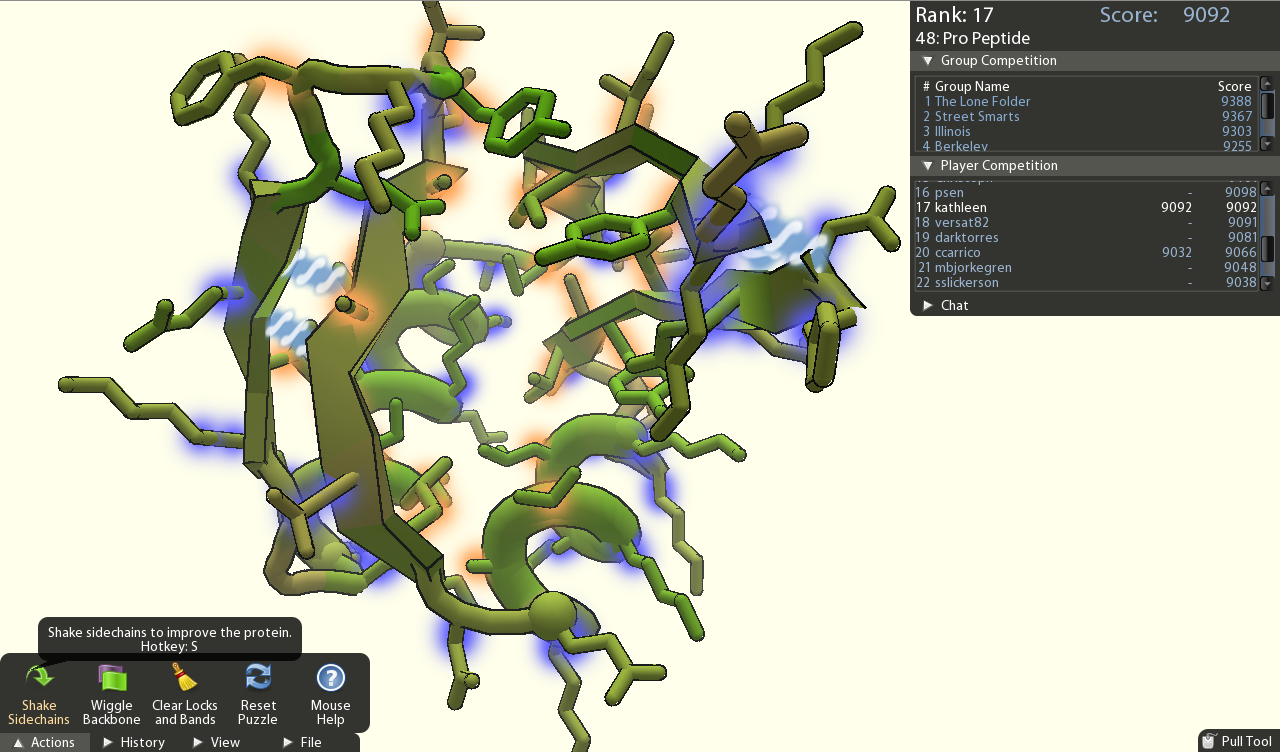
A new game, named Foldit, turns protein folding into a competitive sport. Introductory levels teach the rules, which are the same laws of physics by which protein strands curl and twist into three-dimensional shapes – key for biological mysteries ranging from Alzheimer's to vaccines.

After about 20 minutes of training, people feel like they're playing a video game but are actually mouse-clicking in the name of medical science.

Investigations continue into the cause of a mysterious illness that has resulted in the deaths of thousands of bats since March 2008. At more than 25 caves and mines in the northeastern U.S, bats exhibiting a condition now referred to as “white-nosed syndrome” have been dying.

The U.S. Geological Survey (USGS) recently issued a Wildlife Health Bulletin, advising wildlife and conservation officials throughout the U.S. to be on the lookout for the condition known as “white-nose syndrome” and to report suspected cases of the disease.

USGS wildlife disease specialist Dr. Kimberli Miller advises that "anyone finding sick or dead bats should avoid handling them and should contact their state wildlife conservation agency or the nearest U.S. Fish & Wildlife Service field office to report their observation.”

Neuroscientists at Johns Hopkins have discovered that mice lacking an enzyme that contributes to Alzheimer disease exhibit a number of schizophrenia-like behaviors. The finding raises the possibility that this enzyme may participate in the development of schizophrenia and related psychiatric disorders and therefore may provide a new target for developing therapies.

The BACE1 enzyme, for beta-site amyloid precursor protein cleaving enzyme, generates the amyloid proteins that lead to Alzheimer’s disease. The research team years ago suspected that removing BACE1 might prevent Alzheimer.

“We knew at the time that in addition to amyloid precursor protein, BACE1 interacts with other proteins but we didn’t know how those interactions might affect behavior,” says Alena Savonenko, M.D., Ph.D., an assistant professor in neuropathology at Hopkins.

