






Looking on the bright side can lead to irresponsible financial behavior, says Elizabeth Cowley from the University of Sydney. In a series of studies, Cowley examined repeated gambling in the face of loss. She finds that people often engage in too much positive thinking, selectively focusing on one win among hundreds of losses when they think back on the overall experience.

“When we want to justify engaging in an activity which could potentially be irresponsible – like gambling – we may need to distort our memory of the past to rationalize the decision,” Cowley explains. “People who have frequently spent more money than planned on gambling edit their memories of the past in order to justify gambling again.”

A genetic variation protects some people with heart failure, enabling them to live longer than expected, according to a research team led by investigators at the University of Maryland School of Medicine in Baltimore and the Washington University School of Medicine in St. Louis.

The researchers found that the genetic variation acts just like beta-blockers, a class of drugs used to treat chronic heart failure.

In the study, the researchers found that black heart failure patients with the genetic variation had a natural protection against death and the need for a heart transplant that is the same as the protection provided by beta-blocker therapy.

A close binary system of two candidate black holes in the quasar OJ 287 has shown Einstein some physics love. A central black hole, with a mass equal to 18 billion times that of the Sun, is orbited by a smaller one, and the interaction of the system with its surroundings produces brightness changes that allow astronomers to study the evolution of the orbit.

This evolution is dominated by one of the most intriguing predictions of Einstein's General Theory of Relativity: the emission of gravitational waves.

Astronomers believe that very massive black holes lurk at the centers of most galaxies but, as in the case of our own Galaxy, they often remain silent and are difficult to detect. In other cases where the black holes are surrounded by disks of material that fall onto them (accretion disks), the infalling material is heated and emits huge quantities of radiation: the active nucleus of a galaxy can appear, then, as a quasar.

A 240 million year-old Ichthyosauria specimen went on display at Tromsø University Museum in northern Norway. The Botneheia ichthyosaur, presumably a new species, was the largest predator of its day.

A team from the University of Tromsø, the Norwegian Polar Institute, and the University of Tübingen discovered the exceptionally large specimen at Svalbard, Norway. The preparation and exhibition of the fossil was sponsored by the Norwegian oil company StatoilHydro.

What species is it?

The fossil from the Botneheia Formation at Sauriedalen, Svalbard belongs to the Ichthyosauria (meaning ”fish-lizards”), a large group of marine reptiles that roamed the oceans for most of the Mesozoic. It is among the more “primitive” and early ichthyosaurs of the Triassic that the new find from Svalbard finds its place.
As no large ichthyosaurs have so far been described from the Middle Triassic of Svalbard, there is a high probability that one is dealing with a genus and species new to science.

A Yale University senior named Aliza Shvarts ignited the blogosphere with outrage yesterday, April 17, when the Yale student newspaper announced that Shvarts had artificially inseminated herself "as often as possible" over the past nine months and then periodically induced "miscarriages," all toward the goal of developing a "performance art" project in the School of Art at Yale. But there may be students on my campus who perform a similar type of "art" every week without much fuss.

It may all come down to the meaning of words.

There's a rule of science we normally overlook. That rule? Challenge your assumptions. See what you can derive from a new point of view. Buck the normal. Today, it is normal to hate consumerism. It's normal to loathe what consumerism has done to us...and what it has done to the planet. So as good scientists, let's go anti-conventional. Let's sing an ode in praise of consumerism. Let's see if reversing the normal point of view will produce any surprises.

In praise of consumerism? I know what you're thinking; this is a great subject for the brain-dead or folks who utterly lack a moral compass, like Donald Trump and Paris Hilton. But it’s certainly not a good subject for you and me.

The cost of providing a safety net for at-risk youth is $5,000 per year; the cost of housing a San Quentin inmate is $60,000 per year. Which would you prefer? -- -- -- -- -- -- -- -- What's your reaction when you see a young person begging for money, living in a park or under a freeway? Do you think, "Why don't you just get a job? In and Out Burgers pays $11.00 an hour. I'm not buying your beer." I admit to my own uneasiness and temptation to judge, and I also wonder what has happened to this young person that made them drop out? Who crushed their spirit? In 2003, M. Wald and T. Martinez conducted the Stanford University study "Connected by 25: Improving the Life Chances of the Country's Most Vulnerable 14-24 year olds." In that mouthful of study, they concluded that, "In our society, almost all youth require support until they have connected successfully with the labor force, which generally does not occur until the mid-twenties." Stanford also found that high school dropouts, those in the juvenile justice system and incarcerated youth are unlikely to reach age 25 without becoming homeless.

Teaching robots to understand enough about the real world to allow them act independently has proved to be much more difficult than first thought.

The technologies developed on the iCub platform – such as grasping, locomotion, interaction, and even language-action association – are of great relevance to further advances in the field of industrial service robotics.

The EU-funded RobotCub project, which designed the iCub, will send one each to six European research labs. Each of the labs proposed winning projects to help train the robots to learn about their surroundings – just as a child would.

Data from the ESA/NASA spacecraft SOHO shows clearly that powerful starquakes ripple around the Sun in the wake of mighty solar flares that explode above its surface. The observations give solar physicists new insight into a long-running solar mystery and may even provide a way of studying other stars.

The outermost quarter of the Sun’s interior is a constantly churning maelstrom of hot gas. Turbulence in this region causes ripples that criss-cross the solar surface, making it heave up and down in a patchwork pattern of peaks and troughs.

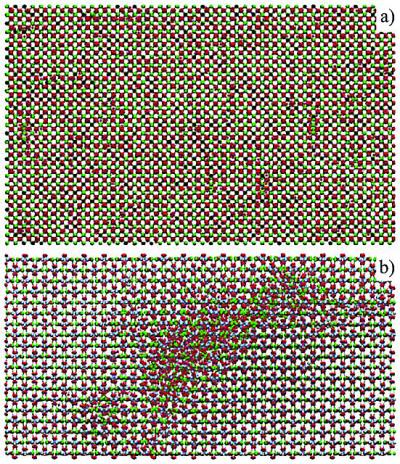
Researchers at the Department of Energy's Pacific Northwest National Laboratory found that the restless movement of oxygen atoms heals radiation-induced damage in the engineered ceramic yttria-stabilized zirconia.

This may lead to development of radiation-resistant materials for nuclear power plants and waste storage.

Scientists Ram Devanathan and Bill Weber modeled how well that ceramic and other materials stand up to radiation. "If you want a material to withstand radiation over millennia, you can't expect it to just sit there and take it. There must be a mechanism for self-healing," said Devanathan.


