






At the end of "Back To The Future", Doc shows up wearing futuristic clothes and possessing a swanky new addition to his DeLorean - a "Mr. Fusion" device so that he no longer required the Plutonium that caused all of the problems with the terrorists. He just threw in potato peels and a beer can (pouring in the beer first, for reasons that were scientifically unclear) and off they went.

It may not be fusion, but it's possible to turn garbage into fuel, say University of Maryland researchers. They started with bacteria from the Chesapeake Bay and came up with a process that may be able to convert large volumes of all kinds of plant products, from leftover brewer’s mash to paper trash, into ethanol and other biofuel alternatives to gasoline.

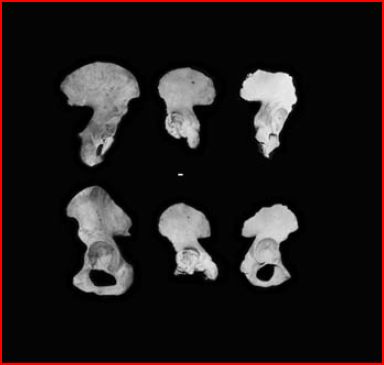
Since the reporting of the so-called “hobbit” fossil from the island of Flores in Indonesia, debate has raged as to whether these remains are of modern humans (Homo sapiens), reduced, for some reason, in stature, or whether they represent a new species, Homo floresiensis.

In a study funded by the National Geographic Society Mission Programs, Lee Berger and colleagues from the University of the Witwatersrand, Rutgers University and Duke University, describe the fossils of small-bodied humans from the Micronesian island of Palau. These people inhabited the island between 1400 and 3000 years ago and share some – although not all – features with the H.

The universe as we currently know it is made up of three physical dimensions of space and a relative one of time, but researchers in the Department of Physics and the Department of Electrical and Computer Engineering at Virginia Tech are exploring the possibility of an extra dimension.

“The idea we’re exploring is that the universe has an imperceptibly small dimension (about one billionth of a nanometer) in addition to the four that we know currently,” Kavic said. “This extra dimension would be curled up, in a state similar to that of the entire universe at the time of the Big Bang.”

The group is looking for small primordial black holes that, when they explode, may produce a radio pulse that could be detected here on Earth. These black holes are called primordial because they were created a fraction of a second after the beginning of the universe.

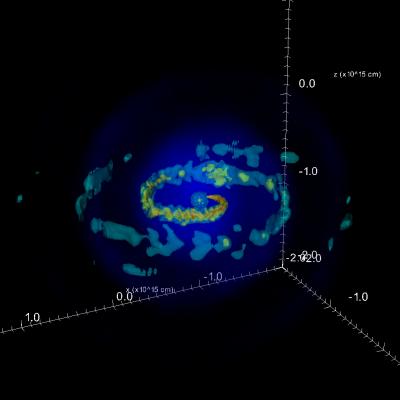
Astronomers at the University of Rochester have announced that low-mass stars and possibly even super-Jupiter-sized planets may be responsible for creating some of the most breathtaking objects in the sky.

The news is ironic because the name “planetary” nebula has always been a misnomer. When these objects were discovered 300 years ago, astronomers couldn’t tell what they were and named them for their resemblance to the planet Uranus. But as early as the mid-19th century, astronomers realized these objects are really great clouds of dust emitted by dying stars.

Rochester researchers now say they have found that planets or low-mass stars orbiting these aged stars may indeed be pivotal to the creation of the nebulae’s fantastic appearance.


Model of the spiral shock waves caused by a planet orbiting a dying star. Credit: University of Rochester

High-energy physicists devoted to recreating the conditions at the beginning of the universe have for the first time observed a new way to produce those basic particles of atoms, protons and neutrons.

Confirming a decades-old prediction, the physicists with the CLEO collaboration say they observed a rare and extremely short-lived subatomic particle with the unusual name of “charmed-strange meson” decay into a proton and anti-neutron.

Detection of the event was attributed to John Yelton, a physicist at the University of Florida, one of many institutions that are part of the CLEO collaboration.

When exotic species invade new territory, they often present a major threat to the other plants and animals living there, that much is clear, but in addition to their destructive tendencies, invasive species can also have a surprisingly “creative” side.

Researchers writing in Current Biology say they have discovered that an invasive population of the freshwater snail Melanoides tuberculata, found on the island of Martinique, harbors a tremendous amount of genetic variation for key life-history traits, such as fecundity, juvenile size, and age at first reproduction. And that means they have a remarkably large potential for evolutionary change.

Using a virtual pendulum and its real-world counterpart, scientists at the University of Illinois have created the first mixed reality state in a physical system. Through bi-directional instantaneous coupling, each pendulum “sensed” the other, their motions became correlated, and the two began swinging as one.

“In a mixed reality state there is no clear boundary between the real system and the virtual system,” said U. of I. physicist Alfred Hubler. “The line blurs between what’s real and what isn’t.”

In the experiment, Hubler and graduate student Vadas Gintautas connected a mechanical pendulum to a virtual one that moved under time-tested equations of motion. The researchers sent data about the real pendulum to the virtual one, and sent information about the virtual pendulum to a motor that influenced motion of the real pendulum.

Video games such as Second Life give users the freedom to create characters in the digital domain that look and seem more human than ever before but while they can have your hair or your hazel eyes, it's still just a pretty face.

A group of researchers from Rensselaer Polytechnic Institute is working to change that.

They are engineering characters with the capacity to have beliefs and to reason about the beliefs of others. The characters will be able to predict and manipulate the behavior of even human players, with whom they interact in the real world, according to the team.

New research suggests that humans are not as fooled as they seem when viewing visual illusions.

Ben-Gurion University of the Negev Psychologist Tzvi Ganel, writing in the March issue of Psychological Science, says we process images in two very distinct ways. He and his colleagues presented research participants with the “Ponzo” illusion, an image common in psychological research that makes two objects that are similar in length appear drastically different. They then hooked participants’ index finger and thumb to computerized position tracking equipment and asked them to grasp the objects with their fingers.

McFluoride

McFluoride

Mar 10 2008 | comment(s)

"I’ll take a burger and fries, hold the fluoride.” Fluoride? Serious scientists, who look, find fluoride in the darnedest places. Researchers from the University of Indiana School of Dentistry report in the scientific journal “Community Dentistry and Oral Epidemiology” that McDonald’s French fries deliver more than guilty pleasure. Your teeth bite into 0.13 milligrams fluoride along with that small portion of McDonald’s fries that goes upward to 0.38 mg in the supersize. So why do we need to know that? Because of fluoridation, where water engineers purposely add fluoride to water supplies to reduce tooth decay, and the billion dollar fluoride products industry, many Americans are fluoride over-dosed.


