



A national database containing images of ballistic markings from all new and imported guns sold in the U.S. should not be created at this time, says a new report from the National Research Council. Such a database has been proposed to help investigators link ballistics evidence -- cartridge cases or bullets found at crime scenes -- to a firearm and the location where it was originally sold.

But given the practical limitations of current technology for generating and comparing images of ballistic markings, searches of such an extensive database would likely produce too many candidate "matches" to be helpful, the report says.

Hardware piracy - making knock-off microchips based on stolen blueprints - has long been a chronic problem in the electronics industry. Computer engineers at the University of Michigan and Rice University have devised a comprehensive way to head off this costly infringement: Each chip would have its own unique lock and key. The patent holder would hold the keys. The chip would securely communicate with the patent-holder to unlock itself, and it could operate only after being unlocked.

The technique is called EPIC, short for Ending Piracy of Integrated Circuits. It relies on established cryptography methods and introduces subtle changes into the chip design process. But it does not affect the chips' performance or power consumption.

According to quantum mechanics, small magnetic objects called nanomagnets can exist in two distinct states (i.e. north pole up and north pole down). They can switch their state through a phenomenon called quantum tunneling.

When the nanomagnet switches its poles, the abrupt change in its magnetization can be observed with low-temperature magnetometry techniques used in del Barco’s lab. The switch is called quantum tunneling because it looks like a funnel cloud tunneling from one pole to another.

A new paper in Nature shows that two almost independent halves of a new magnetic molecule can tunnel, or switch poles, at once under certain conditions. In the process, they appear to cancel out quantum tunneling.

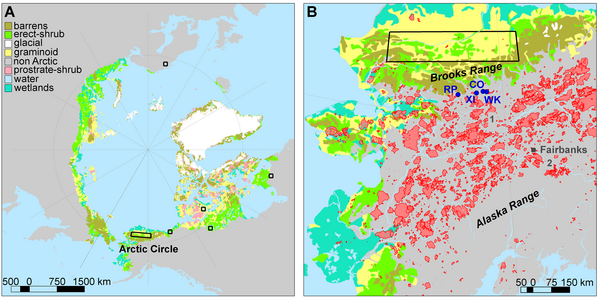
Research from ancient sediment cores indicates that a warming climate could make the world’s arctic tundra far more susceptible to fires than previously thought. The findings are important given the potential for tundra fires to release organic carbon – which could add significantly to the amount of greenhouse gases already blamed for global warming.

Montana State University post-doctoral researcher Philip Higuera is the lead author on the paper, which summarizes a portion of a four-year study funded by the National Science Foundation.

Butterflies and moths are well known for their striking metamorphosis from crawling caterpillars to winged adults. In light of this radical change, not just in body form, but also in lifestyle, diet and dependence on particular sensory cues, it would seem unlikely that learned associations or memories formed at the larval or caterpillar stage could be accessible to the adult moth or butterfly.

Now, scientists at Georgetown University have discovered that a moth can indeed remember what it learned as a caterpillar.

Just picture the scene: you’re at a cocktail party, talking to someone you would like to get to know better but the background noise is making it hard to concentrate. Luckily, humans are very gifted at listening to someone speaking while many other people are talking loudly at the same time. This so-called cocktail-party-phenomenon is based on the ability of the human auditory system to decompose the acoustic world into discrete objects of perception.

It was originally believed that the major acoustic cue used by the auditory system to solve this task was directional information of the sound source, but even though localisation of different sound sources with two ears improves the performance, it can be achieved monaurally, for example in telephone conversations, where no directional information is available.

Girolamo Fracastoro (also known as Hieronymus Fracastorius), was born in 1478 in Verona, at that time still part of the Republic of Venice, to a noble family. He studied at Padua University, where he graduated in 1502. At the same University, he was assigned the chair of Logic and Philosophy.

His teacher was the doctor-philosopher Pietro Pomponazzi and his study colleagues were Andrea Navagero, who became a noted historian, along with Pietro Bembo and Gaspare Contarini, both of whom became Cardinals.

Medicine was his passion but he was also a humanist and a scientist, he was interested in astronomy, mathematics, physics, botany, geology, geography, and even composition of verses. He was contemporary and friend to Nicolaus Copernico (Copernicus).

Many children with autism have elevated blood levels of serotonin – a chemical with strong links to mood and anxiety. But what relevance this “hyperserotonemia” has for autism has remained a mystery.

New research by Vanderbilt University Medical Center investigators provides a physical basis for this phenomenon, which may have profound implications for the origin of some autism-associated deficits.

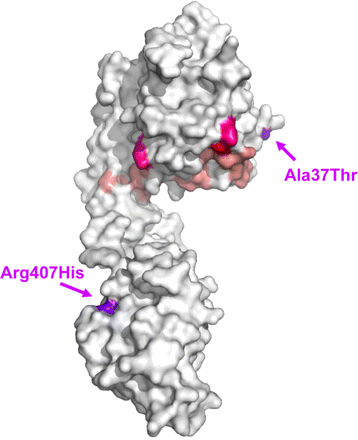
In an advance online publication in the Journal of Clinical Investigation, Ana Carneiro, Ph.D., and colleagues report that a well-known protein found in blood platelets, integrin beta3, physically associates with and regulates the serotonin transporter (SERT), a protein that controls serotonin availability.

Are smart people drawn to the arts or does arts training make people smarter? Or neither?

According to research led by Dr. Michael S. Gazzaniga of the University of California at Santa Barbara, children motivated in the arts develop attention skills and strategies for memory retrieval that also apply to other subject areas.

“A life-affirming dimension is opening up in neuroscience,” said Dr. Gazzaniga, “to discover how the performance and appreciation of the arts enlarge cognitive capacities will be a long step forward in learning how better to learn and more enjoyably and productively to live. The consortium’s new findings and conceptual advances have clarified what now needs to be done.”

Mutations in genes governing an important cell-signaling pathway influence human longevity, scientists at the Albert Einstein College of Medicine of Yeshiva University have found.

The report is the latest finding in the Einstein researchers’ ongoing search for genetic clues to longevity through their study that by now has recruited more than 450 Ashkenazi (Eastern European) Jews between the ages of 95 and 110. Descended from a small founder group, Ashkenazi Jews are more genetically uniform than other groups, making it easier to spot gene differences that are present.


