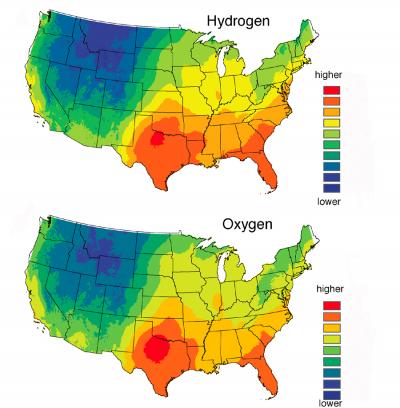






University of Utah scientists developed a new crime-fighting tool by showing that human hair reveals the general location where a person drank water, helping police track past movements of criminal suspects or unidentified murder victims.

“You are what you eat and drink – and that is recorded in your hair,” says geochemist Thure Cerling, who led the research effort with ecologist Jim Ehleringer. The new hair analysis method also may prove useful to anthropologists, archaeologists and medical doctors in addition to police.

“We have found significant variations in hydrogen and oxygen isotopes in hair and water that relate to where a person lives in the United States,” Ehleringer says.

There are currently no objective clinical laboratory blood tests for mood disorders. The current reliance on patient self-report of symptom severity and on the clinicians’ impression is a rate limiting step in effective treatment and new drug development.

Investigators from Indiana propose, and provide proof of principle for, an approach to help identify blood biomarkers for mood state. They measured whole-genome gene expression differences in blood samples from subjects with bipolar disorder that had low mood vs. those that had high mood at the time of the blood draw, and separately, changes in gene expression in brain and blood of a mouse pharmacogenomic model.

The rise of oxygen and the oxidation of deep oceans between 635 and 551 million years ago had an impact on the increase and spread of the earliest complex life, including animals, according to a study in PNAS.

The atmosphere had almost no oxygen until 2.5 billion years ago and it was not until about 600 million years ago that the atmospheric oxygen level rose to a fraction of modern levels. Geologists and evolutionary biologists have speculated that the rise of the breathing gas and subsequent oxygenation of the deep oceans are intimately tied to the evolution of modern biological systems.

A new tool called "Carbon Hero" was regional prize winner in the 2007 European Satellite Navigation Competition, sponsored by ESA’s Technology Transfer Programme. It uses satellite navigation technology to track journeys and tells people their carbon footprint.

“With Carbon Hero calculating your carbon footprint is easy,” explains Andreas Zachariah, a graduate student from the Royal College of Art in London and inventor of Carbon Hero. “This easy-to-use mobile system uses satellite navigation data to calculate the environmental impact of travel. With its specialist database and algorithm, it can determine the mode of transport and its environmental impact with almost no user input.”

The United States is the world's top corn grower, producing 44 percent of the global crop. In 2007, U.S. farmers produced a record 13.1 billion bushels of corn, an increase of nearly 25 percent over the previous year, according to the U.S. Department of Agriculture. The 2007 production value of corn was estimated at more than $3 billion. Favorable prices, a growing demand for ethanol and strong export sales have fueled an increase in farmland acreage devoted to corn production.

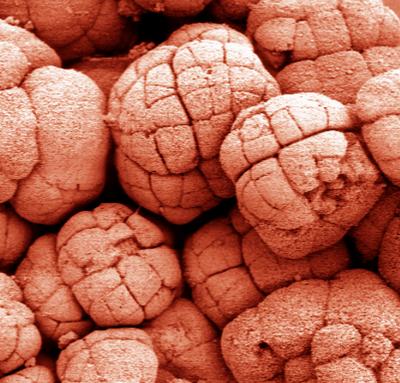
A team of scientists have completed a working draft of the corn genome, an accomplishment that should accelerate efforts to develop better crop varieties to meet society's growing demands for food, livestock feed and fuel.

Corn, also known as maize, underlies myriads of products, from breakfast cereal, meat and milk to toothpaste, shoe polish and ethanol.

The pea is an important crop species but it is unsuited to the Agrobacterium-based genetic modification techniques that are commonly used to work with crops. Researchers have now discovered the first high-throughput forward and reverse genetics tool for the pea (Pisum sativum) and it could have major benefits for crop breeders around the world.

Researchers from the INRA Plant Genomics Research Unit at Evry, and the INRA Grain Legumes Research Unit at Bretenières, both in France, developed a high-quality genetic reference collection of Pisum sativum mutants within the European Grain Legumes Integrated Project.

Abdelhafid Bendahmane and colleagues used plants from an early-flowering garden pea cultivar, Caméor, to create a mutant population, which they then systematically phenotyped for use in both forward and reverse genetics studies.

An intrepid archaeologist is well on her way to dislodging the prevailing assumptions of scholars about the people who built and used Maya temples.

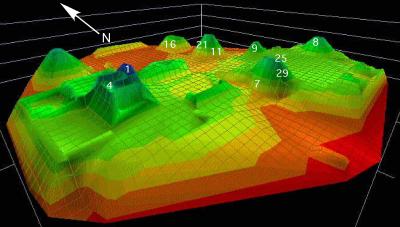
From the grueling work of analyzing the “attributes,” the nitty-gritty physical details of six temples in Yalbac, a Maya center in the jungle of central Belize – and a popular target for antiquities looters – primary investigator Lisa Lucero is building her own theories about the politics of temple construction that began nearly two millennia ago.

Her findings from the fill, the mortar and other remnants of jungle-wrapped structures lead her to believe that kings weren’t the only people building or sponsoring Late Classic period temples (from about 550 to 850), the stepped pyramids that rose like beacons out of the southern lowlands as ea

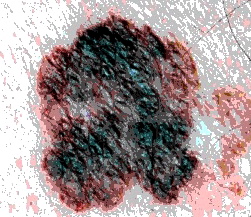
Malignant Melanoma is the most aggressive of malignant cutaneous tumours. Cases with lymphonode involvement, and distant metastases, carry a very poor prognosis, (50% and 20% respectively alive in 5 years), while those presenting without evident lymphonode involvement have a much better survival rate (60% alive in 5 years).

It is therefore extremely important to do early malignant melanoma diagnosis. There are several criteria that may lead to the diagnosis of a malignant melanoma. The most important one is the ABCD rule.

The ABCD diagnosis of Malignant Melanoma -
The case of a 47 year-old woman presenting a wide abdominal zone with vitiligo like hypopigmentation is reported.

In 1977 she underwent, in the same site, melanoma (III Clarke's level) extirpation and local immunotherapy by DNCB ( dinitrochlorobenzene ).

Moshe Inbar et Al. ( Melanoma Research 1996/6/457-459 ) refers a case of melanoma, treated by DNCB in 1973, showing, the new skin, over the back, characterized by vitiligo like hypopigmentation and lack of hair.

Scientists have discovered Antarctic krill (Euphausia superba), a shrimp-like crustacean thought to live only in the upper ocean, are living and feeding down to depths of 3000 metres in the waters around the Antarctic Peninsula. The discovery completely changes scientists’ understanding of the major food source for fish, squid, penguins, seals and whales.

Antarctic krill feed on phytoplankton and are in turn eaten by a wide range of animals including fish, penguins, seals and whales. Phytoplankon are the starting point for the marine food chain and use photosynthesis to extract carbon from carbon dioxide.

