





Mood and anxiety disorders are the most common mental disorders but psychiatrists remain divided as to how to define and classify them.

Definitions in the upcoming Diagnostic and Statistical Manual (DSM-V), the “gold standard” reference book for psychiatrists will have at least have the benefit of high quality longitudinal data.

Ian Colman, Ph.D., lead author of “A Longitudinal Typology of Symptoms of Depression and Anxiety Over the Life Course”, notes, “Rarely have classification systems in psychiatry considered the nature of symptoms of depression and anxiety over time; however research into trajectories of alcohol abuse and antisocial behaviour shows that accounting for symptoms over time may help in better understanding causes and outcomes of these disorders.”

Cancer patients are suffering unnecessarily because they wrongly believe that morphine and other opioids are only used as “comfort for the dying” and as a “last resort” rather than seeing them as legitimate pain killers that can improve their quality of life.

In a study published in the cancer journal Annals of Oncology [1], experts in palliative care also say “the belief that opioids hasten death is widely held” amongst patients and this “has a significant impact on pain management, as patients felt that an offer of opioids signified imminent death”. Previous studies have estimated that between 40-70% of cancer patients may not have their pain properly controlled with the right medication for a variety of reasons.

It has been 35 years since humans last walked on the moon, but there has been much recent discussion about returning, either for exploration or to stage a mission to Mars.

Although psychiatrists are among the least religious physicians, they seem to be the most interested in the religious and spiritual dimensions of their patients, according to survey data published in the December issue of the American Journal of Psychiatry.

Ever since Freud described religious faith as an illusion and a neurosis there has been tension and at times hostility between religion and psychiatry. Psychiatrists are less religious on average than other physicians, according to previously published data from the same survey, and non-psychiatrist physicians who are religious are less willing to refer their patients to psychiatrists.

Polybrominated diphenyl ethers (PBDEs), chemicals used as fire retardants, can be found in numerous items in the home, such as the television, computer, toaster and the sofa. Now, as reported in a KNBC story on Nov. 28, they are being found in alarming concentrations, in human blood and breast milk – a potentially major concern for human health.

In addition, these industrial chemicals have been associated with cases of feline hyperthyroidism, a potentially fatal condition in cats.

UC Riverside scientists interviewed for the KNBC story have done research using rat tissue that shows that PBDEs disrupt mechanisms that are responsible for releasing hormones in the body.

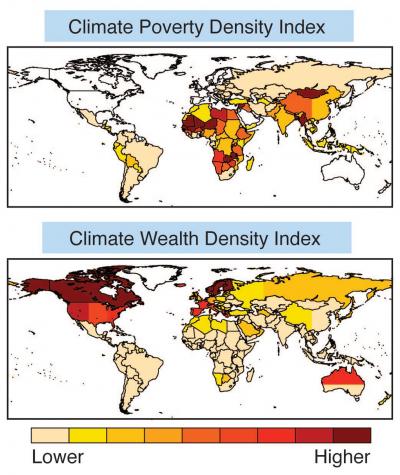
As the United Nations climate negotiations proceed in Bali, Indonesia, researchers have taken a first step toward quantifying the "socioclimatic" exposure of different countries to future climate change.

The research team from Purdue University and the Abdus Salam International Centre for Theoretical Physics in Trieste, Italy, found that China, India and the United States - major greenhouse gas-emitting nations that are currently unbound by the Kyoto treaty - face substantial exposure relative to other nations, but that every area of the world faces high exposure in at least one category.


This image illustrates the projected relative exposure for each country given expected 21st century climate change and

When a female is attracted to a male, entire suites of genes in her brain turn on and off, show biologists from The University of Texas at Austin studying swordtail fish.

Molly Cummings and Hans Hofmann found that some genes were turned on when females found a male attractive, but a larger number of genes were turned off.

“When females were most excited—when attractive males were around—we observed the greatest down regulation [turning off] of genes,” said Cummings, assistant professor of integrative biology. “It’s possible that this could lead to a release of inhibition, a transition to being receptive to mating.”

A new genus and species of dinosaur from the Early Jurassic has been discovered in Antarctica. The massive plant-eating primitive sauropodomorph is called Glacialisaurus hammeri and lived about 190 million years ago.

The recently published description of the new dinosaur is based on partial foot, leg and ankle bones found on Mt. Kirkpatrick near the Beardmore Glacier in Antarctica at an elevation of more than 13,000 feet.

“The fossils were painstakingly removed from the ice and rock using jackhammers, rock saws and chisels under extremely difficult conditions over the course of two field seasons,” said Nathan Smith, a graduate student at The Field Museum.

We all know that if there's one thing certain to happen to professional tennis players who get hurt in skydiving accidents, it's that a clandestine para-military organization will swoop in and replace the now defective natural parts with über-awesome cybernetic ones.

A collaboration of over 50 astronomers, The IPHAS consortium, led from the UK, with partners in Europe, USA, Australia, has released today (10th December 2007) the first comprehensive optical digital survey of our own Milky Way. Conducted by looking at light emitted by hydrogen ions, using the Isaac Newton Telescope on La Palma, the survey contains stunning red images of nebulae and stars. The data is described in a paper submitted to the Monthly Notices of the Royal Astronomical Society.

To date, the IPHAS survey includes some 200 million unique objects in the newly released catalogue. This immense resource will foster studies that can be at once both comprehensive and subtle, of the stellar demographics of the Milky Way and of its three-dimensional structure.

