






Vanessa Hull, 25, a Ph.D. candidate at Michigan State University, is in the snowy, remote mountains of the Sichuan Province of China--the heart of panda habitat. She's hoping to capture, collar and track up to four wild pandas using advanced global positioning systems.

Along with her research gear, Hull, a National Science Foundation (NSF) Graduate Fellow and MSU University Distinguished Fellow, is lugging a small digital video camera and a laptop computer.

NASA's Voyager 2 spacecraft has entered a vast region at the edge of our solar system where the solar wind runs up against the thin gas between the stars, called the heliosheath, and what it found is surprising - our solar system is 'dented.'

Voyager 2 entered the heliosheath on August 30, 2007, crossing the heliosheath boundary, called the solar wind termination shock, about 10 billion miles away from Voyager 1 and almost a billion miles closer to the sun, and confirmed that our solar system is “squashed” – that the bubble carved into interstellar space by the solar wind is not perfectly round.

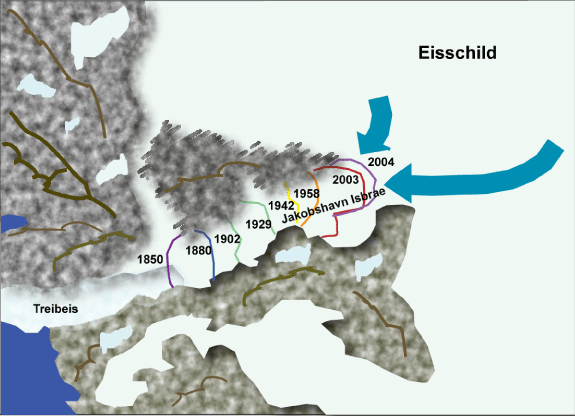
Two researchers have found that the effects of the current warming and melting of Greenland 's glaciers that has alarmed the world's climate scientists occurred in the decades following an abrupt warming in the 1920s.

Their evidence reinforces the belief that glaciers and other bodies of ice are exquisitely hyper-sensitive to climate chang.

Using weather station records from the past century, they recently recognized that temperatures in Greenland had warmed in the 1920s at rates equivalent to the recent past. But they hadn't confirmed that the island's glaciers responded to that earlier warming until now.


1850-2004.

Microbes could provide a clean, renewable energy source and use up carbon dioxide in the process, suggested Dr James Chong at a Science Media Centre press briefing today.

“Methanogens are microbes called archaea that are similar to bacteria. They are responsible for the vast majority of methane produced on earth by living things” says Dr Chong from York University. “They use carbon dioxide to make methane, the major flammable component of natural gas. So methanogens could be used to make a renewable, carbon neutral gas substitute.”

Crohn’s is a condition that affects one in 800 people in the UK and causes chronic intestinal inflammation, leading to pain, bleeding and diarrhoea.

The team found that a bacterium called Mycobacterium paratuberculosis releases a molecule that prevents a type of white blood cell from killing E.coli bacteria found in the body. E.coli is known to be present within Crohn’s disease tissue in increased numbers.

It is thought that the Mycobacteria make their way into the body’s system via cows’ milk and other dairy products. In cattle it can cause an illness called Johne's disease - a wasting, diarrhoeal condition. Until now, however, it has been unclear how this bacterium could trigger intestinal inflammation in humans.

Researchers discovered genetic evidence that human evolution is speeding up – and has not halted or proceeded at a constant rate, as had been thought – indicating that humans on different continents are becoming increasingly different.

“We used a new genomic technology to show that humans are evolving rapidly, and that the pace of change has accelerated a lot in the last 40,000 years, especially since the end of the Ice Age roughly 10,000 years ago,” says research team leader Henry Harpending, a distinguished professor of anthropology at the University of Utah.

Harpending says there are provocative implications from the study, published Dec. 10 in the journal Proceedings of the National Academy of Sciences:

LONDON, December 10 /PRNewswire/ --

- New research announced this week has found an association between certain genes and the severity of multiple sclerosis (MS).

The results of the study by Prof George Ebers, Chair of Clinical Neurology at the Wellcome Trust Centre for Human Genetics, will be published in the journal Proceedings of the National Academy of Sciences and represent a step forward in the understanding of the role of genetics in MS.

The study involved comparing genes from people with severe MS who used wheelchairs within five years of being diagnosed and people who had no disability 20 years after diagnosis.

Imagine you are sitting around a campfire. If you move closer to the fire you get hotter. If you move awayy ou get cooler. Pretty basic, right?

Our closest star, the sun, doesn't follow those rules. As you move away from the solar surface, into the sun's outer atmosphere (the corona) it actually gets a lot hotter before it cools off. The solar surface is about 10,000 degrees Fahrenheit, while temperatures in the corona soar to millions of degrees.

Although scientists have some ideas of what might heat the solar corona, there is no universally accepted explanation.

Countering a common theory that human evolution has slowed to a crawl or even stopped in modern humans, a new study examining data from an international genomics project describes the past 40,000 years as a time of supercharged evolutionary change, driven by exponential population growth and cultural shifts.

In a study published in the Dec. 10 issue of the Proceedings of the National Academy of Sciences (PNAS), a team led by UW-Madison anthropologist John Hawks estimates that positive selection just in the past 5,000 years alone — around the period of the Stone Age — has occurred at a rate roughly 100 times higher than any other period of human evolution.

You study the menu at a restaurant and decide to order the steak rather than the salmon. But when the waiter tells you about the lobster special, you decide lobster trumps steak. Without reconsidering the salmon, you place your order—all because of a trait called “transitivity.”

“Transitivity is the hallmark of rational economic choice,” says Camillo Padoa-Schioppa, a postdoctoral researcher in HMS Professor of Neurobiology John Assad’s lab. According to transitivity, if you prefer A to B and B to C, then you ought to prefer A to C. Or, if you prefer lobster to steak, and steak to salmon, then you will prefer lobster to salmon.

