





Some anti-drinking advertising campaigns may be “catastrophically misconceived” because they play on the entertaining ‘drinking stories’ that young people use to mark their social identity, say researchers who have just completed a three year study of the subject.

Adverts that show drunken incidents, such as being thrown out of a nightclub, being carried home or passing out in a doorway, are often seen by young people as being a typical story of a ‘fun’ night out, rather than as a cautionary tale.

Whilst these adverts, such as Diageo’s thechoiceisyours campaign, imply that being very drunk with friends carries a penalty of social disapproval, for many young people the opposite is often the case.

While the biological basis for homosexuality remains a mystery, a team led by University of Illinois at Chicago researcher David Featherstone has discovered that sexual orientation in fruit flies is controlled by a previously unknown regulator of synapse strength.

Armed with this knowledge, the researchers found they were able to use either genetic manipulation or drugs to turn the flies' homosexual behavior on and off within hours.

Featherstone, associate professor of biological sciences at UIC, and his coworkers discovered a gene in fruit flies they called "genderblind," or GB. A mutation in GB turns flies bisexual.

One gene for pea pod color generates green pods while a variant of that gene gives rise to the yellow-pod phenotype, a feature that helped Gregor Mendel, the 19th century Austrian priest and scientist, first describe genetic inheritance. However, many modern-day geneticists are focused on the strange ability of some genes to be expressed spontaneously in either of two possible ways.

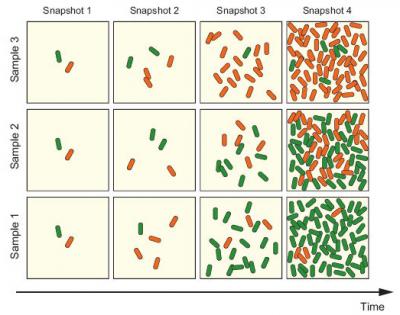
In order to better understand this phenomenon of epigenetic multistability, a major complication for Mendelian genetics, scientists at UC San Diego grew virtual bacterial cells in a computer experiment. They created a two-phenotype model system programmed to grow in ways that matched natural growth.

Policy makers, employers and others can use the science of behavioral economics to steer people toward wiser choices — and dramatically improve their health — without limiting their freedom to do as they please, according to an article in the Journal of the American Medical Association (JAMA). The paper was written by researchers at Carnegie Mellon University, the University of Pennsylvania, Aetna Inc. and the Philadelphia Veterans Affairs Medical Center.

This approach can counter one of the underlying causes of major health problems in the United States and other developed nations — bad decision-making on the part of individuals. Tobacco use, obesity and alcohol abuse account for nearly one-third of all deaths in the United States.

Gary Taubes spoke at Berkeley a few weeks ago; the title of his talk was “The Quality of Calories: What Makes Us Fat and Why No One Seems to Care” (webcast).

Did you know that the last edition of Dr. Spock’s baby book advocated a vegan diet? One of many fascinating details.

Also this:

A new study by a Penn State College of Medicine research team found that honey may offer parents an effective and safe alternative than over the counter children's cough medicines.

The study found that a small dose of buckwheat honey given before bedtime provided better relief of nighttime cough and sleep difficulty in children than no treatment or dextromethorphan (DM), a cough suppressant found in many over-the-counter cold medications.

Honey did a better job reducing the severity, frequency and bothersome nature of nighttime cough from upper respiratory infection than DM or no treatment. Honey also showed a positive effect on the sleep quality of both the coughing child and the child’s parents. DM was not significantly better at alleviating symptoms than no treatment.

In a study of more than 6,000 Los Angeles-area children – the largest study of its kind – researchers at the Keck School of Medicine of the University of Southern California (USC) found that both strabismus (commonly known as cross-eyed or wall-eyed) and amblyopia (often referred to as lazy eye) were more prevalent in older children than in younger children. The study was in the journal Ophthalmology.

The population for this first phase of the Multi-Ethnic Pediatric Eye Disease Study (MEPEDS) was composed equally of African-American and Hispanic youngsters, ages six months to six years, who reside in the Los Angeles County community of Inglewood.

After grabbing headlines for years as the ultimate solution to world energy problems, the “hydrogen economy” has an emerging but lesser-known competitor called the “methanol economy,” according to an article in Chemical & Engineering News.

In the article, C&EN Associate Editor Jyllian Kemsley describes how methanol, an alcohol like ethanol, shows increasing promise as an alternative energy source with advantages over both ethanol and hydrogen.

A methanol economy — championed in a 2006 book by chemistry Nobel Laureate George Olah — would not be dependent on bumper crops of corn and could provide lower tailpipe emissions and a reduced fire hazard.

Scientists in France are reporting for the first time that sculptors from the fantastically wealthy ancient Empire of Mali — once the source of almost half the world’s gold — used blood to form the beautiful patina, or coating, on their works of art.

In a study published in Analytical Chemistry, Pascale Richardin and colleagues describe development of a new, noninvasive test that accurately identifies traces of blood apparently left on ancient African artifacts used in ceremonies involving animal sacrifices.

Archaeologists often had reported or suspected the presence of blood on many African artifacts, the study points out. However, accurately identifying the presence of blood was difficult because of the tiny amounts of blood remaining over the ages.

Scientists in New York are reporting development of a new biodegradable “nanohybrid” plastic that can be engineered to decompose much faster than existing plastics used in everything from soft drink bottles to medical implants. The study is scheduled for the Nov. issue of ACS’ Biomacromolecules.

The plastic is a modified form of polyhydroxybutyrate (PHB), a promising biodegradable plastic produced from bacteria that has been widely hailed as a “green” alternative to petroleum-based plastic for use in packaging, agricultural and biomedical applications. Although commercially available since the 1980s, PHB has seen only limited use because of its brittleness and unpredictable biodegradation rates.

