


In a new thesis, 60 garments from Swedish and international clothing chains have been tested and though around a hundred chemicals were preliminary identified, several of the substances were not on the producers' lists and are suspected to be by-products, residues or chemicals added during transport.

Dependent on occurrence, quantity, toxicity and how easily they may penetrate the skin, four groups of substances were chosen for further analysis. The highest concentrations of two of these, quinolines and aromatic amines, were found in polyester. Cotton contained high concentrations of benzothiazoles, even clothes made from organic cotton.

Understanding of methane-metabolizing organisms might have to be rethought after researchers announced discovery of two new ones.

 The discovery of the novel methane-metabolizing microorganisms was made using techniques that sequence DNA on a large scale and assemble these sequences into genomes using advanced computational tools. 

"Traditionally, these type of methane-metabolizing organisms occur within a single cluster cluster group of microorganisms called Euryarchaeota. This makes us wonder how many other types of methane-metabolizing microorganisms are out there?" asked Gene Tyson, associate professor and Deputy Head of University of Queensland's Australian Centre for Ecogenomics in the School of Chemistry and Molecular Biosciences.  

The identification of a protein that selectively clears damaged chloroplasts from plant cells reveals how plants maintain a "clean workshop" during the process of photosynthesis. Chloroplasts play an important role in transforming light into useable energy for plants, but when these energy powerhouses are damaged, they release harmful substances. When the plant detects this damage, signals are sent to genes involved in chloroplast function and stress adaptation.

At 8 a.m. EDT on October 23, 2015, the National Hurricane Center said that Hurricane Patricia had grown into a monster hurricane. In fact, it is the strongest eastern north pacific hurricane on record. NASA-NOAA's Suomi NPP satellite analyzed the temperatures and structure within the storm as it passed overhead.

On October 23, a Hurricane Warning was in effect from San Blas to Punta San Telmo. A Hurricane Watch was in effect from east of Punta San Telmo to Lazaro Cardenas and a Tropical Storm Warning was in effect from east of Punta San Telmo to Lazaro Cardenas.

A year of treatment with nicotinamide, a form of vitamin B3, significantly lowered the risk of common, non-melanoma skin cancer in high-risk patients, according to a paper in the New England Journal of Medicine.

All 386 participants in the study had a history of skin cancer, increasing their risk for additional skin cancers. Taken as a twice-daily pill for 12 months, nicotinamide reduced the incidence of new non-melanoma skin cancers by 23 percent relative to placebo controls and cut the incidence of pre-cancerous sun spots by around 15 percent. 

Researchers don’t always get it right. Scientists used to toiling in obscurity on arcane subjects can be lured into presenting hyperbolic conclusions from a media that demands sensational headlines, and confirmation bias remains a powerful psychological force within the scientific community.

So what does the media do when honest researchers realize their attention-getting findings were simply wrong? 

If this case of “bee addiction” is any indicator, the answer is nothing.

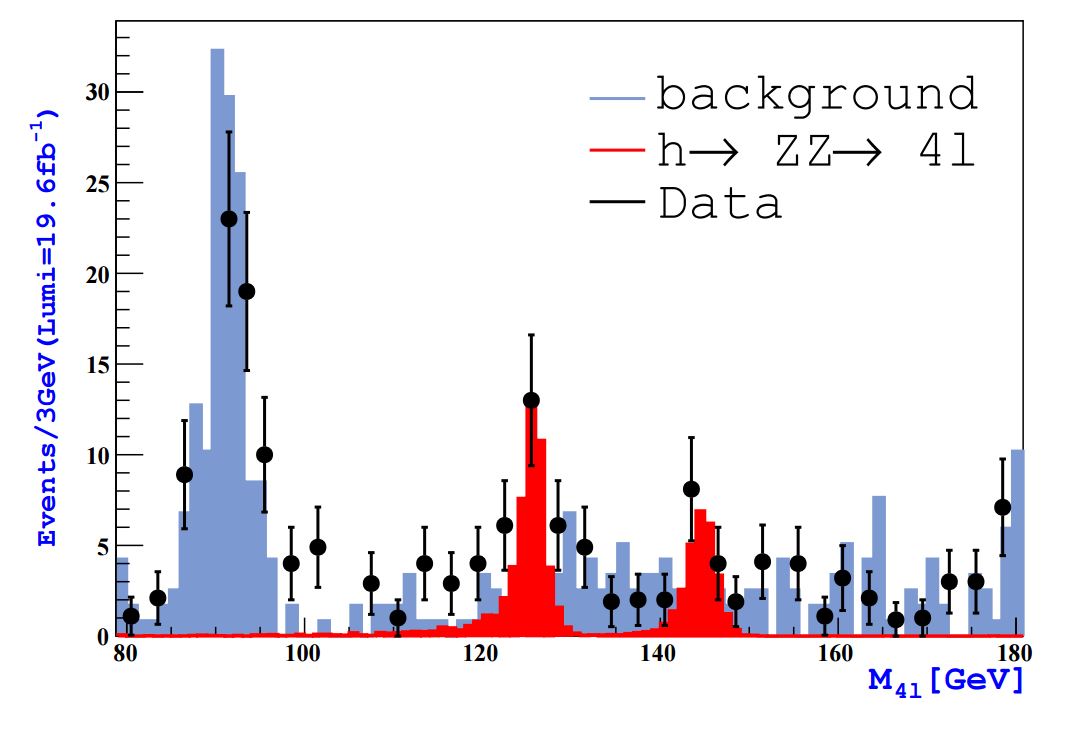
A longtime follower of this blog, Tony Smith, pointed out to me today this arxiv paper published three days ago. In it, CMS data from Run 1 of the LHC are used to speculate that there might be a second Higgs boson hiding in the data at a mass of about 145 GeV. Check out the two graphs that they produce.
The first one, shown below, is their own interpretation of the four-lepton invariant mass from CMS data and background in the H-->ZZ--> four lepton final state:


Scientists from the Institute of Organic Chemistry and Biochemistry in Prague, Czech Republic, and the Max Planck Institute for Chemical Ecology in Jena, Germany, studied the pheromone chemistry of moths and discovered a new evolutionary mechanism: A single amino acid residue in desaturases − enzymes that introduce double bonds, of the tobacco hornworm Manduca sexta − switches the desaturase products from mono- and di-unsaturated to tri-unsaturated sex pheromone precursors.

Regulation of a family of brain proteins known as bromodomain and extra-terminal domain containing transcription regulators (BETs) plays a key role in normal cognition and behavior, according to a study conducted at the Icahn School of Medicine at Mount Sinai and published advanced online on September 21 and in print October 19 in The Journal of Experimental Medicine.

The Mount Sinai study focuses on epigenetics, the study of changes in the action of human genes caused by molecules that regulate when, where and to what degree our genetic material is activated, rather than focusing on genetic changes in the DNA code we inherit from our parents.

Yesterday my 16 year old son surprised me by explaining that he had been taught at school what alpha, beta, and gamma decays are. He had learned a lot, but I was able to add a little more background information to the picture as he asked me what was the neutrino, which his professor had correctly explained was one of the particles emitted in beta decay.

With hindsight, my surprise probably comes from keeping my brain inactive and sticking to a rather conservative idea of how sciences should be taught at school; that idea is that understanding physics requires you to have some solid basis in maths, and that the explanation of phenomena should proceed along with quantitative calculations.

