



Scholars at Indiana University  say that lower citation rates for women are due to bias.

In the past, fewer women worked outside the home and as that gradually shifted, there was hiring bias, which means historically women have had fewer science citations than men. That's simple numbers, just like fewer handicapped people and conservatives get citations in modern academia. But is that bias?

The authors say it is, and speculate it might be the trickle-down effects of having fewer female deans in science. 

There is culture cold war in America over education. One side says American kids are under-performing because teachers are not using agreed upon criteria and so students don't do as well as some other countries on international standardized tests. The other side says American kids are under-performing because the government wants to 'teach to the test' so students do better on international standardized tests.

Both sides are manned by teachers, educational institutions and unions.

Do tests adequately predict academic success? Not really. When American students took the first international standardized test in the early 1960s, they came in next-to-last. But since then, those same students have dominated worldwide science output and Nobel prizes.

As you know, when heat in soup is increased, it will eventually boil.

When time and space are heated, an expanding universe can emerge, without requiring anything like a "Big Bang", according to a new math paper.

The math behind this phase transition between a boring empty space and an expanding universe containing mass is a connection between quantum field theory and Einstein's theory of relativity. Everybody knows of the transitions between liquid, solid and gaseous phases. But also time and space can undergo a phase transition, as the physicists Steven Hawking and Don Page pointed out in 1983. They calculated that empty space can turn into a black hole at a specific temperature.

The Promised Land means different things to different people. To geologists, the site of some of the largest volcanic eruptions in earth's history might fit the bill, and that means Utah is a pretty good place to be.

30 million years ago, more than 5,500 cubic kilometers of magma erupted during a one-week period near a place called Wah Wah Springs. By comparison, this eruption was about 5,000 times larger than the 1980 Mount St. Helens eruption.

Fortunately they are no longer active.

Dinosaurs were already extinct during this time period, but less well known is that 25-30 million years ago, North America was home to rhinos, camels, tortoises and even palm trees. Evidence of the ancient flora and fauna was preserved by volcanic deposits.

There are examples of positive political campaigns - Ronald Reagan appealed to what America could be, for example - but even that message of hope had an undercurrent of fear, namely that if things did not change, America would stay morassed in 1970s stagflation.

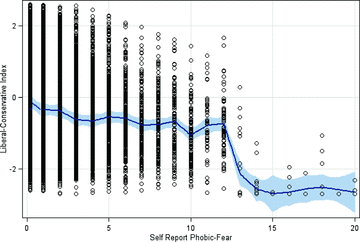
Fear is still used in political campaigns to steer public opinion, but a political scientist claims not everyone is equally predisposed to be influenced by that strategy. Who is most genetically predisposed to be swayed by fear?  Well, it is a humanities study done by someone with no science training, so take a guess.  Answer farther done if you can't connect the cultural dots.

Mothers get all the blame these days but a new paper led suggests that the father's diet before conception may play an equally important role in the health of their offspring. It also raises concerns about the long-term effects of current Western diets and of food insecurity.

A new review outlines the health effects of silica, and calls for action to reduce illness and death from silica exposure at work.

The home team holds the advantage over visitors, at least in the plant world, but a handful of genetic adaptations could even the playing field, according to a new paper.

Genetic tradeoffs, in part, explain the rich diversity of species on earth. If all plants could perform well in all climates, the world would have similar flora from the poles to the Equator. Trade-offs, however, such as protection from freezing temperatures in exchange for growing larger, must be made by plants, limiting the regions where they can flourish.

Shaving foam and baby diapers might not be the first key components to spring to mind if you were tasked with developing a gargantuan Non Lethal Weapon (NLW) for use against enemy warships.
But spring they did, however, to the mind of Lieutenant Commander Daniel L. Whitehurst of the United States Navy –  for he describes just such a weapon in a 2009 research report originating from the Air Command And Staff College, Air University, Maxwell Air Force Base, Alabama. (“The Intellectual and Leadership Center of the Air Force.”)

That weapon is ‘The Slimeball’

No, this is not an article about top models. Rather, the subject of discussion are models that predict the existence of heavy partners of the top quark.


