


This week, Americans officially start focusing on Christmas holiday celebrations and that means a lot of high-calorie food.

If you have ever wondered about why you can tap a newly opened beer bottle and its suds will foam out and go all over the place, researchers from Carlos III University and Universite Pierre et Marie Curie, Institut Jean le Rond d'Alembert have provided some insight - by exploring the phenomenon of cavitation. 

Cavitation, a phenomenon relevant to such common engineering concerns as erosion of ship propellers, is the mechanism by which bubbles appear in a liquid such as beer after an impact, said Javier Rodriguez-Rodriguez, the lead researcher from Carlos III University.

Though more and more women are given antidepressant medication while they are pregnant and there have been more diagnosed cases of autism, there is no connection between the use of antidepressant medication - SSRIs - during the course of pregnancy and the risk of having a child with autism.

Diabetics who received prescribed heart medications by mail were less likely to visit the emergency room than patients who picked up prescriptions in person, according to a new Kaiser Permanente study published in the American Journal of Managed Care which examined 17,217 adult Kaiser Permanente members with diabetes who were first prescribed heart medications in 2006 and followed them for 3 years.

This study is the first to examine the potential impacts of mail order pharmacy on patient safety and utilization, and explores the concern of patients experiencing adverse outcomes because they do not meet face-to-face with a pharmacist.

I may today perhaps make the boldest claim I ever made, at least many will think so, and I am not known for my humbleness (though I should be – how many established scientists do see themselves as merely a perverted, psychopathic robot?): The world’s first ever touchable, functioning quantum many-worlds model that can violate John Bell’s inequality even stronger than standard quantum mechanics!

 C/2012 S1, Comet ISON, began in the Oort cloud, almost a light year away and has traveled for over a million years.

On Thanksgiving Day, Nov. 28, 2013, Comet ISON will sling shot around the sun - but what happens next is a mystery. Either it will break up due to the intense heat and gravity of the sun or it will speed back away, destination unknown, but certainly never to return.

Acid rain and ozone depletion may seem like modern problems but it has been connected to the Permian extinction 250 million years ago, a mass die-off so severe in Earth's history that even Mother Jones hasn't used it as a corollary of modern climate issues.

Contemporaneous volcanic eruptions in Siberia and the atmospheric effects of those eruptions long ago would have caused the devastation rather than leaving an outside light on. New results from a team including show that the atmospheric effects of these eruptions could have been devastating. Their work is published in Geology.

Researchers from the University of Granada have grown artificial skin from the adult stem cells of an umbilical cord. The paper inl Stem Cells Translational Medicine shows the ability of Wharton jelly mesenschymal stem cells to turn to oral-mucosa or skin-regeneration epithelia.

To grow the artificial skin the researchers also used a biomaterial made of fibrin and agarose, designed and developed by the University of Granada research team. The work has been carried out in the laboratories of the Faculty of Medicine, alongside the Experimental Unit of the Granada "Virgen de las Nieves" University Hospital Complex.

Would you drink wine flavored with mint, honey and a dash of psychotropic resins? Ancient Canaanites did more than 3,000 years ago.

Archaeologists have unearthed what may be the oldest, and largest,ancient wine cellar in the Near East, containing forty jars, each of which held up to fifty liters of strong, sweet wine flavored with mint, honey and a dash of psychotropic resins.  The cellar was discovered in the ruined palace of a sprawling Canaanite city in northern Israel, called Tel Kabri, far from many of Israel's modern-day wineries, and dates to about 1,700 B.C. 

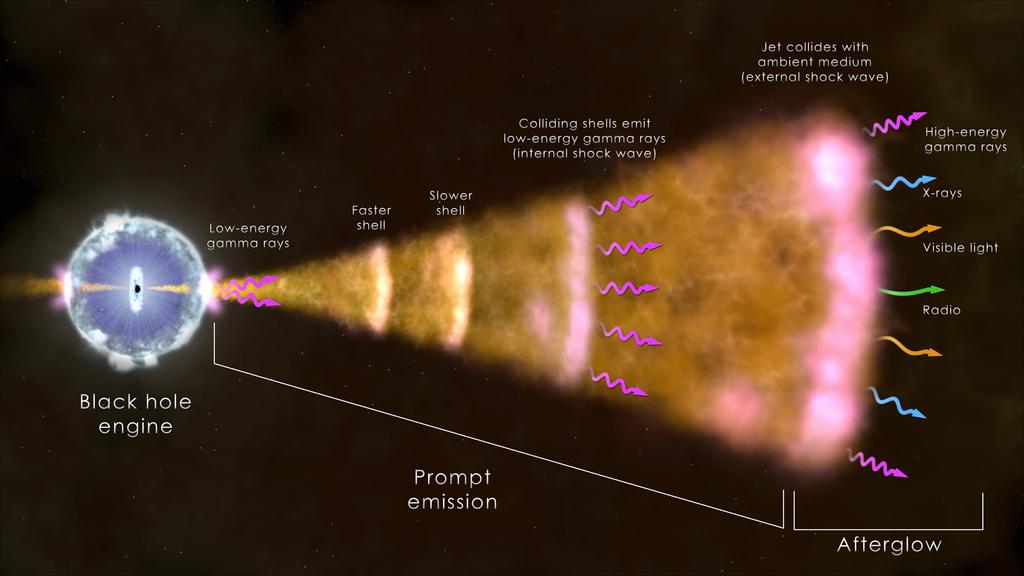
Recently, a gamma-ray burst occurred with an optical flash that peaked at magnitude 7 on the astronomical brightness scale, easily visible through binoculars. It is the second-brightest flash ever seen from a gamma-ray burst. 

On April 27th, a blast of light from a dying star in a distant galaxy became the focus of astronomers around the world. The gamma-ray burst was designated GRB 130427A and a trio of NASA satellites, working in concert with ground-based robotic telescopes, captured never-before-seen details that challenge current theoretical understandings of how gamma-ray bursts work.

NASA's Swift Gamma-ray Burst Mission detected the burst almost simultaneously with the GBM and quickly relayed its position to ground-based observatories.

