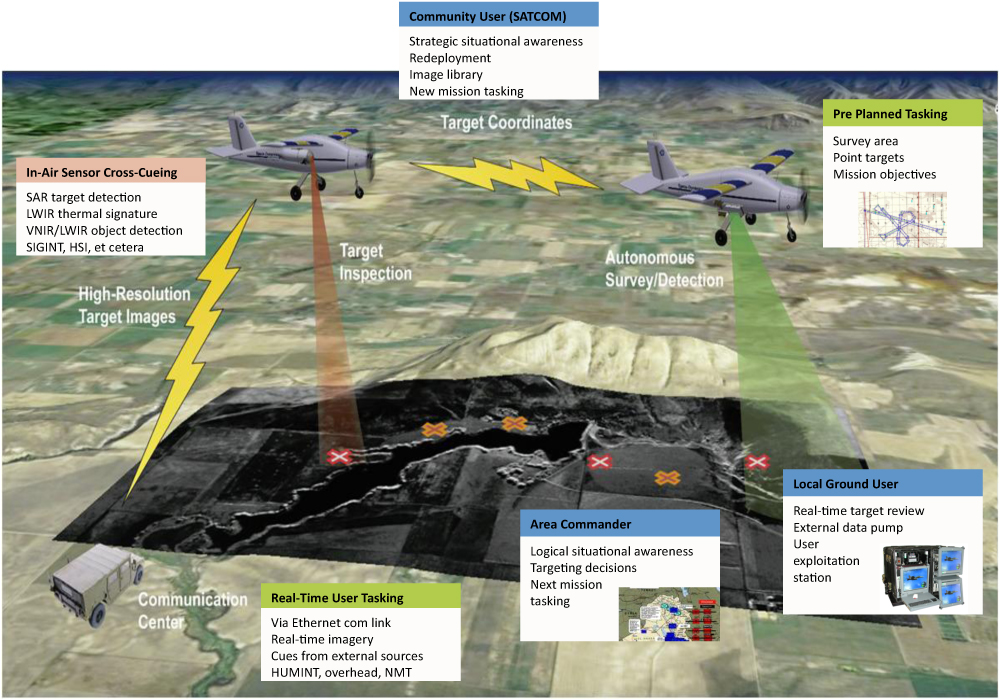





In the modern world, even residents of London generate more intelligence, surveillance and reconnaissance (ISR) data than human operators can collate and that can severely limit the ability of an analyst to generate intelligence reports in operationally relevant time frames, like when ambassadors and looters are rioting and claiming it is for social justice.

Naval Research Laboratory may have the answer - a multi-user tracking capability which enables the system to manage collection of imagery without continuous monitoring by a ground or airborne operator, thus requiring fewer personnel and freeing up operational assets.

The proof against local realism is humankind’s the most relevant finding in the realm of science and philosophy; there is no excuse to be ignorant about it while pretending to be interested and knowledgeable about cool science and its implications for philosophy. It was a difficult topic once, but from now on, there is no excuse anymore: Any good high school student, certainly any university undergraduate is able to follow the arguments as long as there is no religious/obsessive hurdle to overcome internally.

Studies....So Many Studies...


Lots of buzz over recent weeks on various studies concerning autism, genetics, and environment, along with the incidence of autism occurring in subsequent siblings.
Here's a trivia question; what's the longest alliance in history?

Unless you went by the title, you were probably stumped.  Maybe you believe it is England and Portugal at 638 years.   You were unlikely to guess Scotland and France but a University of Manchester historian says she has uncovered evidence which shows a defensive alliance  between Scotland and France (against the English, naturally) might never have formally ended – potentially making it the longest in history.

In a paper to be published next year, Dr. Siobhan Talbott argues the Franco-Scottish Auld Alliance of 1295 survived numerous wars between Britain and France, even after the Act of Union was signed in 1707. Trade, she says, is a major reason for its longevity.

MSNBC reported on the latest set of new NASA prizes:
NASA today announced three new competitions offering a total of $5 million in prizes — and only one of them involves actually putting something in outer space.
I'm a huge fan of prizes.  Although I love NASA's work, I dream of a day where fully half of NASA's workload consists of evaluating prize entries by indy companies that are hitting specific get-us-to-space benchmarks.

Weakened immunity is a serious issue for older people. Because our immune systems become less effective as we age we suffer from more infections and these are often more severe. This is an important process that has probably evolved to prevent certain cancers, but as the proportion of inactive cells builds up over time our defenses become weakened. This takes a serious toll on health and quality of life. 

Research in the Journal of Immunology outlines a new mechanism controlling aging in white blood cells. The research opens up the possibility of temporarily reversing the effects of aging on immunity and could, in the future, allow for the short-term boosting of the immune systems of older people. 

Why did adult human cardiac myocytes, specialized muscle cells in the heart,  lose the ability found in newts and salamanders to proliferate, perhaps explaining why the human heart has little regenerative capacity?
 
A study using cell lines and mice may lead to methods of reprogramming a patient's own cardiac myocytes within the heart itself to create new muscle to repair damage, said Dr.

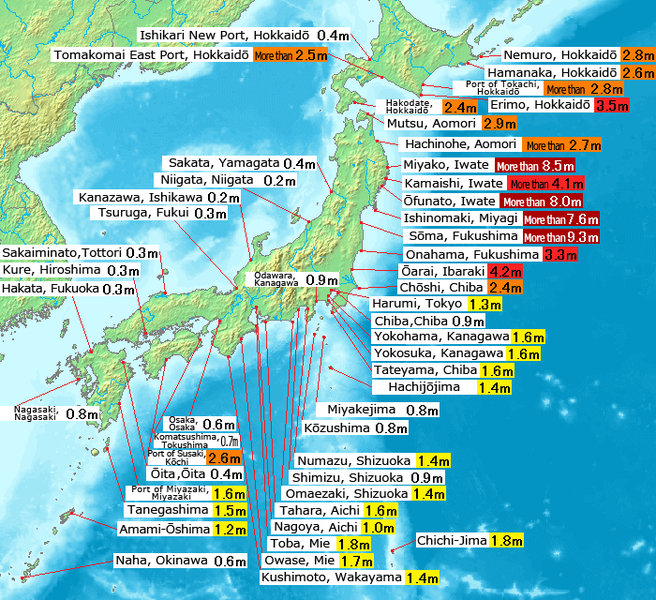
We all remember the earthquake and ensuing tsunami that hit Japan (see figure 1) and caused major troubles in the Fukushima nuclear power plant, which was severely damaged. Problems with containing radiation followed, leading to the pumping of huge amounts of seawater into the reactor, in an attempt to cool it down.


earthquake observed in Japan

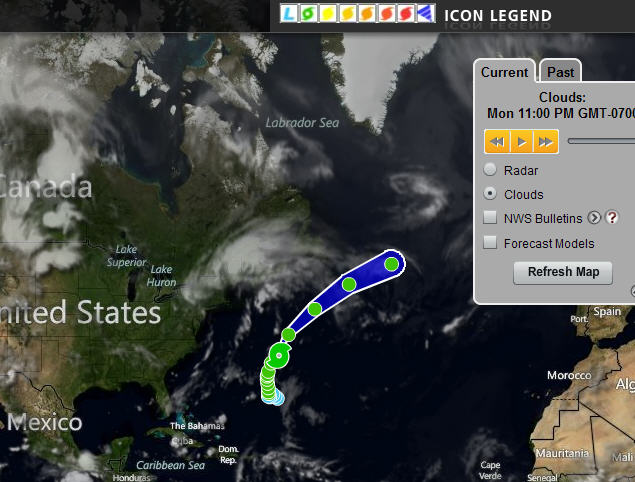
As hurricane season ramps up, MyWeather.com is offering critical information to those at risk of tropical storms and hurricanes.   Here is the science behind the storms and 5 common myths debunked.

1) Myth: The area and size of a hurricane determines the severity of its impact.

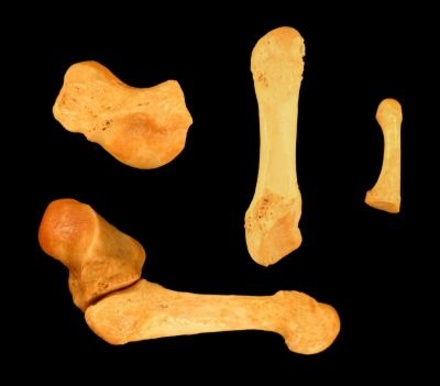
When nails appeared on all fingers and toes in modern primates about 55 million years ago, they led to the development of critical functions, including finger pads that allow for sensitive touch and the ability to grasp.

