The best way to discover whether someone is full of crap or not is to look at their past predictions. If you're digital media expert Jim Griffin and you put your rep publically on the line predicting internet video in 2002, you're probably on the side of 'smart and right'.
Jim Griffin (
onehouse.com) made a wager at
LongBets that “A profitable video-on-demand service aimed at consumers will offer 10,000 titles to 5 million subscribers by 2010.” He won, donating the $2000 prize to the
EFF. Was this futurism, the random picking of potential paths by a random pundit? In his own analysis on a private list,
“What we’ve got here is a failure to communicate.”
The much-revered writers of the Golden Age of science fiction can be quite rough around the edges, even downright embarrassing on occasion. The writing is hurried, the plots of plot-driven books are disturbingly inconsistent, and the characters are primarily stock types and authorial mouthpieces. To top it off, many of these novels are ambitious, earnestly offered as novels of big ideas. These ideas are usually sympathetic (tolerance, freedom, racial equality, escape from religious tyranny), but generally reduced to platitudes expressed in long, somnolent sermons by the your standard pointy-headed philosopher-scientist.
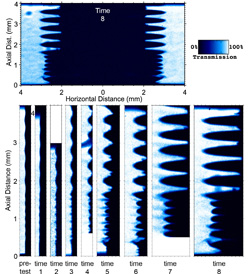
New X-ray imaging capability at Sandia's Z accelerator may help remove an obstacle in efforts to harness nuclear fusion to generate electrical power from sea water. More accurate simulations could lead to 'break-even' fusion in the future.
Magneto-Rayleigh-Taylor (MRT) instabilities are spoilers that arise wherever electromagnetic forces are used to contract - 'pinch' - a plasma, which is essentially a cloud of ions. The pinch method is the basis of the operation of Z, a dark-horse contender in the fusion race. A pinch contracts plasma so suddenly and tightly that hydrogen isotopes available from sea water, placed in a capsule within the plasma, should fuse.
I posted
an article critical of microwave ovens and nanotechnology. This adds to many posts critical of science and scientists. Am I another enemy of science? That last post told lay persons not to heat Ramen noodles in the microwave oven. She cannot understand why and neither do I know exactly why. Moreover, since most people are too lazy or busy to look into such petty differences as between still internally dry Ramen noodles and watery potatoes, you could charge me with implying that the general population should not use microwaves at all.
Writing balanced posts can be tricky, especially in relation to vaccines. Vaccines, like religions and politics, have become a hot-button topic in social discussions, and these three areas are absolutely polarized, definitely enter-at-your-own-risk sorts of discussions that can quickly turn to pissing matches. Ah, but they don't have to, I don't think, and not all disagreement is about that sort of thing.
In the past, support for environmental initiatives in the United States has been embraced by those on both sides of the aisle. Democrats have also made leaps and bounds in environmental protection laws including their staunch defense of the EPA. Republicans can lay claim to one of the most militant conservationists, Theodore Roosevelt, who established national parks and forests. However, today, the cooperation between the two parties has broken down to the detriment of everything from the environment to the economy.
Many robot designs are understandably human-looking - they infrequently have legs, since a realistic gait that passes for human is difficult (though see
RunBot - Mountaineering Robot and
The Science Of A Bionic Woman for the latest) but a torso, a head and arms are common. Hands, though, are delicate instruments and tough to emulate.
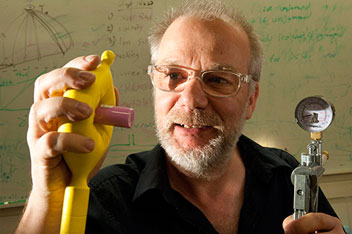
But a group of researchers have
bypassed traditional notions of robot hand design and created a gripper using coffee and a balloon.
You're on this website so you obviously know how to read. And some regard the digital revolution as a monumental one but there was one even greater; the invention of writing itself.
If you are in the Chicago area this weekend and keen to learn about how and where writing originated - in not just one place but at four distinct times and places - a panel of scholars will explore how writing developed in ancient Mesopotamia, Egypt, China, and Mesoamerica.
The seminar is Saturday, November 13, 2010 at 1:00 pm at the Oriental Institute, Breasted Hall
1155 East 58th Street, Chicago, IL. A reception will follow the symposium at 5 PM.
One of a three part series on epigenetics, transhumanism, and future human evolution.
Dr. Bruce Lipton: The Biology of Belief
Hurricane forecasts were way off again last year so if you're still wondering
if a trained chimp 'can predict hurricanes better than NOAA'(1) a Nature Geoscience article has good news for you; forecasts can still be wrong 75% of the time but now can be wrong for years in advance too.