
An archaeological team has discovered the oldest Roman baths in Asia Minor - underneath existing Roman baths.  Location:  Sagalassos, Turkey, which was inhabited as a city until the 7th century AD, when it was destroyed by earthquakes. 

Prior to the Sagalassos discovery, the Capito Baths in Miletus, built during the reign of Emperor Claudius (41-54 AD), were the oldest known Roman bathing complex in Asia Minor.
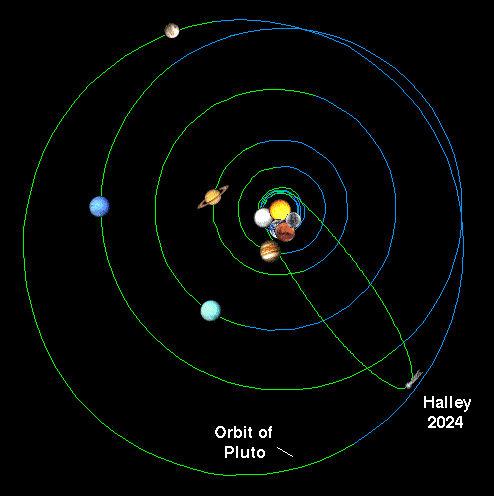
Even though Halley's Comet has a regular orbit it's not an easy task to map its appearances throughout history - and it may be that one of those appearances matches an ancient Greek testimony and has only now been realized, write Daniel W. Graham and Eric Hintz in the Journal of Cosmology, which would make it the first scientific claim about the famous extraterrestrial event.

In 1705, Edmond Halley used Newtonian theory and predicted the return of a comet seen in 1682.  It did return as predicted, in 1758, putting Halley on the stellar map and driving a stake into the evil hearts of competing theories to Newton.  
Two players share a deck composed of three cards: Jack, Queen, and King. The highest card wins. You each ante one. You each get a card. The third card remains unseen. There's one standard round of betting, with a max bet of one chip each, giving the following choices: the first player can check or bet one. Player two can call, fold, check or raise one (as appropriate). If needed, player one can then call or fold (no re-raising).
Retirement in less than three week’s time!  What shall I sing?  How about this?
And now the end is near
And so I face the final curtain
Well, that’s my second most hated song, suited either to a dictator facing trial at the International Criminal Court or a drunkard expiring in a ditch.  Even the melody was stolen from a much superior (in my opinion) French song “Comme d'habitude”[1,2].

Not that I could justifiably sing it, anyway:
Regrets I’ve had a few
But then again too few to mention
On the contrary, my career in science is littered with them.  One of the most poignant is the memory of the many students we have had whose work has not reached publication to the extent that it should have.
In almost everything, size matters.  And usually, being bigger helps.   I don't know anyone who couldn't use a larger refrigerator but University of Bristol physicists have done the unthinkable and made the smallest refrigerator ever.
Is there a pill that might inoculate us from smog?

Is there a gene we can target that would make us resistant to resurgent infectious diseases?

And is there a way to use genetic data to insulate new immigrants from some of the metabolic challenges of living in a new land of plenty?

Welcome to the slowly emerging world of environmental medicine and its inevitable outgrowth, environmental pharmaceuticals: compounds specifically suited for mitigating the physiological challenges of mega-city life in the 21st century.

The inchoate drive for such pills — disparate, proceeding in entrepreneurial fits and starts — is fueled by twin facts:
When nerve cells communicate with each other, they do so through electrical pulses.  Most everything in our bodies comes down to induction when you think about it.   

Since the early days of neuroscience, the accepted idea was that nerve cells simply sum up tiny action potentials generated by the incoming pulses and emit an action potential themselves when a threshold is reached but Moritz Helias and Markus Diesmann from the RIKEN Brain Science Institute (Japan) and Moritz Deger and Stefan Rotter from the Bernstein Center Freiburg (Germany) say they have figured out exactly what happens right before a nerve cell emits a pulse
Petermann Ice Island - Now There Are two

Petermann Ice Island (2010) has now broken into two parts.   The smaller island is about 80 km2.  It is the thinner of the two and is likely to melt away first.  Based on the labels already in use in comments1, I shall designate the larger island as Petermann 2010-A and the smaller one as Petermann 2010-B.


Petermann Ice Islands A and B
image source: http://ocean.dmi.dk/arctic/images/MODIS/Kennedy/201009091609.ASAR.jpg
In Australia this week a crucial battle begins to combat every Australian farmer’s nightmare, the worst locust plague in 40 years.

There is a $100 million national campaign in Australia to prevent a locust plague from wiping billions of dollars from the value of the Australian rural sector.

The public are being asked to help to pinpoint the locations of the young locusts or ‘hoppers’ because the "strike time" for spraying is limited to one month before they start flying in plagues, and devastating orchards, vineyards and pastures. See locust plague clip at http://www.youtube.com/watch?v=I8STQStqUzE&feature=related

It’s long been a peeve of mine that some computer programs are programmed to try to sound friendly, cheerful, or just colloquial. It seems out of place to me, forced, overly artificial. I don’t mean that I want all the output from computers to sound like the stilted science-fiction stuff, saying “affirmative” instead of “yes”, and the like. But neither do I ever want to see (or hear) things like “Oops!”, “Hurray!”, nor even “I’m sorry,” coming from my laptop, mobile phone, car, or washing machine.

Some examples:

It’s common when you’ve finished installing new software on your computer for the installation package to wrap up with a message like, “Congratulations!