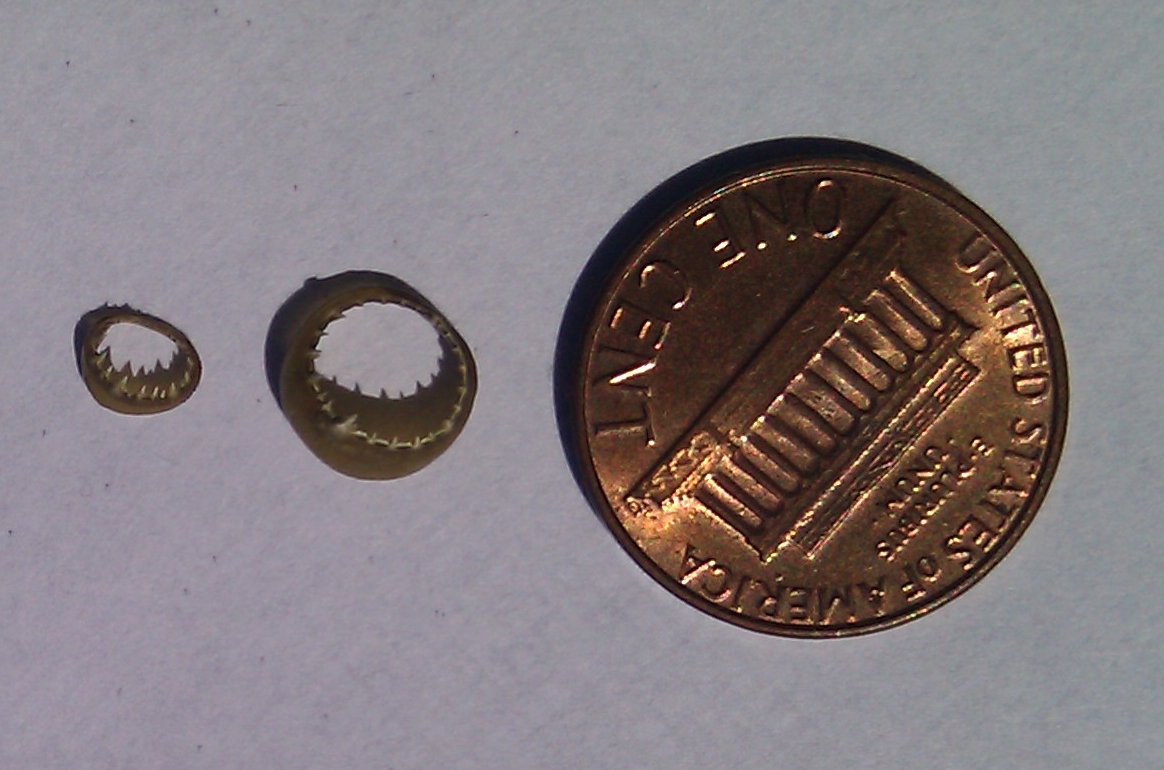
One month to go before the Physics Department closes! And I have the job of classifying and disposing of unwanted and waste chemicals. This year, when “everything must go”, this is proving a mammoth task.
How did I get this job? Being the only practicing chemist in the department, in effect
I am Snape, the Potions Master. This in not only because of my academic training, but my work has taught me what chemical can go with which without creating an explosion (for example,
NOT acetone and chloroform!)
Edges are where topics intersect. Edges are where uncomfortable thoughts reside. Edges define a topic by being just barely part of that topic. They are the border between what is known, and what is speculative.
Working around edges requires new methods, disruption, and massive creativity. Web2.0 is about breaking the border between reader and creator. Science2.0 is about expanding the choices of how we do science. The new space race and things like the X-Prize are about breaking down the old framework of space exploration to make new methods. Heck, DARPA is about research at the edge of things.
The SpaceUpDC.org 'unconference' last week was all about edges.
I just watched Nic Marks of the New Economics Foundation's recent TED talk, which I hope I can embed below. Marks and I both appear have a problem with the amount of media attention that the financial industry gets. For me, I don't like the contradiction where science writing has to be dumbed down because "people don't get science," but the finance section of a newspaper is filled with so much jargon that few people have a clue what it means. He has a slightly different problem - why is it there at all?
One of the crazy repercussions of the idiotic “war on drugs”, apart from destruction of innocent lives and whole countries like Mexico and the US, is that you cannot openly buy many quite harmless substances while relatively dangerous ones are freely available.
An interesting chemical in this respect and also in regards to the philosophy of mind and what we understand to be “truth” is 2-(diphenylmethoxy)-N,N-dimethylethylamine, short Diphenhydramine (DPH). As a sleep aid it is available cheaply in 99 cent stores (in the US). You can also spend a lot of money instead buying the exact same marketed as Benadryl against allergies.
The InterAcademy Council Board, composed of presidents of 15 academies of science and equivalent organizations(1) representing Argentina, Australia, Brazil, China, France, Germany, India, Indonesia, Japan, South Africa, Turkey, the United Kingdom, and the United States, pulled no punches in assessing the U.N.'s Intergovernmental Panel on Climate Change (IPCC) performance during the latter part of the decade.
Despite overwhelming evidence for climate change, the IPCC issued “substantive findings” based on little proof and needs to rework its process, the independent review said. The UN had requested the IAC review.
That's a long way down from the heady days of a 2007 Nobel Peace prize for the IPCC.
First of all, yes, I know not to expect any better of the
Express. But
it's coming up on a year since Squid Says: What's for Dinner? Probably Not You, so it must be time for another rant.
I just can't help taking the bait, even though this is clearly trolling:
Millions of killer giant squid are not only devouring vast amounts of fish they have even started attacking humans . . . Hunting in 1,000-strong packs the giant squid can out-swim and out-think fish.
Wave functions and characteristic vectors.
There aren’t many cyclopses in nature, and those that exist don’t live up to expectation. They tend to be crustaceans like water fleas and another aptly named “cyclops” (see left photo below) or early invertebrate fish-like ancestors of ours like lancelets.
Getting these animals tipsy and stabbing them through the eye with a stake turns out to be much less impressive than when Odysseus did it.
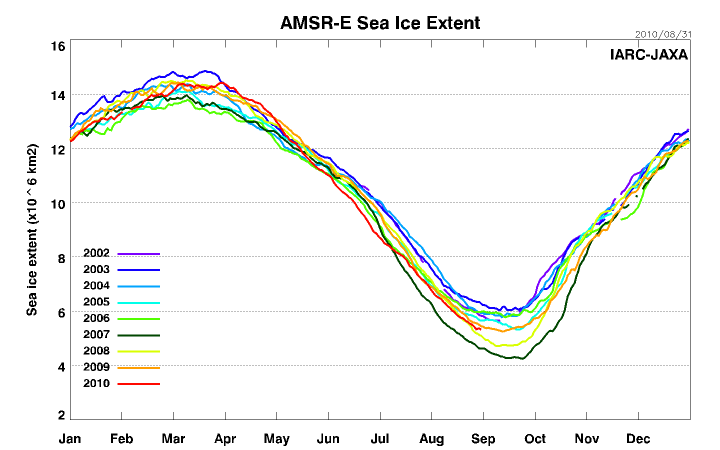
Arctic Ice September 2010As I write these words - September 01 2010 - Arctic sea ice extent as reported by NSIDC and JAXA is not as low as I had expected it to be.
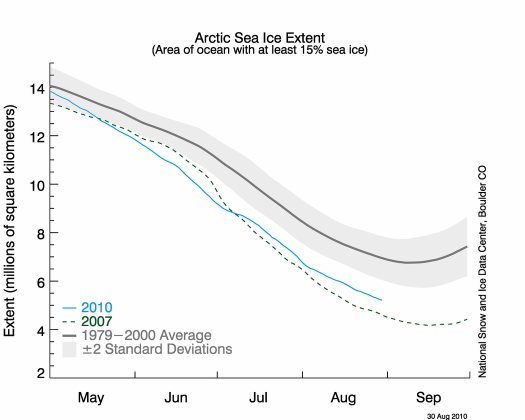
image source:
http://nsidc.org/arcticseaicenews/.
The IARC-JAXA graph shows 2010 extent as 4th lowest of recent years thus far, behind 2007, 2008 and 2009.
A new paper produced by the
DZERO collaboration got me quite interested today, for several reasons. The analysis is based on a large data sample: over seven inverse femtobarns of proton-antiproton collisions! This is a huge dataset, the result of about 500 trillion proton-antiproton collisions! In fact, the measurement these data has made possible is extremely precise and it exposes quite strikingly the shortcomings of our present modeling of the production of vector bosons.

.jpg "Bucket Chemistry!")