For some people, raising "good" cholesterol levels isn't necessarily a healthy choice, according to a new study in Arteriosclerosis, Thrombosis, and Vascular Biology. The study is the first to find that a high level of the supposedly good cholesterol places a subgroup of patients at high risk for recurrent coronary events, such as chest pain, heart attack, and death.
Researchers at the University of Leeds have found that a compound known as pyrophosphite may have been an important energy source for primitive lifeforms.
The findings, published in the journal Chemical Communications, are the first to suggest that pyrophosphite may have been relevant in the shift from basic chemistry to complex biology when life on earth began. Since completing this research, the authors have found even further evidence for the importance of this molecule and plan to further investigate its role in abiogenesis - how life on Earth emerged from inanimate matter billions of years ago.
Scientists from the University of Alabama, Huntsille have developed a new way to use satellite instruments to measure surface temperatures over most of the world's land area.
The new technique developed by Dr. Roy Spencer and Dr. Danny Braswell, both research scientists in the Earth System Science Center at The University of Alabama in Huntsville, uses microwave sensors on NOAA and NASA satellites to collect surface temperature data over virtually all of Earth's land area.
They say they hope the new system will provide a stable method for monitoring climate change without some of the problems associated with the existing network of surface thermometers.
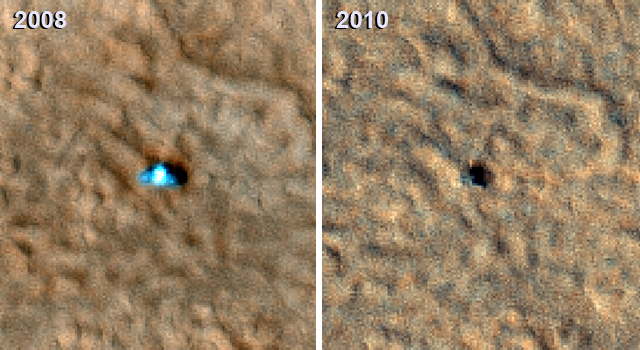
The Phoenix Mars Lander is dead, says NASA. Last week, the Mars Odyssey orbiter flew over the Phoenix landing site in final attempts to communicate with the lander but no transmission was detected and since Phoenix also did not communicate during 150 flights earlier this year, NASA declared its mission over.
The latest image transmitted by the Mars Reconnaissance Orbiter showed what appears to be ice damage to the lander's solar panels.
Arctic Heroes #1 - Alfred WegenerThe history of Arctic and Antarctic exploration and discovery is filled with the names of heroes. Many of those names get repeated over and over in popular writings on polar exploration. Other names tend to get forgotten. Here, in no particular order, I hope to write of some of these heroes, both remembered and forgotten.
Alfred_Wegener is most famous for his
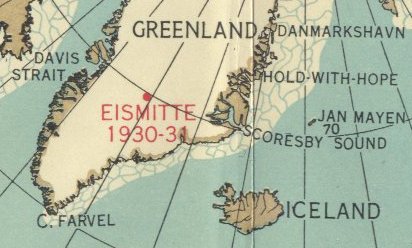
Theory of the Drift of the Continents. He is less widely known for his enthusiastic contributions to climatology and meteorology, which led to his death on the Greenland ice sheet in 1930 under the most heroic circumstances.
One of the worst things I see on the internet, as both a parent of children on the spectrum and as scientifically-based, rational person who works hard to instruct my students in critical thinking skills and being able to detect pseudoscience, is the woo that abounds relating to alternative autism treatments.
The charlatans and snake oil salesmen abound, and one of these individuals, who promises to cure your child of his autism is a chiropractor named Chun Wong who really, really likes the woo. His latest article on his site, dated May 10, is about helminthic therapy for autism, or as I've decided to call it, Wong's wormy wormy woo.
Have a talent and enjoyment for inflicting prescribed doses of pain? Your dream job awaits. (Biology undergraduate required.) Contact: 555-8428
…as seen in classified ads.
You are not supposed to be reading this. You’re an ape who never evolved to read, but you can do so because writing culturally evolved to be shaped just right for your illiterate visual system. As I have argue in my research and recent books, culture’s trick for getting writing into us was to harness our ancient visual system for a new purpose (The Vision Revolution), a trick also used for speech and music (upcoming in Harnessed). (Hint: The trick to harnessing is, in each case, to mimic nature.)
A team of archaeologists has captured a snapshot of rural life in the village of Sanyangzhuang in western China during the Han Dynasty, over 2,000 years ago.
Researchers found that the town, though located in a remote section of the Han Dynasty kingdom, appears quite well off. Exploration has revealed tiled roofs, compounds with brick foundations, eight-meter deep wells lined with bricks, toilets, cart and human foot tracks, roads and trees.
There is an abundance of metal tools, including plow shares, as well as grinding stones and coins. Also found have been fossilized impressions of mulberry leaves, which researchers see as a sign of silk cultivation.
Scientists from the University of California, Berekley have captured images of a comet diving into the sun.
Using instruments aboard NASA's twin STEREO spacecraft, the researchers were able to track the comet as it approached the sun and estimate an approximate time and place of impact. STEREO (Solar Terrestrial Relations Observatory) was launched in 2006 and consists of identical spacecraft orbiting the sun, one ahead of Earth and one behind Earth, providing a stereo view of the sun.
After tracking the comet, the team studied data from the ground-based Mauna Loa Solar Observatory in Hawaii, and found images in the predicted spot of what appears to be a comet approaching the edge of the sun from behind the solar disk.
If you want boost your romantic relationship, and achieve and maintain satisfaction with your partner, show some gratitude.
Positive thinking has been shown to have a longstanding constructive effect on our emotional life. Extending these positive emotions and gratitude to our romantic partners can increase the benefit of positive thinking tenfold, say the authors of a new study in Personal Relationships.