Listening to music based on the genre it belongs to may lead you away from songs or albums you would actually enjoy, say the authors of a study in the New Journal of Physics.
The research shows that searching for the temporal aspects of songs – their rhythm – might be a better way to find music you like than using current automatic genre classifications.
By studying similar and different characteristics of specific rhythmic durations and the occurrence of rhythmic sequences, the group of Brazilian researchers found that it is possible to correctly identify the musical genres of specific musical pieces.
An innovative paint system may make it possible to lower the fuel consumption of airplanes and ships, reducing costs and carbon dioxide emissions, according to researchers at the Fraunhofer Institute for Manufacturing Engineering and Applied Materials Research. When applied to every airplane every year throughout the world, the paint could save a volume of 4.48 million tons of fuel.
The inspiration for the paint's structure comes from the scales of fast-swimming sharks that have evolved in a manner that significantly diminishes drag. The challenge was to apply this knowledge to a paint that could withstand the extreme demands of aviation. Temperature fluctuations of -55 to +70 degrees Celsius; intensive UV radiation and high speeds.
Researchers writing in Current Biology say they may have determined what makes musical notes sound good (or bad) by studying the preferences of more than 250 college students from Minnesota to a variety of musical and nonmusical sounds.
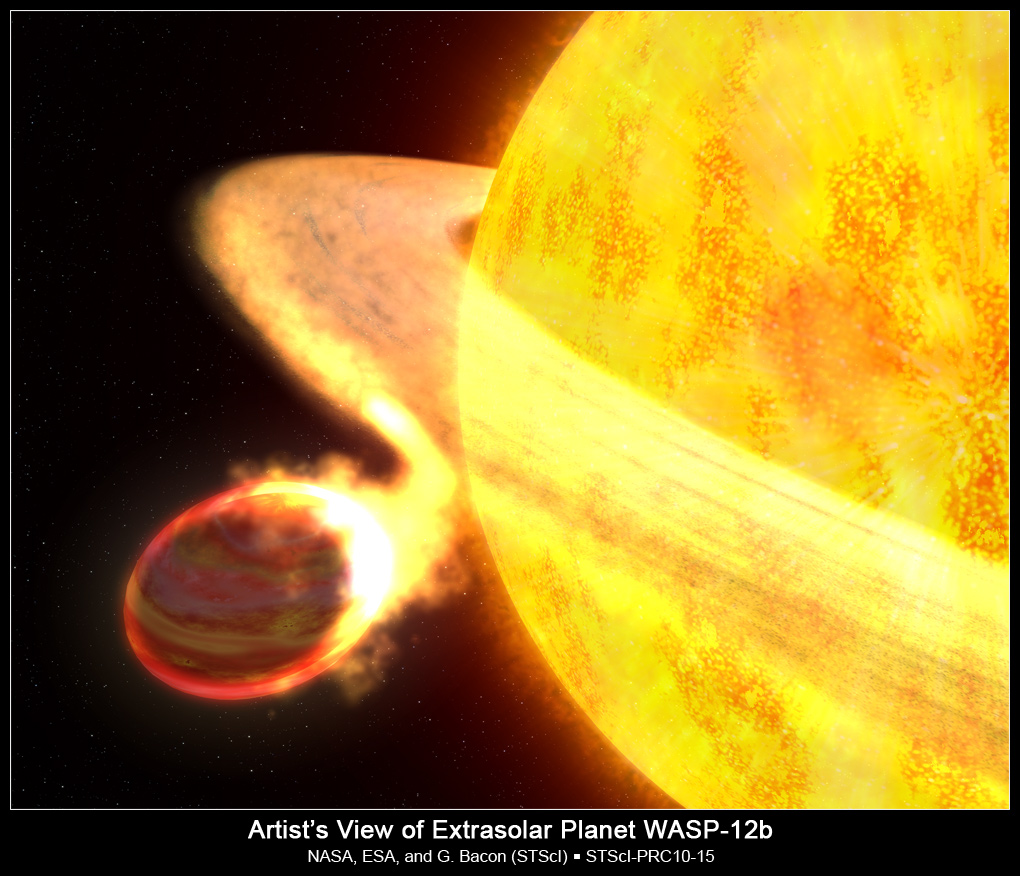
WASP-12b is the hottest known planet in the Milky Way galaxy, and it may also be the shortest-lived. The planet is being eaten by its parent star, according to observations made by a new instrument on NASA's Hubble Space Telescope, the Cosmic Origins Spectrograph (COS). The planet may only have another 10 million years left before it is completely devoured. The discovery has been documented in The Astrophysical Journal Letters.
WASP-12 is a yellow dwarf star located approximately 600 light-years away in the winter constellation Auriga. The exoplanet was discovered by the United Kingdom's Wide Area Search for Planets (WASP) in 2008. The automated survey looks for the periodic dimming of stars from planets passing in front of them, an effect called transiting.
Scientists have developed the first cell controlled by a synthetic genome which may allow them to probe the basic machinery of life and engineer bacteria specially designed to solve environmental or energy problems.
The research team, led by Craig Venter, has already chemically synthesized a bacterial genome, and transplanted the genome of one bacterium to another. Now, the scientists have put both methods together, to create what they call a "synthetic cell," although only its genome is synthetic.
Albert Einstein said scientists would never be able to observe the instantaneous velocity of tiny particles as they randomly shake and shimmy, so called Brownian motion, but physicist at the University of Texas say they have done so.
In 1907, Einstein likely did not foresee a time when dust-sized particles of glass could be trapped and suspended in air by dual laser beam "optical tweezers." Nor would he have known that ultrasonic vibrations from a plate-like transducer would shake those glass beads into the air to be tweezed and measured as they moved in suspension.
Birds wouldn't be happy in a Trader Joe's, it seems. Stuffed with aisles full of organically grown, gluten-free, range fed deliciousness, birds would see through expensive marketing and know that, nutritionally, organic food is no better, it is just a different process.
And scientist birds would be confused why no one in the food industry knows what the word 'organic' means.
What Is The Meaning Of "organic" (and Inorganic) Food? by
professor Lee Silver
It's been several months since Michael White invited me to blog here at Scientific Blogging. I think the immediate occasion for his invitation was a conversation we had about Douglas Hofstadter's 2007 book I Am a Strange Loop. I don't remember the details of what I said in that conversation, but I guess something in it made Mike think that I had something to offer here. That conversation was one of many we've enjoyed over the past year on topics at least potentially relevant to the bloggers and readers on this site: science fiction, science books written for a general public, the academy, the relationship between science and the humanities.
Finally, the Bose-Einstein Correlations article by CMS to which I have personally contributed during the last few months
is now an arxiv entry, and has been sent to
Physical Review Letters. This is a success for the CMS collaboration, since we are the first to measure this effect in the new LHC proton-proton collisions, at 0.9 and 2.36 TeV of center-of-mass energy.
My recent article The Origins of Virtue sparked a discussion in which Josh Witten has assumed that Gerhard Adam and I are confused as to the subject of genic selection. The confusion lies entirely with Josh, but the matter deserves clarification for readers.
Gerhard and I (I hope I’m not putting words into Gerhard’s mouth that he would find unpalatable!) have no problem with the purely technical aspects of genic selection. The problem arises when conclusions are derived from these studies that are of a purely personal nature, mere opinions and prejudices with no scientific basis. As a self-styled champion of the scientific method, Josh should be supporting us in this endeavour, unfortunately the opposite is the case.