Economics And Climate Change
I am confident that global climate change is real.
I am also confident that over-complicated knee-jerk legislation and taxation will make matters worse. Problems get solved by rational actions, not panic attacks.
Either economics stands on science or it stands on quicksand.
The principles of taxation are not founded in science. But they could be.
The world is faced with a problem in need of a solution.
The problem is this:
I am constantly amazed at how pathologizing variable phenomena is usually a human social agent. Consider the XY fertile Akodon females who go roaming around in South America. No other rodents seem to have told these fertile XY females that they have a disorder of sex development (DSD). That will undoubtedly be left to some of the "powers that be" of the human species. Shall I say rats? Or shall I say of mice and men?
A team of Yale paleontologists have discovered a rich array of exceptionally preserved fossils of marine animals in Morocco that lived during the the early part of the Ordovician, between 480 million and 472 million years ago.
The specimens are the oldest yet discovered soft-bodied fossils from a period marked by intense biodiversification. The findings, which appear in Nature, greatly expand scientists' understanding of the sea creatures and ecosystems that existed at a crucial point in evolutionary history, when most of the animal life on the planet was found in the oceans.
Judging by recent polls, you would think that the environment is not much of a concern to Americans. And You would also be wrong, say researchers from Standford University. When pollsters ask Americans to name the most important problem facing the country, the environment is rarely mentioned. But these results change drastically if pollsters replace "country" with "world" in the question, the researchers say.
"For years, the wording used in traditional surveys has systematically underestimated the priority that the public has placed on global warming and the environment," said Jon Krosnick, a professor of communication and of political science at Stanford. "To fully understand public concern about these issues, traditional surveys should be asking a different question."
To avoid of the health risks associated with traditional cigarettes, attempts have been made to develop cigarettes that contain no tobacco and no nicotine. But a team of researchers writing in Cell Cycle has found that the supposedly safe cigarettes may be more carcinogenic because they actually induce more extensive DNA damage than tobacco products.
Using laser scanning cytometry (LSC) technology to measure DNA damage response to the smoke from commercially available tobacco- and nicotine-free cigarettes, the research team expected to find the alternative products were less hazardous than regular tobacco cigarettes.
By analyzing tiny variations in the isotopic composition of silver in meteorites and Earth rocks, scientists are putting together a timetable of how our planet was assembled 4.5 billion years ago. The new study, published in Science, indicates that water and other key volatiles may have been present in at least some of Earth's original building blocks, rather than acquired later from comets, as some scientists have suggested.
Compared to the Solar System as a whole, Earth is depleted in volatile elements, such as hydrogen, carbon, and nitrogen, which likely never condensed on planets formed in the inner, hotter, part of the Solar System. Earth is also depleted in moderately volatile elements, such as silver.
MIT neuroscientists writing in the Journal of Neurophysiology have developed a new method to analyze brain imaging data – one that may paint a clearer picture of how our brain produces and understands language.
Research with patients who developed specific language deficits (such as the inability to comprehend passive sentences) following brain injury suggest that different aspects of language may reside in different parts of the brain. But attempts to find these functionally specific regions of the brain with current neuroimaging technologies have been inconsistent and controversial.
A RAND corporation study examining the long-term economic consequences of childhood psychological disorders suggests the conditions diminish people's ability to work and earn as adults, costing $2.1 trillion over the lifetimes of all affected Americans.
The findings, published in Social Science&Medicine, show that people who suffer from childhood conditions such as depression and substance abuse are less likely to be married, attain less education and see their income reduced by about 20 percent over their lifetimes.
Carbon Fudgeprints
It seems that everyone has a carbon footprint. The idea is that everything you do puts CO2 into the atmosphere or if it doesn't then it jolly well ought to so let's work out the carbon equivalent by just making stuff up.
No calculation could be simpler.
I go to the shop and I buy a loaf of bread.
The bread was delivered by truck to the shop
from the baker who got the grain by truck from the farm
which got the seed and fertiliser by truck from ...
Stop it, please! William of Ockham wouldn't like it.
A sinkhole in Saint-Jude, Quebec
has just collapsed a house, killing a family of four inside, leading people to ask what they are, how they occur and obviously who is at risk.
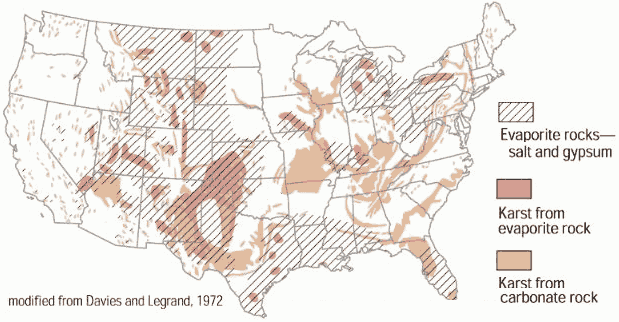
Sinkholes are depressions that occur when soil or bedrock has been removed and only air remains - commonly when the rock below the land surface is limestone, carbonate rock or salt beds that have been naturally dissolved by ground water circulating through them and then the water dries up.