Mirror neurons are the cells in the brain that fire not only when we perform a particular action but also when we watch someone else perform that same action.
Neuroscientists believe this "mirroring" is the mechanism by which we can "read" the minds of others and empathize with them. It's how we "feel" someone's pain, how we discern a grimace from a grin, a smirk from a smile.
However, there was no proof that mirror neurons existed — only suspicion and indirect evidence. Now, researching writing in Current Biology say they have for the first time made a direct recording of mirror neurons in the human brain.
Despite their vocal criticism of the health care legislation enacted by Congress, the majority of Americans want some kind of reform, according to a new poll conducted by Indiana University's Center for Health Policy and Professionalism Research (CHPPR).
Fifty-eight percent of Americans (96 percent of Republicans, 10 percent of Democrats and 54 percent of Independents) support repealing the health care reform legislation that was signed into law by President Barack Obama in March.
Scientists assume that all exoplanets orbit in more or less the same plane and move along their orbits in the same direction of their host star's rotation. But now astronomers have discovered nine new exoplanets that may upset this conventional wisdom.
Researchers say that when combined with earlier observations of transiting exoplanets, the new images indicate that six out of a larger sample of 27 were found to be orbiting in the opposite direction to the rotation of their host star -- the exact reverse of what is seen in our own solar system.
Moderate alcohol consumption may reduce your risk for stroke, but cigarette smoking could offset that benefit, according to research presented at the American Academy of Neurology's 62nd Annual Meeting in Toronto this week.
Scientists followed the drinking and smoking habits of 22,524 people in the United Kingdom who were between the ages of 39 and 79 and did not have a history of heart attack or stroke at the start of the study. During the 12-year study, 864 strokes occurred.
Stanford scientists have harvested a tiny electric current from algae cells, found at the very source of energy production – photosynthesis, a plant's method of converting sunlight to chemical energy.
The research may be one of the many possible first steps toward generating "high efficiency" bioelectricity that doesn't give off carbon dioxide as a byproduct, the researchers say.
New tissue engineering research could greatly reduce the number of lab animals required for FDA mandated experimental trials on new health products with medical formulations.
Scientists from Tel Aviv University writing in Tissue Engineering say that the necessary tissue for animal trials can be produced from adult rat stem cells ― cells that can be stimulated to create skin, bone, fat and muscle tissue from an animal in a laboratory setting.
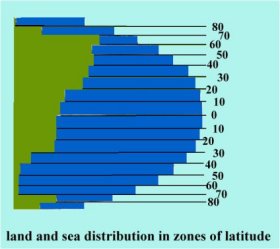
Understanding Climate : #6 - HypsographyI am trying to explain in this series the most important aspects of the sciences most relevant to climate as a cross-disciplinary study. My intention is to help my readers to build up a sort of 'mental model' of the most important components of the earth's climate sytems.
The first parts covered mainly astronomical considerations: axial tilt, orbital eccentricity and solar variation, for example.
I now turn to the topic of hypsography.
New readers may wish to start at
Understanding Climate : #1 - Components Of Climate.
Inkjet Printing Technique
An asteroid impact was likely not responsible for the extinction of the North American megafauna – such as mammoths, saber tooth cats, giant ground sloths and Dire wolves – along with the Clovis hunter-gatherer culture some 13,000 years ago, suggests a new study in PNAS.
When the last ice age came to an end approximately 13,000 years ago and the glaciers covering a large portion of the North American continent began melting and retreating toward the north, a sudden cooling period known as the Younger Dryas reversed the warming process and caused glaciers to expand again. Even though this cooling period lasted only for 1,300 years, a blink of an eye in geologic timeframes, it witnessed the disappearance of an entire fauna of large mammals.
New images from the ESA's Herschel space observatory reveal the formation of previously unseen large stars that reside in the Rosette Nebula, each one up to ten times the mass of our Sun.
Astronomers say it is important to understand the formation of high-mass stars in our Galaxy because they feed so much light and other forms of energy into their parent cloud they can often trigger the formation of the next generation of stars.