Most people believe the individual is the best judge of his or her own personality. But a Washington University Psychologist says that we are not the know-it-alls that we think we are.
Simine Vazire, Ph.D., Washington University assistant professor of psychology, says that the individual is more accurate in assessing one's own internal, or neurotic traits, such as anxiety, while friends are better barometers of intellect-related traits, such as intelligence and creativity, and even strangers are equally adept as our friends and ourselves at spotting the extrovert in us all.
While much attention has been given to the potential global impact of climate change, less has been paid to how a warmer planet would affect regional climates. The Intergovernmental Panel on Climate Change (IPCC) projects that the global average temperature will rise about 1°C by the middle of the century, but the global average does not tell us anything about what will happen to regional climates, for example rainfall in the western United States or Hawaiian Islands.
Analyzing warming projections in models used by the IPCC, a team of scientists claim that ocean temperature patterns in the tropics and subtropics will change in ways that will lead to significant changes in rainfall patterns. The study will be published in the Journal of Climate this month.
Researchers at UT Southwestern Medical Center say that increasing the normally occurring process of making nerve cells might prevent addiction. The conclusion is based on a rodent study demonstrating that blocking new growth of specific brain nerve cells increases vulnerability for cocaine addiction and relapse.
Published in Journal of Neuroscience, the study's findings are the first to directly link addiction with the process, called neurogenesis, in the region of the brain called the hippocampus.
While the research specifically focused on what happens when neurogenesis is blocked, the scientists said the results suggest that increasing adult neurogenesis might be a potential way to combat drug addiction and relapse.
The flowering plant purple loosestrife - Lythrum salicaria - has been heading north since it was first introduced to the eastern seaboard from Europe 150 years ago. This exotic invader chokes out native species and has dramatically altered wetland habitats in North America.
But as this invasive plant has spread north it has run into challenges posed by a shorter growing season, according to a study conducted by researchers from the University of Toronto's Department of Ecology and Evolutionary Ecology. Scientists have found that adapting to the Great White North carries a severe reproductive penalty that may limit its spread. The results are highlighted this week in Nature.
Cigarette smoking may increase the risk of experiencing an aneurysm for people who carry common gene variants, according to research presented at the American Stroke Association's International Stroke Conference 2010.
In one study, researchers found that the chance of an intracranial aneurysm increased between 37 percent and 48 percent for people who carried one copy of an identified risky gene variation. However, when the gene variant was combined with smoking the equivalent of one pack a day for 20 years, the risk increased more than five-fold. People with two copies of the gene variant were at even higher risk.
University of Pennsylvania scientists have found that mixed lineage leukemia (MLL), has an unusual way to keep the molecular motors running. The cancer cells rely on the normal version of an associated protein to stay alive.
MLL happens when a piece of chromosome 11 breaks off at the normal MLL-associated gene. The broken gene attaches itself to another chromosome, resulting in a fusion protein that eventually causes uncontrolled growth of blood cells.
Researchers discovered that this runaway growth triggered by the fusion protein is blocked when the gene for the normal protein is deleted from leukemia cells. This indicates that the normal protein is required for MLL to proliferate.
Much like the Chicago Bears' defensive lineman William "The Fridge" Perry cleaned out the New England Patriots in Superbowl XX, you really should clean your fridge out more often.
In fact, most Americans clean their fridges only once or twice a year, according to the
Wall Street Journal. That's registering really high on the vomit-encrusted nastiness scale.
1 People don't generally clean fridges until something triggers them to act, such as a spill or a pungent odor. Or, if you're a conscientious renter, when you move into and out of apartments.
2
The Third Player HypothesisEver since our first ancestor had enough brain cells to ponder something more than the flavor of
roast dinosaur, we have pondered over the why of our world: the real causes of observed effects.
At one time it was thought that most ordinary events in our lives were caused for the amusement of gods. Thor throws a hissy-fit and we poor mortals get zapped for no good reason. Today, in the 21st century, we laugh at such nonsense. But if we examine our own beliefs, are we all that different today?
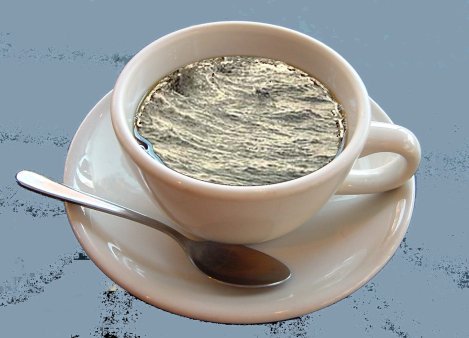
Science Fun With A Hot Drink
Here is a most enjoyable physics experiment that anyone can do almost anywhere.
You will need:
1 hot drink,
1 comfortable chair,
1 table or desk.
You will not need:
1 thermometer.
Having made yourself a nice steaming hot drink, sit in the chair and put the cup on the table.
You may, if preferred, put the cup on the table and then sit down. This will in no way affect the validity of the results. However, if you sit on the table and put the chair on the cup you are likely to invalidate the entire experiment, so stop being so silly!
Can a differential equation cure cancer?
A fascinating article in
Forbes suggests that using mathematics may be able to create drug combinations that are far more effective than the ones now in use.
1 "I have a suspicion that we are using almost all the cancer drugs in the wrong way," Larry Norton, Memorial Sloan-Kettering Cancer Center deputy physician-in-chief for breast cancer, says. "For all I know, we may be able to cure cancer with existing agents."
2