Along with drastic reductions in carbon dioxide emissions, a team of climate scientists says internationally coordinated research and field-testing on geoengineering the planet's atmosphere need to begin immediately in order to limit risk of climate change. In a new Nature editorial, the team argues that collaborative and government-supported studies on solar-radiation management, a form of geoengineering, would reduce the risk of nations' unilateral experiments and help identify technologies with the least risk.
Whether prayer is supernatural or not, the common religious practice may generally benefit the Nine out of 10 Americans who say they pray. In a recent study appearing in Psychological Science, researchers found that when people's prayers are directed at those who have wronged them they're more likely to forgive and move on.
The conclusion is based on two experiments. In the first, researchers had a group of men and women pray one single prayer for their romantic partner's well being. Others—the experimental controls—simply described their partner, speaking into a tape recorder.
Photosynthesizing sea slugs take 'you are what you eat' to an extreme: by eating photosynthesizing algae, these "solar-powered" sea slugs are able to live off photosynthesis for months. How does this work? Is this just a straightforward case of symbiosis between algae and sea slugs?
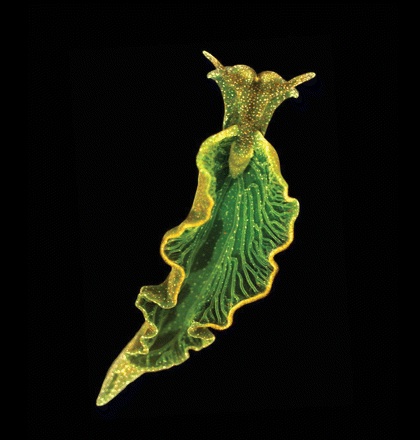
It turns out that this is not a case of symbiosis: this is a case of the amazing and ubiquitous power of viruses to dramatically reshape the genetic landscape.
Cheap, powerful sequencing has enabled scientists to sample the viral world like never before. Our understanding of marine viruses, in particular, has exploded as researchers have sequenced whatever they can find in samples of seawater.
I recently encountered the following
chart as part of an argument that CO
2 does not affect global temperatures. It instantly raised my suspicions because the temperature data is just too clean--I can't believe that global temperatures is almost always one of two values, 12 degrees or 22 degrees, and that there is no noise in the measurements.

Note that this chart implies that the current temperature is about 12 degrees Celsius.
When aliens come to Earth to investigate life here, they don’t simply beam up a specimen and start probing. (And they’re also, by the way, not disproportionately interested in the anus.) Only a novice prober would do a simple beam-and-probe, and would surely get a quick rap on a proboscis from the instructor. The problem with abducting an animal of interest, all by itself, is that you can’t understand an animal without an appreciation of the environment the animal inhabits.
Take 2 minutes with Canadian astronaut Chris Hadfield and you too will know how to pee in space. And the origins of shooting stars. He starts with "when you go to the bathroom on Earth, you are relying on gravity, pretty heavily... imagine if you were halfway done and someone shut off the gravity, it would be a mess..." and it just gets better from there. You'll never look at the sky the same way again.
The January 12th earthquake in Haiti killed an estimated 200,000 people and left 1.5 million homeless. Now, researchers are returning to the island this week to determine whether the quake could trigger another major event to the east or west of Haiti's capital Port-au-Prince. Most aftershocks occur within weeks of the initial quake and the team urgently needs to get to the site to make a detailed assessment before crucial geological information disappears.
Northwestern University researchers have developed a new material that could help with the remediation of nuclear waste that behaves much like a Venus Flytrap, permanently trapping only its desired 'prey,' the radioactive ion cesium. The results were published online this week in Nature Chemistry.
The synthetic material, made from layers of a gallium, sulfur and antimony compound, is very selective. The researchers found it to be extremely successful in removing cesium -- found in nuclear waste but very difficult to clean up -- from a sodium-heavy solution. (The solution had concentrations similar to those in real liquid nuclear waste.)
Malaria and cholera take devastating tolls in the developing world. Mosquito-borne Malaria kills more than 1 million people annually and no vaccine currently exists. Cholera, a diarrheal illness
that is common in developing countries, can be fatal and the lone vaccine is too expensive to prevent outbreaks after floods. Despite the challenges posed by the malaria and cholera, University of Central Florida biomedical researchers say they have developed what may be the first low-cost dual vaccine for both