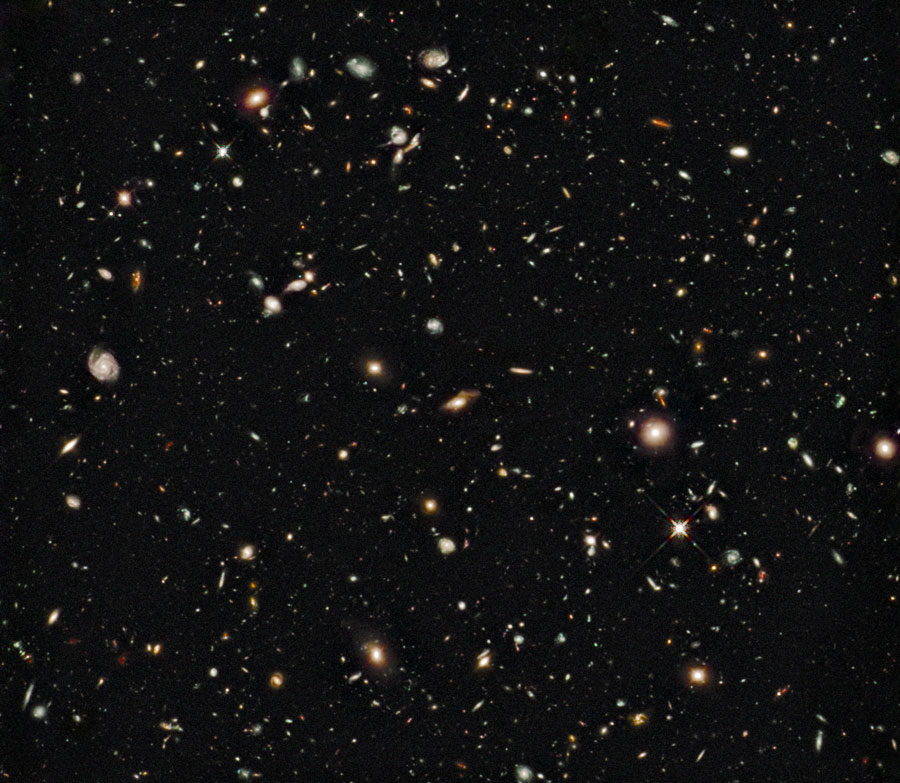





This image of a tiny patch of sky reveals the oldest galaxies ever seen. Their light has traveled 13 billion years to the Hubble Space Telescope, stretched along the way from ultraviolet to near-infrared by the expanding universe. After this long wait, astronomers wasted no time, publishing 12 papers on the data in 3 months.  The beautiful color images were just released yesterday:


“Yes, Virginia, there is a Santa Claus.”

That sentence from American journalism’s best-known Santa Claus editorial (the New York Sun’s “Is There A Santa Claus?”) is still so popular that 112 years after it first ran, Macy’s is basing its holiday advertising campaign on it for the second consecutive year. 

This year, Macy’s and the CBS television network are co-sponsoring an animated children’s program about Virginia O’Hanlon, the eight year old girl who sent her inquiry “Please tell me the truth. Is There A Santa Claus?” to the Sun in 1897.
To Know CO2

To Know CO2

Dec 10 2009 | comment(s)

You have to know your CO2! When I wrote Your CO2 Is Bad For You In Your Space Suit I was not talking about the EPA. Here I will not talk about the life's CO2 exchange cycle either unless I have to. My focus is on some new thoughts related to carbon dioxide. Have you observed the birth of a CO2 molecule for instance?


An image straight out of a CGI powered sci-fi movie lit up the skies over Norway earlier today at 8:45 a.m. local time. The phenomenon appeared as a spinning spiral of white light, entered around a bright star-like object. A bright blue tail streamed from the center of the object down towards earth.

The phenomenon was visible for over two minutes, could be seen for hundreds of miles, and was witnessed by thousands of individuals. It has been dubbed “Star-Gate,” and theories of its origin range from a misfired Russian missile, a meteor fireball, northern lights, a black hole, and alien activity. The only thing that everyone agrees upon, including scientists and the military, is as of now its appearance is a mystery - and is like nothing ever seen before.
What's the relationship between soy consumption and breast cancer? Some major news from JAMA:
    It’s all true! He was right! He was totally, hopelessly wrong about selfish genes, but he was right about memes. Well…he was a little bit right. He was wrong to equate the evolution of memes to the evolution of organisms, meme evolution being Lamarckian in character. But he was right to point out the potential capacity for memes (i.e cultural concepts) to prevent logical thought in the minds of their hosts. To ‘colonise’ those minds as Fred Phillips puts it. Dawkins likes to use religion to illustrate this point, but I prefer his own pet theory of   selfish genes.

The Big Dipper has a secret, invisible to the unaided eye, according to a new paper published in The Astrophysical Journal, which says that one of the stars that makes the bend in the ladle's handle, Alcor, has a smaller red dwarf companion.

Newly discovered Alcor B orbits its larger sibling and was caught in the act with an innovative technique called "common parallactic motion" by members of Project 1640, an international collaborative team that includes astrophysicists at the American Museum of Natural History, the University of Cambridge's Institute of Astronomy, the California Institute of Technology, and
NASA's Jet Propulsion Laboratory.

The holidays are challenging for most everyone's midsection but are they a factor in actual obesity rather than seasonal weight gain?   And are weekends just as detrimental?

Researchers at the University of Pittsburgh and Quinnipiac University say yes to both.  Even weekend eating patterns can have a significant impact.

J. Jeffrey Inman, a University of Pittsburgh professor of marketing and associate dean for research in the Joseph M. Katz Graduate School of Business, and coauthor Adwait Khare, Quinnipiac University professor of marketing, studied two years' worth of data on consumers' eating behavior and found that the quantity and quality of foods eaten during a meal and over the course of the day differs considerably on weekends and holidays.

Why is the Fourier Transform so useful both in theoretical and applied science and engineering?  In short, often it is more convenient to solve a problem in Fourier space than the space of the problem's original formulation.

