I found the premise of Barbara Bradley Hagerty's new book "
Fingerprints of God" quite intriguing. The author, raised as a Christian Scientist, attempts to look into alternative religions and science to see if her faith is justified. There is nothing really new here - in terms of topics that have been covered in many other popular books.
But what I found interesting was her interpretation of her experiences and investigations. She chronicles her struggles and revelations in an autobiographical format - and I'm usually a sucker for autobiographies.
It's hard to make a good cartoon cephalopod, I guess. Yesterday I was disappointed about the
Squidbillies. Tomorrow I may despair of Spongebob's pal
Squidward. Today, I sigh over Nemo's little octopus friend Pearl.
I was profoundly impressed with the combination of scientific accuracy and aesthetic appeal achieved by the writer and animators of Finding Nemo. I mean, that song Mr. Ray sings about naming the zones of the ocean? Total brilliance!
The concept of altruism, a selfless concern for the welfare of others, a traditional virtue in many cultures and a core aspect of various religious traditions, has long been debated in philosophical circles. More recently, evolutionary biologists have joined the debate, saying that altruism may have evolved because any action that improves the likelihood of a relative's survival and reproduction increases the chance of an individual's DNA being passed on.
There have been many discussions relating to
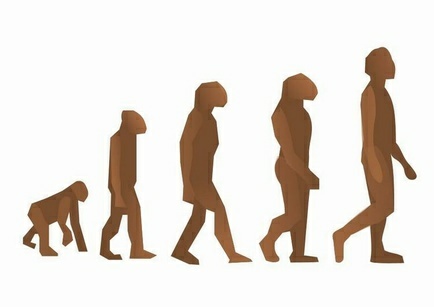
transhumanism and augmenting intelligence as well as just
intelligence itself. However, at the heart of many of these discussions the subject of Artificial Intalligence (AI) emerges. This raises the question of whether AI is possible and what it actually means.
There is no question that machines can be built to perform many intelligent-like acts and simulate human intelligence, but I would argue that there is a fundamental difference that isn't often mentioned.
*Laws that should be formally on the books but sadly are only known in the collective Geek conscious.
Matt Blum of
Wired writes, "There are many, many laws having nothing to do with government, that are useful to know because they tell you something about how the universe works. There are Newton’s laws of motion, the laws of thermodynamics, Boyle’s law, Heisenberg’s uncertainty principle, among dozens more."
While today we're pretty darned certain there is no intelligent life on Mars, in the early 20th century, it was still an open question.
So-- about four decades before the publically known Project Ozma search-- the Navy stepped up to find out.
Well before SETI (the Search for Extraterrestrial Intelligence), Project Ozma, Area 51, or even the 1938 radio hoax 'War of the Worlds', the Navy was looking for Martians.
With the COP15 conference fast approaching, the world's political leaders are gearing up to hash out a global agreement that will save us from ever increasing greenhouse gas emissions and the unstoppable climate change that will follow.
New research published this week in Geophysical Research Letters, however, may complicate their plans. The new research, conducted by a professor of Earth Science at the University of Bristol, shows that the balance between the airborne and the absorbed fraction of CO2 has stayed approximately constant since 1850, despite emissions of CO2 having risen from about 2 billion tons a year in 1850 to 35 billion tons a year now.
After the successful introduction of myspace, facebook, twitter and however many other social networking sites that now exist, researchers at London's Natural History Museum have created a social networking tool called 'Scratchpads' just for natural historians. The platform is designed to get specialists together to share their data and prevent the discipline from being buried under a landslide of painstakingly collected data that isn't always used.
If you're sore from a strenuous workout or your thumb is pulsating because you hit it with a hammer, look at a pretty picture or listen to your favorite song. It just might help you cope with whatever unpleasant feeling you're experiencing . That's the conclusion of a study published in the Proceedings of the National Academy of Sciences that looked at the connection between human emotions and physical pain.
"Emotions – or mood – can alter how we react to pain since they're interlinked," says lead author Mathieu Roy. "Our tests revealed when pain is perceived by our brain and how that pain can be amplified when combined with negative emotions."