Ready for another turn into National-Enquirer mode of particle physics reporting ? I have a figure to discuss. It is a result now a few months old, but one which received little attention -less than it should have, perhaps. I myself got to see it only a few weeks ago in a presentation given by Jacobo Konigsberg, CDF spokesperson, at a workshop in Bologna.
The scandalistic cut of this article is manifest in the title: facing a dearth of exciting reports of new physics discoveries, we are bound to now and then swerve off the path of our usual responsible handling of two-sigma effects, odd deviations, and assorted zoology. It is, I believe, a necessary resource to rely on, if we are to keep the interest of Science readers on particle physics.
Today, while thrift-shopping, I found an important component for our satellite building.
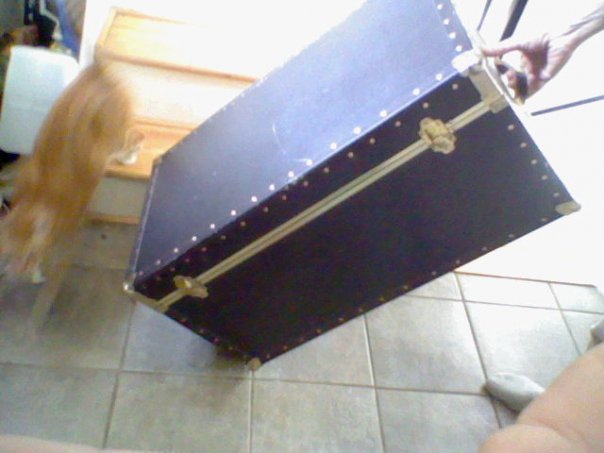
Yes, it's a rolling trunk, and I'll admit it's not the most exciting science prop. But there are four important details that make this an important detail in DIY satellite building.
1) Pragmatics. I need a place to store the satellite and components when I'm not working on it.
2) Conveyance. I need something to lug the kit around when I take it over to my friend's workshop, when we eventually get to final assembly.
Science and art aren't mutually exclusive. You can demonstrate scientific concepts artistically, and sometimes even physics can be phun. Take, for example, Sir Isaac's Loft, a feature in the Franklin

Institute that "blends art and science into a 3,600 square feet display of aesthetic innovation." And with awesome exhibit names like the "Bowling Ball of Doom," how can you go wrong?
Sustainability stretches through greener chemistry. Imagine having a choice in designing environmentally friendly materials. This opportunity is presented in "Identifying the Molecular Origin of Global Warming" scheduled for the November 12's ACS Journal of Physical Chemistry. The approach taken by Partha Bera et al. seeks to explain how fundamental properties influence molecular absorption in the atmospheric window. What are the major factors that make some molecules more effective greenhouse gases (GHGs)?
The most distant galaxy cluster yet, known as JKCS041, has been discovered by combining data from NASA's Chandra X-ray Observatory and optical and infrared telescopes at the United Kingdom Infrared Telescope (UKIRT), the Canada-France-Hawaii telescope in Hawaii and NASA's Spitzer Space Telescope. The JKCS041 cluster is located about 10.2 billion light years away, and is observed as it was when the Universe was only about a quarter of its present age.
The previous record holder for a galaxy cluster was 9.2 billion light years away, XMMXCS J2215.9-1738, discovered by ESA's XMM-Newton in 2006, which broke the previous distance record by only about 0.1 billion light years while JKCS041 surpasses XMMXCS J2215.9 by about ten times that.
Education quality is a moving target these days. With college education a right since the early 1990s and student loans unlimited to pay for it, costs and claims have expanded, as hot air must, to fill the available money space.
Because everyone with good grades can afford to go to Stanford with enough loans or rich parents, lower ranked schools have no reason to charge less because the pool of high-ranked schools can accept is limited - they just have to wait.
Critics of global warming will note that if the people behind the Kyoto protocol can't even get basic accounting correct there may be plenty of errors in simulations but science is about convergence over time. And owning up to little mistakes and fixing them.
An international team has found a critical error in the accounting method used to measure compliance with carbon limits and the flaw, which centers on the measurement of CO2 emissions from the use of bioenergy, could undermine greenhouse gas reduction goals if not addressed.
Sex crimes against pre-teen children are no higher during Halloween than at any other times of the year and diverting law enforcement places people at more risk, according to a study in Sexual Abuse: A Journal of Research and Treatment.
That's not to say parents shouldn't use caution or supervision but the findings raise questions about the wisdom of law enforcement practices aimed at dealing with a problem that does not appear to exist.
The guys over at
Deep-Sea News have organized an "
Ocean Bloggers Challenge" to fund ocean-related education for classrooms in need. It's through a really nifty website called Donors Choose, which lets you see exactly where your money is going.
The projects they've chosen for the challenge include sending students on an overnight sea voyage and setting up a classroom saltwater aquarium, among others.
The
recent report of a set of fossils of geniune significance for our understanding of human evolution highlights just how scientifically pathetic the PR circus over the primate fossil
Darwinius masillae really was. Paleontologist Jørn Hurum, who purchased the fossil from a collector, clearly thought he had made the find of his life, and so he decided to milk it for all it was worth. The result was science via PR blitz.