Nothing makes biologists happier than psychologists declaring things a product of evolution. Now it turns out even social constructs like 'taking turns' have gotten some benefit from evolutions' 'invisible hand'.
How so? It spans across species so it must be evolution, say University of Leicester psychologists professor Andrew Colman and Dr Lindsay Browning, who carried out the simulations due to appear in the September issue of Evolutionary Ecology Research which they say helps explain the evolution of cooperative turn-taking.
If you've read your history and wondered about when the next Ice Age is coming, you can thank global warming it hasn't happened. But it could be worse. Earth's 4.5 billion years have seen several instances where temperatures changed dramatically, like in life ending ways, along with asteroids bombarding the planet and any number of species going extinct without a single activist to hunger strike for them.
But one of the biggest moments in Earth's lifetime is a positive one - the Cambrian explosion roughly 540 million years ago when complex, multi-cellular life burst out all over the planet. Scientists can pinpoint this pivotal period as leading to life as we know it today but no one is sure what caused the Cambrian explosion of life.
The news that Newcastle University researchers have used embryonic stem cells to create human sperm under laboratory conditions has led to a lot of questions; like, who will television commercials make fun of if all men are gone?
In the technique developed at Newcastle, stem cells with XY chromosomes (male) were developed into germline stem cells which were then prompted to complete meiosis - cell division with halving of the chromosome set. These were shown to produce fully mature sperm called In Vitro Derived sperm (IVD sperm).
Rising levels of smokestack emissions from oceangoing ships will cause an estimated 87,000 deaths worldwide each year by 2012 — so more than heat wave deaths in French elderly people in 2003 while French young people protested much fewer deaths in the American invasion of Iraq but far less than the nearly 15,000,000 who die annually from cancer.
And it's almost one-third higher than the previously claimed 60,000 deaths but, like many things in pollution-related deaths, accurate numbers are hard to pin down. You take some sample data and you extrapolate.
If nanotechnology has a dream future, it is self-assembling and self-organizing systems - something nature has been producing for millions of years.
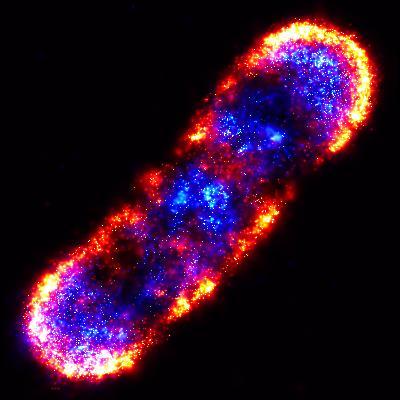
A team of scientists has examined how thousands of bacterial membrane proteins are able to assemble into clusters that direct cell movement to select chemicals in their environment and they say their results provide valuable insight into how complex periodic patterns in biological systems can be generated and repaired.
The Swan Nebula, also called the Omega Nebula because when seen through a small telescope the nebula has a shape that reminds some observers of the final letter of the Greek alphabet, omega, while others see a swan with its distinctive long, curved neck, is a dazzling stellar nursery located about 5500 light-years away towards the constellation of Sagittarius (the Archer).
Don't feel left out, lawn games and crustaceans, it is also called the Horseshoe and the Lobster Nebula.
No matter its name, it is an active star-forming region of gas and dust about 15 light-years across and has recently spawned a cluster of massive, hot stars. The intense light and strong winds from these hulking infants have carved remarkable filigree structures in the gas and dust.
The Young People's Development Programme (YPDP) in England, a government-backed youth development pilot program aimed at reducing teenage pregnancies, drunkenness and cannabis use not only didn't reduce teenage pregnancies or drunkenness or marijuana use, it might actually have increased pregnancies, according to research led by Meg Wiggins of the Institute of Education, University of London and Chris Bonell at the London School of Hygiene and Tropical Medicine.
They were commissioned by the Department of Health to carry out an independent evaluation of the YPDP, which was initiated in 2004.
I have pondered writing about the transhumanism movement for a while, and the opportunity has finally landed on my desktop when I read a brief article by Kyle Munkittrick of the Institute for Emerging Ethics&Technologies. The article is in the form of a FAQ expressly addressing the question of whether aging is a moral good, and in it Munkittrick briefly explains and (thinks that he) refutes some of the standard arguments against transhumanism. Let’s take a look.
 Patrick Draper is a graduate student in physics at the University of Chicago and Argonne National Lab. He is a native of Illinois and lives in Hyde Park, Chicago with his wife Karen and parrot Felix, to whom he is grateful for their love, patience, and correcting his sign errors. He is a supporter of the international effort to put a muon collider on Mars, and is waiting for NASA to return his phone calls.
I asked Patrick to write here about his studies on the discovery reach for a MSSM Higgs boson after I saw his paper on the arxiv a month ago, and am now glad I did. Enjoy!